Anthropic Fable 5.2 Hands-On: 3A Games and Excel Clones from One Prompt

Anthropic's new Fable 5.2 builds playable games and full apps from three-line prompts — impressive, but costly.
AI blogger Matthew Berman ran more than a dozen extreme tests on Anthropic's new Fable 5.2. With just three lines of prompt, the model generated a playable Gears of War clone in days, consuming billions of tokens and tens of thousands of dollars per project; the same approach recreated Fall Guys, Excel, a DaVinci Resolve video editor, a hand-written WebGL2 physics simulation, Blender architectural designs, and explainer animations from a single prompt. Benchmarks show Fable 5.2 mostly leads Opus 5.5 on Frontier Suite, OSWorld 2.1, and Humanity's Last Exam, though not universally. Pricing is about 20% lower than the previous generation but still notably pricier than Opus 5.5, so quality versus cost must be weighed.
In the fiercely competitive race for AI coding models, Anthropic has quietly released a new model that many developers are calling "the strongest on the planet" — Fable 5.2. Well-known AI blogger Matthew Berman put it through more than a dozen extreme tests in his latest video, and the conclusions are striking: with just three lines of prompt, it can build a playable Gears of War clone in a matter of days.
One Prompt, a Playable AAA-Scale Game
The first demo Berman showed was a complete Gears of War clone built on Unreal Engine. He wrote only three lines of prompt: "Recreate Gears of War: E-Day in Unreal Engine. Just one level, but the visuals, gameplay, and characters should be as close to the original as possible." Then he enabled Ultra Code mode and let it run on its own.
The project consumed roughly 8.5 billion tokens, which works out to about $15,000 at API pricing. The game includes a cover system, tactical reloads, AI enemies, lighting, and textures — all generated by the model. While playtesting, Berman repeatedly exclaimed "this is actually really fun," and at one point forgot he was recording a video.
The same approach was replicated on other classic games: a Fall Guys clone called "Tumble Beans" built with about 9 billion tokens over 71 hours at an estimated cost of $13,000, supporting multiplayer with physics-based bouncing and level complexity on par with a shippable title; and an Unreal Engine-based 3D visualization of Tokyo that consumed 6.72 billion tokens over roughly 70 hours at an estimated cost of $11,000, featuring real-time traffic, pedestrians, arriving trains, and ray-traced reflections.
Unreal Engine is a mainstream commercial game engine developed by Epic Games, widely used for AAA games, virtual film production, and architectural visualization. It is known for high-fidelity rendering (Lumen global illumination, Nanite micro-polygon geometry) and its Blueprint visual scripting system, but traditionally producing a single playable level requires artists, programmers, and designers working in coordination for months. The "Ultra Code mode" mentioned here refers to an agentic workflow in which the model continuously writes, compiles, and debugs code during long autonomous runs — essentially letting the model independently complete the full development cycle of a small-to-medium engineering project.
Not Just Games: From Excel to Video Editors
If you thought this was only good for games, you'd be underestimating its generality. Berman used it to build a fully featured Microsoft Excel clone in nearly 50 hours, with every formula clickable and editable, support for pivot tables and sample data loading, running in the browser and ready to share via a link for anyone to try.
Another case is a locally running DaVinci Resolve clone — waveform display, video preview, clip splitting, magnetic snapping, keyframes, and a full set of keyboard shortcuts. Interestingly, another member of Berman's team, Alex, independently built his own video editor the same way and is already using it to edit footage.
These projects reveal a trend: work that once required an entire engineering team and months to complete can now be delivered as a prototype by one person with one model in a few dozen hours.
WebGL2 is a low-level browser graphics API that lets JavaScript call the GPU directly for hardware-accelerated rendering without plugins. "Hand-written WebGL2, no three.js dependency" here means the model didn't rely on any wrapper library but wrote its own shaders (GLSL), vertex buffer management, and rendering pipeline — an extremely high bar for code-generation correctness and consistency. A pivot table, meanwhile, is one of Excel's most iconic features, involving grouped aggregation, cross-row/column computation, and dynamic recalculation, and is generally regarded as a key indicator of a spreadsheet app's completeness.
Physics Simulation and 3D Generation: From Water Balloons to Tokyo
In scientific visualization, Fable 5.2 also stands out. A "bullet piercing a water balloon" physics simulation demo was required to be a single HTML file, with no three.js or external libraries, purely hand-written WebGL2. The model produced a complete interactive scene with ray tracing, real-time physics recalculation, and adjustable bullet speed/caliber/lighting/gravity, consuming only 41 million tokens over about 2.5 hours at a cost of roughly $91.
On 3D modeling, the model generated a residential building design in Blender with a pool, solar panels, a terrace, and a garage, consuming 13 million tokens at about $30. There was also a 3D-printed load-bearing tower design, generated under the constraints of 10 grams or less and a 0.4mm nozzle with PLA, which ultimately withstood stacking a laptop, a Mac mini, a DGX Spark, and even a power drill.

Berman also had it generate a complete 3D European town, with residents, animals, and vehicles all AI-driven, and citizens holding full conversations with each other. This kind of "world simulation" scenario was previously the domain of research-grade projects; now it's the product of a single prompt.
Motion Graphics and Explainer Content Are "Solved"
The most practically valuable finding in the video may be the motion graphics generation capability. Berman used a single prompt to generate a nearly 2-minute educational animation on "how software decompilation works," as well as an explainer video on "how LLMs work," covering visualizations of concepts like embeddings, transformer layers, the training process, loss curves, and next-token prediction.
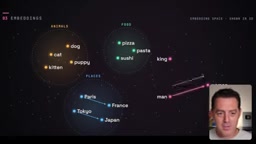
Content like this used to take a professional motion design team weeks to produce; now it takes a single prompt, 45 minutes, and about $25. For content creators, this may be the most direct productivity revolution yet.
Benchmarks: Leading Across the Board, But Not a Clean Sweep
Benchmark data cited by Berman shows Fable 5.2 comprehensively outperforming the previous flagship Opus 5.5 on major leaderboards such as Frontier Code 2.0 and Frontier Suite (69.9). It scored 89.3 on the OSWorld 2.1 operating-system control benchmark, far ahead of Astra's 79.5 and Opus 5.5's 87. It scored 74.2 on Humanity's Last Exam, about 10 points higher than Fable 5.1.
There are exceptions: on the Automation benchmark, Carbon holds a narrow lead (Fable 5.2 scored 51); and on Terminal Bench, Mythos 5.2, released the same day, narrowly beat Fable 5.2 with 75.3 versus 74.6.
More noteworthy is the hands-on experience. Berman says he has "already burned over 100 billion tokens on this model," and his most striking impression is its extreme autonomy — it makes decisions for you, and more than 90% of the time they match your expectations. When running max thinking plus Ultra Code for a full-codebase review, tasks that used to take 60 to 120 minutes now finish in under 10, while surfacing a large number of bugs, security issues, and UI inconsistencies.
OSWorld is a benchmark for evaluating an AI agent's operating-system control capabilities, with tasks including cross-application file operations, document editing, and system configuration in real desktop scenarios — testing multi-step planning and GUI interaction. A higher score means the model is better at independently "getting things done on a computer." Humanity's Last Exam (HLE) consists of thousands of hard cross-disciplinary questions spanning math, physics, the humanities, and more, and is regarded as one of the hardest comprehensive knowledge-reasoning tests today; scores are generally low, so a few points of difference often signals a significant capability gain. Terminal Bench focuses on real engineering tasks in command-line environments, such as repository fixes and script writing.
Pricing and Trade-offs: Stronger, but More Expensive
Fable 5.2 is priced about 20% lower than Fable 5.1, at $8 per million input tokens and $40 per million output tokens. Fast mode offers a 2.5x speedup but doubles the price to $16/$80.
Berman's conclusion is clear: Fable 5.2 is indeed stronger than Opus 5.5, but Opus 5.5 is faster, cheaper, and more efficient. Whether to switch day-to-day projects to Fable 5.2 depends on whether the task's quality requirements justify paying several times the cost.
Looking at these demos, a more thought-provoking question emerges: when a model can generate a shippable game from three lines of prompt, what moat is left in software development? Berman repeatedly says "software is dead" in the video, which is of course an exaggeration — but what he built with a few dozen hours and tens of thousands of dollars in token costs is genuinely redefining the upper limit of "what one person can make."

Background Notes
Motion graphics refers to content that presents graphics, text, and data in animated form, common in educational videos, product demos, and brand packaging, with typical tools including After Effects. Its difficulty lies in unifying timeline choreography, easing curves, layer compositing, and the rhythm of visual storytelling. Embedding is a representation method that maps discrete words or concepts into high-dimensional dense vectors, where semantically similar vectors are closer together in space; Transformer is the mainstream architecture of today's large models, relying on self-attention mechanisms to model dependencies between any positions in a sequence. Getting a model to turn these abstract concepts into coherent animation means it possesses both domain knowledge and visual choreography ability.
Related articles

RL Racing Agent Stuck Against the Wall? Try These Recovery Strategies
RL racing agent stuck against walls? We analyze recovery data, observation limits, and action space, comparing DAgger, behavior cloning, and SAC with diagnostic experiments.

Giving AI Agents Long-Term Memory: A New Approach to Supply Chain Disruption Decisions
A developer uses Hindsight to build persistent memory for a supply chain AI agent, enabling retrieval of past disruptions and decision outcomes. The article analyzes its architecture, memory retention and recall design, and engineering challenges such as what to remember and how to evaluate memory effectiveness.

Cyber Book Hunt: How the BT Community 'Hijacked' Salinger's Unpublished Work
Salinger's unpublished novella, locked in a university library and barred from copying, was leaked after a private tracker posted a 6 TB bounty—solved not by hacking but by scanning a 25-copy underground eBay print run.