Anthropic Cracks Down on Game Rewrites: AI Copyright Boundaries Tighten Again

Anthropic tightens control over AI game rewrite uses, reflecting AI platforms' shift from tool neutrality to use-case review.
Based on a Hacker News post, this article analyzes Anthropic's move to impose stricter controls on using its models to "rewrite video games." Game code, art, and narrative are copyright-dense, and AI rewrites can easily trigger adaptation rights and derivative work disputes. Proactively restricting such uses can reduce indirect infringement risk and aligns with Anthropic's responsible AI positioning. This marks a shift by AI vendors from "tool neutrality" to use-case review and may prompt industry follow-up. For developers, mod and remake projects relying on a single model face reduced availability and migration risk; they should distinguish original from adapted scenarios, conduct copyright due diligence in advance, and retain alternative models or local deployment options.
Event Overview: Anthropic's Enforcement Action as Seen from Community Discussion
A post titled "Anthropic Cracking Down on Video Game Rewrites" on Hacker News has drawn attention, with discussion pointing to Anthropic taking stricter control measures against the use of its AI models to rewrite and modify video games. Although the post itself contains limited information, combined with the increasingly tense contest between AI companies and game copyright holders in recent times, this development deserves in-depth interpretation.
The core fact is: Anthropic has begun imposing restrictions on "video game rewrite" use cases. "Rewrite" here typically refers to using large language models to automatically rewrite or recreate game code, narrative text, character dialogue, and even overall gameplay logic. Such behavior has long lingered in the copyright gray zone, and now that Anthropic has brought it into its enforcement scope, it means the boundaries of AI platforms' responsibility for downstream applications are being redrawn.
Note: The original material only provides the title and a small amount of interaction data, without disclosing specific enforcement methods, the games involved, or the scope of affected users. This article's analysis is based on the directional signal revealed by the title.
Why "Game Rewrites" Have Become a Regulatory Target
Direct Conflict Between Copyright Risk and IP Protection
Video games are a content form with extremely high copyright density—code, art, music, and narrative text layered on top of one another. Using AI to "rewrite" existing games easily touches sensitive areas of reproduction rights, adaptation rights, and the determination of derivative works. If Anthropic continues to allow such uses, it may face pressure from game publishers and even be drawn into indirect infringement disputes.
From a platform governance perspective, proactively tightening is more cost-effective than passively responding to lawsuits. This is consistent with Anthropic's long-standing positioning on safety and responsible AI: when the legality of a use case is highly uncertain, restricting it from occurring is the lowest-cost way to reduce systemic risk.
Adaptation rights and derivative works are key legal concepts for understanding such risks. Adaptation rights refer to the right enjoyed by copyright holders to authorize others to alter a work and create new works with originality; derivative works are new works created on the basis of the original work, such as game mods, remakes, and fan fiction. If AI rewrites an existing game and the output is substantially similar in expression to the original game, it may fall within the scope controlled by adaptation rights. Even if the AI generates "new" code or text, as long as its source or structure clearly depends on the original game, rights holders will most likely claim derivative work infringement. Platforms therefore face a dilemma: not restricting it may be deemed aiding infringement, while restricting it loses some developer users. Proactively reviewing use cases and requiring users to declare that they do not involve third-party IP is a common practice for platforms to reduce their own legal risk.
Shift from "Tool Neutrality" to "Use-Case Review"
Traditionally, AI companies have tended to position themselves as neutral tool providers, pushing compliance responsibility to end users. But the particularity of use cases like "game rewrites" is that their purpose is inherently strongly tied to existing IP, making it difficult to easily defend them as "fair use." Anthropic's enforcement action can therefore be seen as a kind of use-case-level review—no longer just looking at "who is using it," but at "what it is being used for."
This shift has demonstrative significance for the entire industry. If leading model vendors begin drawing lines by use case, other platforms are likely to follow, thereby reshaping the default rules for AI-assisted content creation.
Safe harbor principles and platform liability form the institutional background of this shift. In traditional internet governance, platforms often rely on safe harbor principles to claim that they merely provide neutral tools and are not responsible for user behavior; but the premise for applying this principle is that the platform is unaware and does not actively facilitate infringement. When AI models can directly generate content highly similar to copyrighted works, the space for platforms to argue "neutrality" is compressed. The U.S. Copyright Office and regulators in many countries have repeatedly emphasized in recent years that AI service providers need to establish filtering and review mechanisms for high-risk uses. Vendors such as Anthropic are therefore moving from a passive "notice-and-takedown" model to proactive use-case classification and usage policy restrictions, which in essence redistributes compliance responsibility across the AI value chain.
Practical Impact on Developers and Creators
Projects Relying on AI Rewrites Face Disruption Risk
For teams using Claude-series models for game mod development, fan remakes, or code refactoring, the most direct impact is reduced availability. Even if Anthropic does not completely ban the relevant capabilities, tighter enforcement means a higher probability of false positives and less stable service expectations. If a project builds its core processes on a single model, migration costs and shutdown risks will both rise.
Pragmatic choices include: evaluating alternative models in advance, deploying open-source weights locally to retain control, and narrowing the scope of AI use to original content that does not involve third-party IP.
Model lock-in and portability are risks developers need to quantify. When a project binds its core processes to a single commercial API, changes to terms of service, model version deprecation, or tighter use restrictions can all cause shutdowns. Mitigation measures include: abstracting the model invocation layer so that switching backends only requires configuration changes; retaining key prompts and output samples to quickly reproduce results on new models; and, for high-value links with clear compliance requirements, prioritizing open-source weight models that can be deployed locally. It should be noted that local deployment does not automatically solve copyright issues; it mainly reduces service interruption risk, not legal risk.
The Line Between Original and Adapted Work Needs Clearer Internal Guidelines
Teams should distinguish between two scenarios at project initiation: first, using AI to assist in developing completely original games; second, using AI to process the assets and logic of existing games. The former has lower risk, while the latter requires copyright due diligence or even authorization. Writing this line into team guidelines is more effective than remedying problems afterward.
Copyright due diligence should be moved forward to the project initiation stage in AI-assisted creation scenarios. Basic steps include: confirming the rights status of the materials being processed (whether they have entered the public domain, whether lenient licenses are used); assessing the degree of expressive similarity between AI output and the original work; and obtaining written authorization or legal opinions for derivative content intended for commercialization. For the mod community, attention should also be paid to restrictive clauses in game EULAs regarding reverse engineering and derivative creation—many publishers allow non-commercial mods but prohibit their use for commercial purposes or circumvention of technical protection measures. Teams can solidify these checks into an initiation checklist to avoid discovering authorization obstacles in the mid-to-late stages of development.
The Bigger Picture: AI Platform Governance Is Tightening
Anthropic's move is not an isolated event. From model output filtering and usage policy updates to restrictions on specific application scenarios, mainstream AI vendors are shifting the focus of governance from "model capabilities" to "deployment consequences." Game rewrites are just one facet; similar logic will also appear in areas such as film and television fan works, software reverse engineering, and character IP generation.
For the ecosystem, this creates a contradiction: the stronger AI capabilities become, the easier they are to use for high-value but high-risk rewriting tasks; and the more responsible platforms become, the more inclined they are to restrict these tasks. The final result may be a continuous tug-of-war between capability and permission, with creators needing to find a new balance between efficiency and compliance.
FAQ
What specific behaviors has Anthropic restricted? The material does not provide details; it can only be confirmed that the direction is to tighten control over "video game rewrite" use cases.
Will ordinary players be affected? The main impact is on developers and mod authors who use AI to batch-rewrite game content. Ordinary gameplay is not within the scope of discussion.
Are there compliant alternative paths? Using original materials, obtaining authorization, or shifting to creation that does not rely on third-party IP are currently more prudent directions.
Related articles
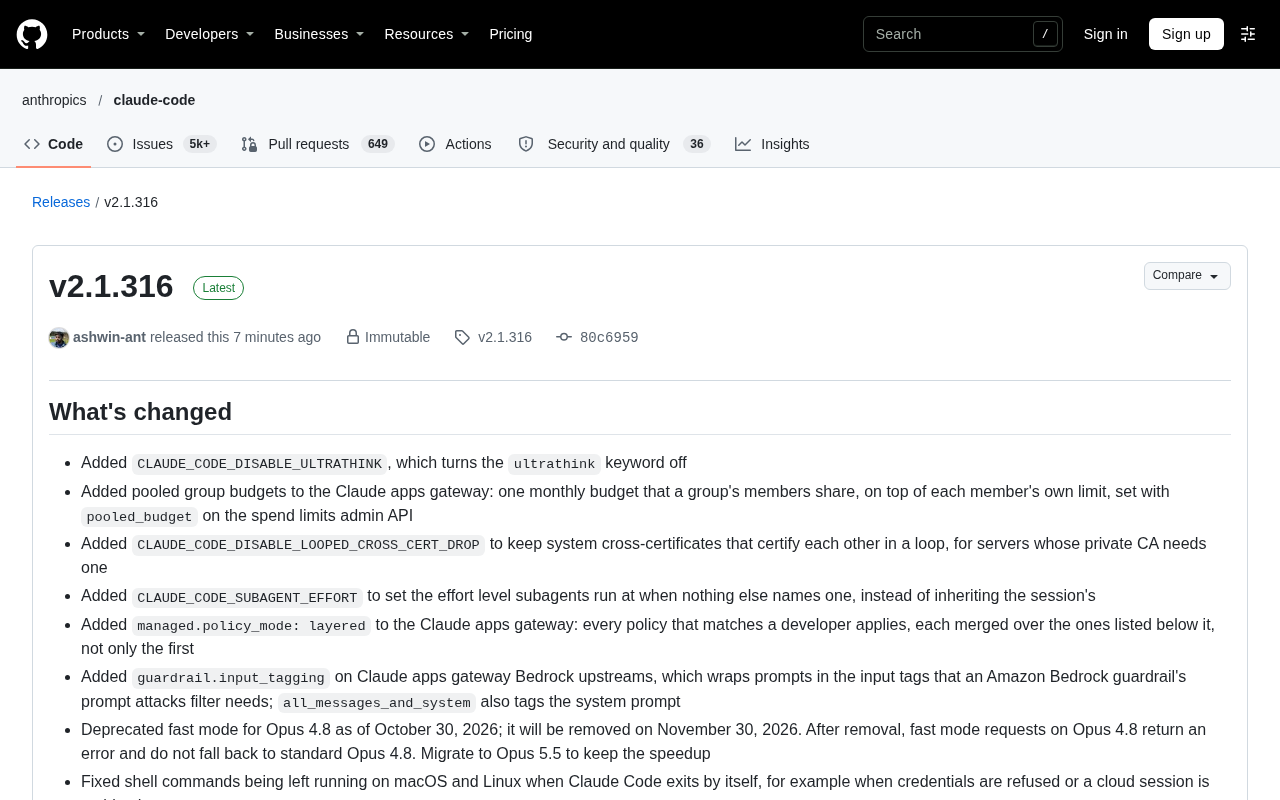
Claude Code v2.1.316 Update Analysis: Enterprise Gateway and Multiple Stability Fixes
Claude Code v2.1.316 released: new enterprise gateway pooled group budgets, layered policy mode, subagent effort control, dozens of Shell, network, and session recovery fixes, and Opus 4.8 fast mode deprecated.

17th-Century British Floods and Doomsday Panic: A New Perspective on Weather History
Based on a Hacker News discussion of '17th-Century British Floods and Foreboding,' this piece explores how extreme weather was given divine and political significance, and what weather history teaches us about contemporary climate communication.

Salesforce Acquires Rune for $375M: AI Logistics Tech Bolsters Defense Business
Salesforce reportedly acquires defense tech startup Rune for $375M. Rune's AI logistics tech will strengthen Salesforce's Missionforce defense platform, continuing its M&A spree.