Anthropic Files S-1: The Truth Behind $16.3B Revenue and $80.7B Loss

Anthropic files S-1: explosive revenue growth alongside massive losses, with compute commitments and founder control in focus.
Anthropic publicly filed its S-1 with the SEC to list on Nasdaq under ANT. The filing shows $16.3B in H1 2026 revenue, up 1,300% year-over-year, but a net loss of $80.7B, of which $72.4B is an accounting effect from convertible note fair value changes and about $8B is operating loss. The company carries $265.6B in fixed compute purchase commitments, and the take-or-pay structure creates extreme cost rigidity. Customer structure is diversified but lacks long-term contracts, raising questions about revenue stability. Founders hold 50.1% voting power through Class F stock, limiting ordinary shareholders' say. The filing also names Google and OpenAI as primary competitors and warns of insufficient insurance coverage for catastrophic AI risk. Offering price and share count remain undetermined.
One Document, Two Extreme Numbers
When Anthropic publicly filed its S-1 with the U.S. Securities and Exchange Commission (SEC) on October 26, it simultaneously exposed both the AI industry's most alluring growth curve and its most unsettling financial black hole. The IPO application document shows the company recorded $16.3 billion in revenue in the first half of 2026, while its net loss for the same period reached $80.7 billion. For a company whose mission is "safe AI," these numbers are themselves a confession about commercial reality.
The S-1 is the registration statement a company must submit to initiate the IPO process. Anthropic says it has applied to list its Class A common stock on Nasdaq under the ticker symbol ANT. But the key information left blank in the document is equally telling: neither the offering price range nor the number of shares to be issued is filled in. This means we know the outline of the story, but not yet the price of the ending.

The S-1 is the core registration statement a U.S. company submits to the SEC when applying for an IPO, formally titled the "Securities Registration Statement" and established under the Securities Act of 1933. The document typically must disclose the company's business model, risk factors, financial condition, management structure, equity arrangements, and use of proceeds. After submission to the SEC, the document enters a review phase, and the company must revise it repeatedly (filing S-1/A amendments) in response to SEC comments until the SEC declares the registration effective, after which the offering price can be set and the stock listed for trading. Leaving the offering price and share count blank in an S-1 is therefore common practice and does not indicate missing information—it simply means the pricing stage has not yet begun. For tech companies, the S-1 is the first window through which the outside world gains a systematic understanding of their true financial picture.
Revenue Curve: From $41 Million to $16.3 Billion
The revenue trajectory disclosed in the filing clearly outlines the explosive power of generative AI commercialization. Full-year revenue was $41 million in 2023, jumped to $386 million in 2024, and reached $4.6 billion in 2025. In the first six months of 2026 alone, revenue surged to $16.3 billion. The filing describes this growth rate as 1,300% year-over-year.
But Anthropic added a warning of its own in the filing: the company does not expect revenue to continue growing at a similar rate. Such proactively cautious language is unusual in IPO documents, yet it fits the current logic of the still-unclosed gap between AI infrastructure investment and output. High-speed growth depends on enterprise customers' continued purchasing of large model capabilities, and the sustainability of that purchasing is itself full of uncertainty.
Dissecting the Loss: How Much of the $80.7 Billion Is "Paper Numbers"
The $80.7 billion half-year net loss looks alarming at first glance, but the filing breaks it down. Of that, $72.4 billion comes from changes in the fair value of convertible notes and similar financial instruments, which the filing explicitly states was primarily driven by an increase in the company's valuation. In other words, this is an accounting effect, not an operating cash outflow for the period. Excluding this item, all other factors combined caused roughly $8 billion in losses.
Full-year 2025 net loss was approximately $42 billion. The filing also candidly admits: since its founding, Anthropic has lost money every year and may never achieve profitability. This statement redefines the losses from "phase-based investment" to "structural risk"—and for readers focused on AI company valuation logic, this is a signal more worth reading closely than the revenue growth rate.
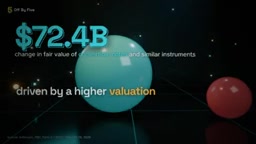
Convertible notes are financial instruments combining features of debt and equity, allowing holders to convert them into company shares under agreed conditions. In accounting treatment, such instruments typically must be measured at fair value—that is, revalued each reporting period based on parameters such as company valuation, expected share price, and volatility. When company valuation rises, the value of the conversion right increases accordingly, and accounting recognizes a fair value change loss, though this does not correspond to any cash outflow. Conversely, a decline in valuation may produce a book gain. Such losses are therefore often called "paper losses" or non-cash expenses. When analyzing such companies, investors typically look at fair value changes separately from operating losses to judge the true rate of cash burn.
The Future Bill: $265.6 Billion in Compute Commitments
If the loss figures are the rearview mirror, then the commitments in the filing are the road ahead. As of June 30, Anthropic had approximately $265.6 billion in fixed or minimum compute purchase commitments, with terms ranging from 1 to 20 years. The filing specifically lists three cloud agreements: at least $114.5 billion to Google (through July 2033), at least $110 billion to Amazon (through April 2036), and at least $44.9 billion to Microsoft (through May 2033).
The key point is that these agreements require Anthropic to pay regardless of actual usage. This means that even if revenue growth slows, the compute bill will not decelerate in step. This "take-or-pay" structure pushes the company's cost rigidity to an extremely high level and is a core clue to understanding the difficulty of its path to profitability.
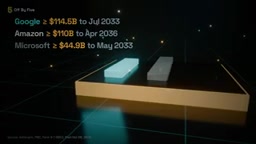
"Take-or-pay" is a long-term contract clause common in the energy and infrastructure industries, requiring the buyer to pay a minimum amount within an agreed period regardless of whether the product or service is actually taken. In AI compute procurement, cloud providers—seeking to recoup capital expenditure on large-scale data centers—often require AI companies to sign multi-year minimum purchase commitments. Such commitments are disclosed in financial statements as contractual obligations and, while not necessarily immediately recorded as liabilities, can significantly affect a company's long-term cash flow forecasts. For startups with volatile revenue, take-or-pay contracts mean cost rigidity far exceeds revenue elasticity; if demand falls short of expectations, the company must still fulfill payment obligations, amplifying operating risk.
Customer Structure: Diversified but Lacking Stickiness
On the revenue side, the filing gives a relatively healthy signal: in the first nine months of 2026, no single customer contributed more than 10% of revenue, and the top five customers combined accounted for about 25%. Customer concentration is lower than at many enterprise software companies, indicating a relatively diversified revenue base.
But the warning that immediately follows weakens this advantage: many top customers have not signed long-term contracts and can cut spending at any time. For AI companies relying on API calls and enterprise contracts, such "terminable at any time" customer relationships mean revenue stability is far less solid than the numbers superficially suggest.
Control: Who Really Owns Anthropic
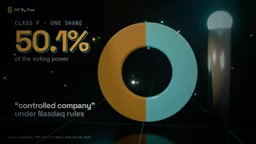
Anthropic's corporate governance structure is the most easily overlooked yet far-reaching part of this filing. The company is incorporated as a Public Benefit Corporation, and a special entity called the Long-Term Benefit Trust has the power to elect and remove a majority of board members. At the same time, a company established by the seven co-founders will hold one share of Class F stock carrying 50.1% of voting power.
The filing defines Anthropic as a "controlled company" under Nasdaq rules. This means that on most matters submitted to shareholder vote, ordinary shareholders cannot outvote the founders. For secondary-market investors, buying ANT stock buys economic interest, not real say over the company's direction.
A Public Benefit Corporation (PBC) is a special U.S. corporate form that requires a company to write specific public benefit missions into its charter and weigh them in decision-making while pursuing shareholder financial returns. PBC directors are legally permitted to consider non-shareholder stakeholders and need not focus solely on maximizing shareholder value. Nasdaq's "controlled company" designation means that when an individual, entity, or group holds more than 50% of voting power, the company may be exempt from certain corporate governance requirements, such as the rule that a majority of the board must be independent directors. Together, these two arrangements allow Anthropic to maintain its public benefit mission while concentrating actual control in the hands of the founding team and the trust.
Risk Disclosure: Competitors and Existential Risk
The language in the filing's risk section is direct. It lists Google and OpenAI as primary competitors and warns that if advanced AI systems are not built and operated with appropriate safeguards, they could pose catastrophic or existential risks. More unusually, the filing states that following a catastrophic AI-related event, the insurance industry as a whole may not have sufficient capacity to cover losses.
This statement pulls AI safety risk from ethical discussion into the realm of financial disclosure. For a company whose brand narrative centers on safety, this is both candor and a confirmation of its own risk exposure.
Known and Unknown
What is currently certain: the scale of revenue Anthropic reports, the size of its compute commitments, and the control arrangements of the founding team. What remains undetermined: the offering price, the number of shares, and when trading will begin. The S-1 provides a panoramic view of the company's history and finances, but the final IPO pricing remains an open question.
This document is not investment advice, but it is a business text worth reading page by page. It shows the real state of a frontier AI company seeking balance between explosive revenue and rigid costs, and it shows just how complex a capital structure can become when "safety" is part of a company's DNA.
Related articles

Using and Topping Up Claude in China: Three Methods Compared and a Guide to Avoiding Account Bans
A guide to using and topping up Claude in China: compare direct overseas credit card payment, US Apple ID and Android Google Play in-app purchases, and self-service website top-up by barriers, cost, and suspension risk, plus five habits to reduce the chance of a ban.

From ChatGPT Content Restrictions to Eval, Observability, and Guardrail in Practice
Through a hands-on e-commerce order Agent, this article explains the engineering logic behind ChatGPT content restrictions and how Eval, Observability, and Guardrail work together to prevent same-name user data leaks and prompt injection risks.
DeepSeek Open-Sources Super-Agent: An Architecture Deep Dive into the Router and Worker Design of an Always-On Coding Assistant
DeepSeek open-sources the always-on coding agent dsh-superagent, using a separated Router-Worker architecture that balances continuous operation and permission control. This article analyzes its design approach, what the code actually delivers, and the safety debate surrounding autonomous coding assistants, helping developers decide whether it is worth learning from.