DeepSeek Open-Sources Super-Agent: An Architecture Deep Dive into the Router and Worker Design of an Always-On Coding Assistant
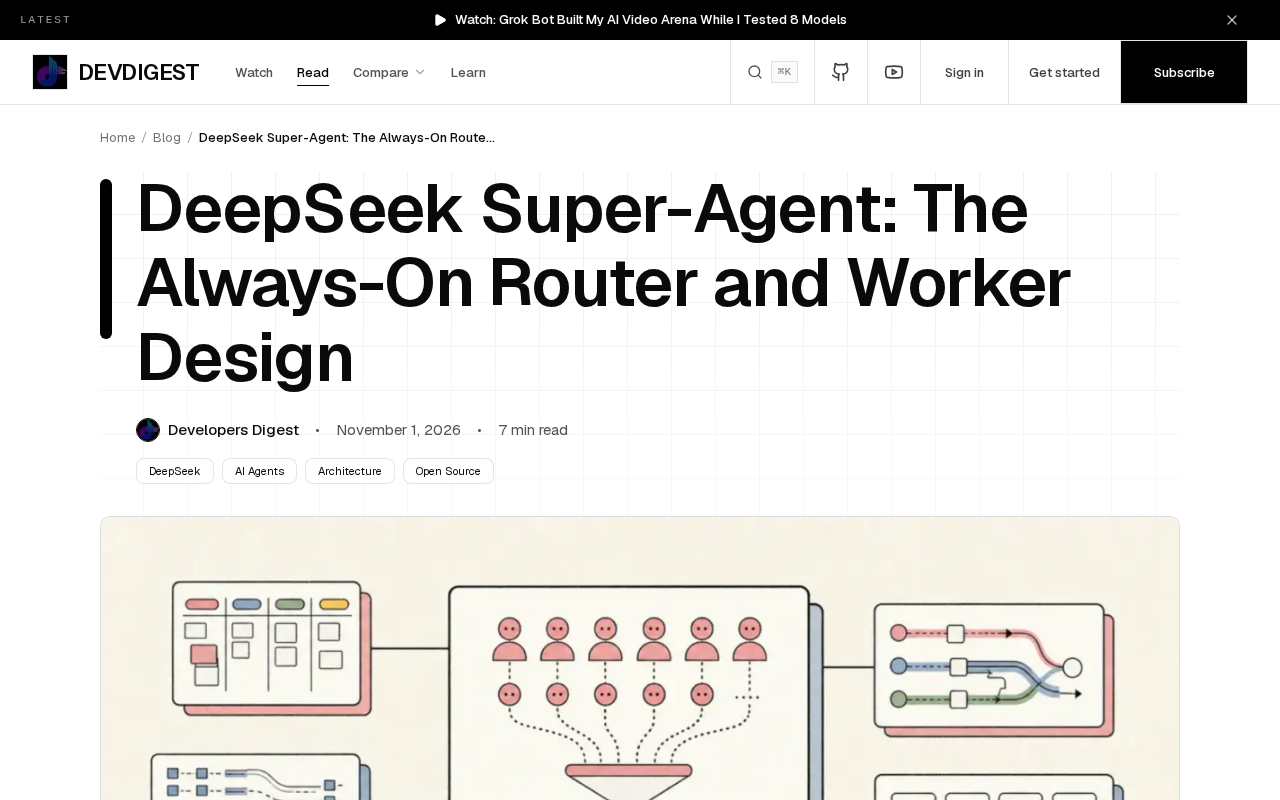
DeepSeek open-sources the always-on coding agent dsh-superagent, addressing the safety debate with a Router-Worker separation architecture.
DeepSeek has open-sourced an always-on coding agent named dsh-superagent, whose core is an architecture that separates a Router from a Worker: the Router receives tasks, determines intent, and dispatches them, while the Worker performs code generation and file operations on demand. This split keeps the always-on process lightweight and provides a clear point of enforcement for permission control and task gating. The article notes that always-on and autonomous execution bring security risks different from ordinary code completion tools, and the source material explicitly mentions a safety debate but gives no specific implementation details, model selection, or performance data. For developers, the architecture's decoupling of decision-making and execution is worth learning from, but early-stage open-source projects lack documentation and validation, so you should review the code yourself and assess the security boundaries before integrating it into production.
DeepSeek recently open-sourced dsh-superagent, a coding agent billed as "always-online 24/7." Unlike the common single-model conversational coding assistants, its core design is an always-on architecture that separates a Router from a Worker. This design answers the engineering question of "how to keep an Agent continuously online without letting it run out of control," and it has also sparked discussion about the safety boundaries of autonomous coding assistants.
Router-Worker Separation: The Engineering Solution for Always-On Agents
Architecture Breakdown
According to public project information, dsh-superagent splits the system into two roles: the Router receives tasks, determines intent, and dispatches them, while the Worker performs the actual time-consuming actions such as code generation and file operations. The direct benefit of this separation is that the always-on process does not need to cram every capability into a single context—the Router can listen in a lightweight way, while Workers are spun up or reused on demand.
This split is critical for "always-on" scenarios. Traditional conversational coding assistants rely on users actively initiating requests, whereas an always-on Agent needs to decide for itself when to step in and to what degree. The Router layer takes on this gating responsibility, and it also gives permission control a clear point of enforcement.
Always-on Agent refers to an agent form that does not rely on users initiating requests one by one, but instead runs continuously in the background over the long term and autonomously decides when to intervene. Compared with conversational assistants, it requires an additional scheduling loop, task queue, and state management, making it more sensitive to context length, process stability, and resource usage. Splitting the Router from the Worker is essentially about keeping the listening process lightweight and placing heavy computation in reclaimable execution units—a common layering approach in server-side Agent systems.
What the Code Actually Delivers
According to the source material, the project has been open-sourced but the specific implementation details are limited. What can be confirmed is that the repository is named dsh-superagent, positioned as a coding agent, with code organized around the division of labor between Router and Worker. For developers who want to reuse it, they will need to review the repository themselves to confirm the interfaces, dependencies, and deployment methods—the source material does not provide a specific module breakdown, model selection, or performance data, and no precise parameters should be speculated about here.
The Safety Debate: The Cost of Always-On and Autonomous
The source material explicitly mentions a "safety debate." The risk profile of an always-on coding Agent differs from that of ordinary code completion tools: it holds environment access over the long term, may execute commands unattended, and has a larger blast radius when something goes wrong. Although the Router layer is naturally suited to act as a permission gate, whether the gate itself is strict enough and how the Worker's sandbox boundaries are drawn are questions that require real-world testing by the community.
This kind of discussion aligns with the broader anxiety around Agent engineering in recent years: the more autonomous the capability, the more important observability and rollback-ability become. By separating the two, dsh-superagent is, to some extent, responding to these concerns at the architectural level—but architecture is not a guarantee, and everything ultimately depends on implementation details.
Blast Radius is borrowed from failure engineering and describes the scope that a single erroneous operation may affect. For an always-on coding Agent, which can read and write files, execute shell commands, and access credentials, a misjudgment or a prompt injection could spread the impact from a single session to the entire repository or even the deployment environment. Common ways to reduce the blast radius include least privilege, worker sandboxing, command allowlists, and rollback-capable snapshot mechanisms—which are also key dimensions for evaluating the implementation quality of such projects.
Prompt Injection refers to an attacker hiding malicious instructions in content the Agent will read (such as code comments, issue text, or dependency documentation) to induce the model to deviate from its original task and carry out the attacker's intent. Because always-on Agents continuously read external input and possess execution permissions, their injection surface is far larger than that of pure conversational assistants. If the Router layer only performs intent dispatch without input sanitization, injected content could reach the Worker directly, so a permission gate usually needs to be paired with content filtering and pre-execution confirmation.
What This Means for Developers
For teams looking to build an always-on coding assistant, this Router-Worker separation is worth learning from: it decouples "decision-making" from "execution," making it easier to apply rate limiting, auditing, and replacement separately. At the same time, it is important to recognize that early-stage open-source projects often lack sufficient documentation and validation, so you should assess the security boundaries yourself before integrating them directly into a production environment.
FAQ
What is dsh-superagent?
An always-on coding agent open-sourced by DeepSeekAd, designed with a separation between Router and Worker.
How is it different from ordinary coding assistants?
It emphasizes always-on presence and task dispatch rather than simple conversational completion; the Router layer handles judgment and dispatch, while the Worker handles execution.
Can it be used in production?
The source material does not provide a maturity assessment; it is recommended to review the code and security boundaries first before deciding.
One-line Summary
DeepSeek open-sources the always-on coding agent dsh-superagent, responding to the safety debate with a Router-Worker separation architecture.
Paragraph Summary
DeepSeek has open-sourced an always-on coding agent named dsh-superagent, whose core is an architecture that separates a Router from a Worker: the Router receives tasks, determines intent, and dispatches them, while the Worker performs time-consuming actions such as code generation and file operations on demand. This split keeps the always-on process lightweight and provides a clear point of enforcement for permission control and task gating. The article notes that always-on and autonomous execution bring security risks different from those of ordinary code completion tools; the source material explicitly mentions a safety debate but does not provide specific implementation details, model selection, or performance data. For developers, this architecture is worth learning from for its decoupling of decision-making and execution, but early-stage open-source projects lack documentation and validation, so you should review the code yourself and assess the security boundaries before integrating it into production.
Related articles

AI Weekly: Claude Code Backdoor Incident and AI Giants' Capital Game
AI security this week: Cursor marketplace seeded with a Claude Code backdoor affecting Mac and Windows developers. Meanwhile, Amazon AI capex hits $75.9B, Google AI search revenue lags traditional search, Anthropic launches Ultra subscription, and OpenAI commits to robots.txt training signals while publicly defending fair use.

Malicious Claude Code Extension Infiltrates Cursor: Version 2.1.313 Self-Check and Cleanup Guide
A malicious Claude Code build 2.1.313 appeared in the Cursor extension marketplace for about 11 hours, affecting up to 5,000 users. StepSecurity disclosed that it stole system information, git email, and environment variable names, and attempted to implant SSH keys and reverse tunnels. This article covers the incident, malicious behavior, and complete self-check and cleanup steps.

15 Essential Prompts for Vibe Coding: Keep AI from Wrecking Your Code
Vibe Coding often tempts AI to break your code. These 15 prompts—from PRD, architecture, and database to testing and debugging—chain each output as the source of truth, turning AI coding from casual chat into a controllable engineering process.