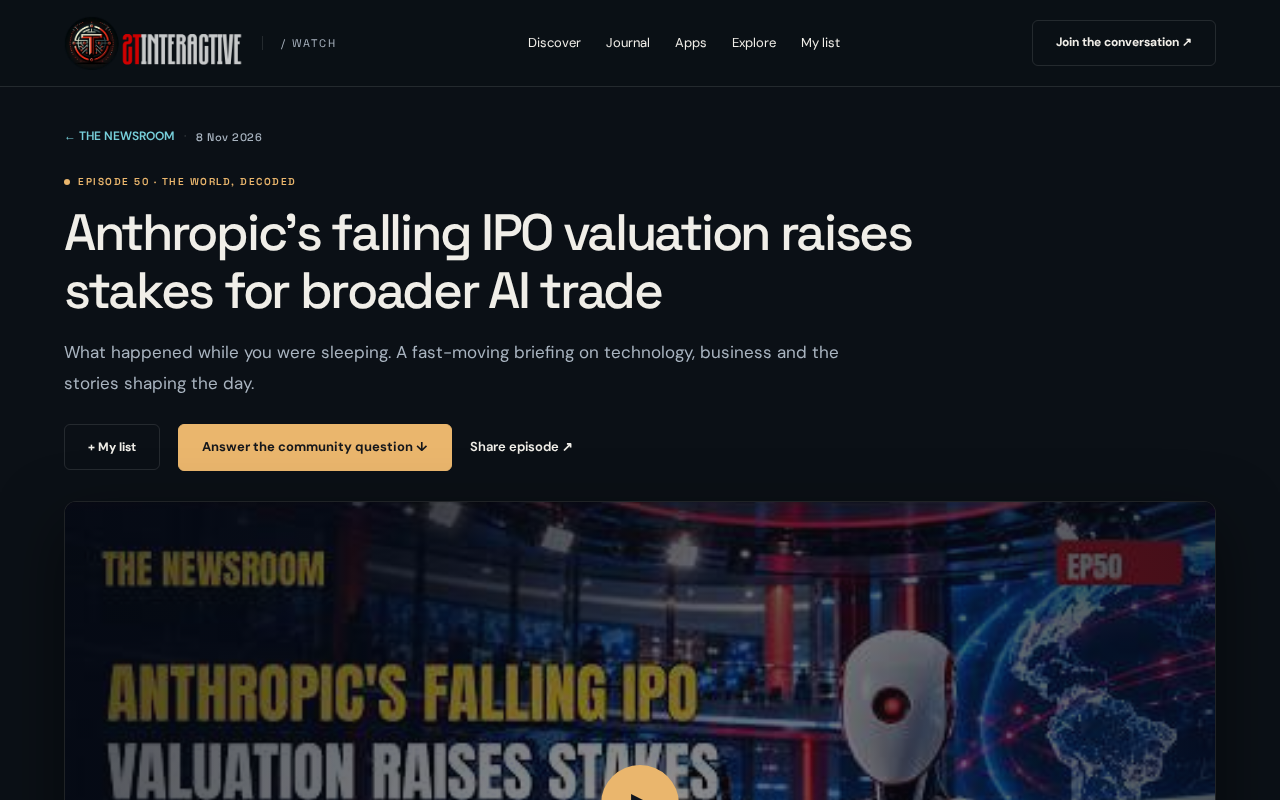
Anthropic IPO Valuation Slips, AI Trade Logic Faces Reassessment

Anthropic's IPO valuation decline is seen as a signal of a higher risk threshold for the AI trade, but a single data point is not enough to assert a sector turn.
Anthropic's IPO valuation has slipped, and the market interprets this as raising the risk threshold for trades across the entire AI sector. The article notes that IPO valuation is the market's collective pricing of future growth potential; the downward revision reflects investors' increasingly cautious expectations for the pace of AI commercialization, with pricing logic transitioning from "narrative-driven" to "fundamentals-driven." This change may transmit through three paths: lowering the valuation anchors of similar unlisted AI companies, triggering sentiment-driven corrections in listed AI targets, and making institutional allocation decisions more selective. However, the discussion on Hacker News received only 3 points and 0 comments, indicating the market has not yet formed a consensus interpretation and leaving room for larger expectation adjustments. The article emphasizes that a single valuation signal is insufficient to assert an overall turn in the AI trade and that more comparable company performance and Anthropic's own business progress should be continuously observed; short-term valuation fluctuations are more a reflection of market sentiment.
What the Valuation Decline Means
Anthropic's IPO valuation has slipped, and the market is amplifying this signal. According to a discussion on Hacker News, this change could raise the risk threshold for trades across the entire AI sector. For those watching the direction of the AI industry, this is not just a valuation adjustment for one company—it is a stress test of the current AI investment narrative.
IPO valuation is the market's collective pricing of a company's future growth potential. As a leading AI model company, Anthropic's downward valuation revision reflects that investors' expectations for the pace of AI commercialization are becoming more cautious.
To be clear, the original information only gives the fact of a "valuation decline" and does not disclose specific figures or the size of the drop. Therefore, a more reliable interpretation is directional: market pricing of AI companies is transitioning from "narrative-driven" to "fundamentals-driven." This transition itself is not unusual, but for AI trades that rely on high valuations for support, it is a signal that must be taken seriously.
"IPO valuation" and post-listing "market capitalization" are not the same concept. The former is the pricing range determined before a company's initial public offering through negotiation among underwriters, institutional investors, and company management based on comparable company multiples, growth expectations, market sentiment, and other factors. It is usually calculated as the offering price multiplied by the total share count after issuance. This price is essentially "forward-looking pricing," reflecting the market's discounted expectations for the company's growth path over the next several years rather than profits already realized today. Therefore, when an IPO valuation is revised downward, it often means that underwriters and early investors have made marginal changes to their judgments about the growth curve, the pace of commercialization, or the exit window, and its signaling significance is stronger than day-to-day fluctuations in the secondary market. For AI model companies that are not yet profitable, valuation anchors rely more on narrative and comparable transactions, and the spillover effects of a downward revision are also more pronounced.
Impact on the Broader AI Trade
The phrase "raises stakes for broader AI trade" in the headline deserves closer examination. "Broader AI trade" refers to the entire investment and trading chain built around the AI theme, including model companies, computing power suppliers, application-layer enterprises, and related financial products.
There are roughly three transmission paths for Anthropic's valuation decline: first, the valuation anchors of similar unlisted AI companies are pulled lower; second, listed AI-related targets may face sentiment-driven corrections; third, investment institutions' allocation decisions in the AI sector will become more selective. In other words, a single company's valuation change could become the trigger for a shift in risk appetite across the entire sector.
From an industry perspective, this is not necessarily a bad thing. A return to rational valuations helps squeeze out bubbles and allows companies with genuine technical barriers and revenue capability to receive more reasonable pricing. But for short-term traders, higher volatility is a direct consequence.
"AI trade" is a common expression in financial markets, referring to a multi-asset investment portfolio or trading strategy built around a certain theme, rather than a single stock. For the AI theme, this trading chain usually covers: underlying computing power and semiconductor suppliers, cloud infrastructure providers, foundation model companies, vertical application and agent-layer enterprises, as well as related ETFs, convertible bonds, and private fund products. These targets are interconnected through two channels—"valuation anchoring" and "risk appetite." When the valuation of a leading model company is revised downward, institutional investors often recalibrate the pricing multiples of similar assets and adjust portfolio weights accordingly. Understanding the structure of this chain helps explain why a single company's valuation change is viewed as a sector-level signal rather than an isolated event.
Why This Signal Matters
Anthropic is in the first tier of the AI model field, and its IPO moves are themselves a bellwether. The valuation decline is seen by market participants as a vote on the prospects for AI commercialization.
Looking at the discussion heat on Hacker News (the item received 3 points and 0 comments), the community's reaction to this news is still relatively calm. Limited discussion indicates that the market has not yet formed a consensus interpretation, which precisely means that subsequent information releases could trigger larger expectation adjustments.
For content creators and industry observers, the value of tracking such valuation signals lies in the fact that they can help us judge the progress of the AI industry's shift from a technology narrative to a business narrative. Model capability is no longer the only variable; revenue structure, cost control, and customer retention are becoming more important evaluation dimensions.
Hacker News is a technology community under Y Combinator. The ranking of its items is determined jointly by users' "points" (upvotes) and discussion heat, while the number of comments reflects the level of controversy and depth of participation. An item with only 3 points and 0 comments usually means it has not yet entered the community's mainstream view, possibly because it was posted recently, the headline contains limited information, or the topic itself is in a "wait-and-see" period. In information diffusion research, this low-interaction state often corresponds to a stage of "unsettled expectations"—market participants have not yet reached consensus on the meaning of the news, so if follow-up reports or comparable cases emerge later, the magnitude of expectation adjustment may be amplified. Using community heat as one sentiment indicator can help observers distinguish between "information already priced in" and "information not yet digested."
Taking a Single Signal Rationally
It should be noted that a single piece of news about a valuation decline is not enough to assert an overall turn in the AI trade. IPO valuation is affected by multiple factors, including market liquidity, the performance of comparable companies, and the choice of issuance window.
A more reasonable approach is to place this signal within a longer observation sequence: whether similar companies also adjust valuations later, how publicly traded AI targets react, and how Anthropic's own business progresses. A single data point provides the direction for asking questions, not the conclusion itself.
The long-term trend of the AI industry is still determined by technology implementation and business value, and short-term valuation fluctuations are more a reflection of market sentiment. For practitioners and investors, maintaining sensitivity to fundamental signals is more meaningful than chasing the rise and fall of valuation numbers.
Related articles
 Tech Frontiers
GitHub Daily · November 8: Agent Infrastructure Blooms Across the Board
GitHub Daily Nov 8: agent infrastructure dominates Trending—browser automation, design systems, skill libraries, VM runtimes, and context compression—while veteran tools warm up.
 Tech Frontiers
Comparing Routing Mechanisms of 10 Open-Source MoE Models: DeepSeek, Qwen, Mixtral, Llama 4, gpt-oss
A configuration-based comparison of routing mechanisms in 10 open-source MoE models, analyzing DeepSeek, Qwen, Mixtral, Llama 4, and gpt-oss on expert count, top-k, shared experts, gating, and load balancing.
 Tech Frontiers
Vibe Coding Step-by-Step Guide: Learn to Build Products with AI in Six Steps
Breaking down the six-step methodology of Bilibili's 748-episode Vibe Coding course, analyzing the usage boundaries and prompt techniques of Codex, Claude Code, and Cursor, and discussing who this AI coding course suits, who it doesn't, and how to avoid the trap of watching without acting.