Anthropic Launches FlashProve: Verifiable Inference Brings Trust to LLM Deployment

Anthropic releases open-source FlashProve, using cryptography for efficient verifiable inference to rebuild trust in AI deployment.
Anthropic unveils FlashProve, a cryptography-based verifiable inference method that lets developers confirm whether a response truly came from a specified model, with efficiency far surpassing prior open-source solutions. The article explains that verifiable inference is key to trust in AI deployment—preventing session hijacking, model swapping to bypass safety limits, or providers secretly using cheaper models—while helping safety evaluators confirm test models match production ones. Built on mature cryptography and emphasizing efficiency, FlashProve aims to move verifiable inference from feasible to usable. The research, done with cryptography scholar Alessandro Chiesa and others, is fully open-sourced.
Anthropic's latest research introduces FlashProve, a cryptography-based verifiable inference method. It enables developers to confirm whether a given response actually came from a specified model, and it is substantially more efficient than previous open-source solutions. This research is not just a technical breakthrough—it points to an increasingly urgent question in AI deployment: how do we trust that the model on the other side of the screen is the one it claims to be?
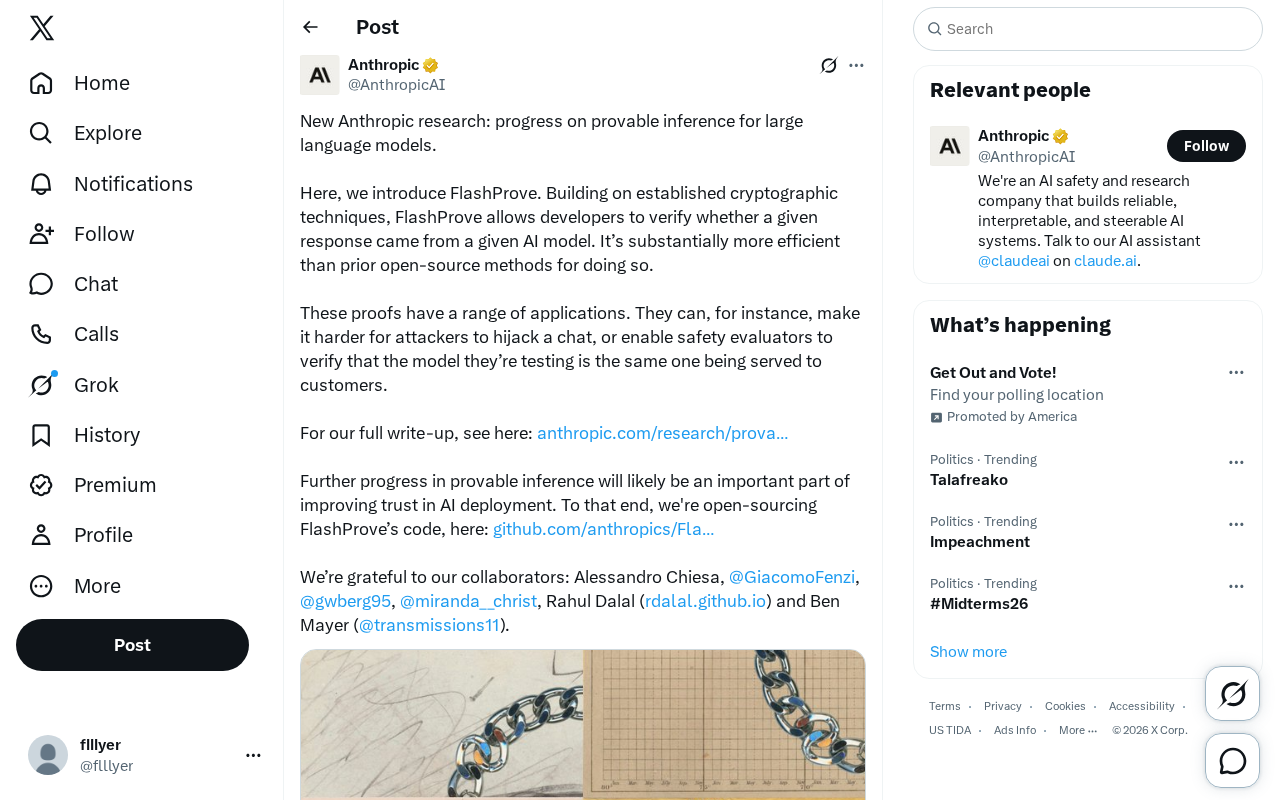
Why Verifiable Inference Matters
When users interact with an AI model, there is a default assumption—that the service provider is running the model it claims to run. But this assumption does not always hold. Attackers could hijack conversations, swap in a different model to bypass safety restrictions, or providers could silently substitute a cheaper, less capable model.
In its announcement, Anthropic lists several applications of verifiable inference: making it harder for attackers to hijack chat sessions, and enabling safety evaluators to confirm that the model they tested is the same one customers actually use. These scenarios all point to a core value—building trust in AI deployment.
From an industry perspective, model verification has long remained theoretical. Although open-source methods have previously achieved similar functionality, efficiency bottlenecks have made them hard to deploy in practice. FlashProve is positioned precisely to break through this bottleneck.
Verifiable Inference is a concept at the intersection of cryptography and machine learning. It refers to enabling a third party to mathematically confirm that a given inference was indeed executed by a specified model on a specified input, without fully trusting the model operator. The basic idea is that the model, while generating output, also attaches a proof that can be independently verified, so that the verifier can judge whether the output is compliant without re-running the entire model. This is fundamentally different from after-the-fact detection methods such as "model watermarking" or "output fingerprinting"—the latter only provide statistical clues, whereas verifiable inference provides guarantees that can be formally checked. Implementation approaches typically include zero-knowledge proofs, succinct arguments (SNARK/STARK), and interactive proofs, with different schemes trading off among proof size, generation overhead, and verification cost.
FlashProve's Technical Approach and Efficiency Breakthrough
According to Anthropic's description, FlashProve builds on mature cryptographic techniques, but the specific algorithmic details have not been disclosed. The key known information is that it is substantially more efficient than previous open-source methods.
The significance of this efficiency gain should not be underestimated. Verifiable inference typically requires attaching cryptographic proofs during the inference process, which introduces additional computational overhead. If the overhead is too large, almost no service provider would be willing to enable it in real deployments. By making efficiency a core selling point, FlashProve attempts to move verifiable inference from "feasible" to "usable."
Anthropic has open-sourced the FlashProve code and included a link to the full research paper. This approach is consistent with the company's recent open strategy in areas such as interpretability and safety evaluation.
Zero-Knowledge Proof (ZKP) is a class of cryptographic protocols that allows a prover to convince a verifier that a statement is true without revealing any information beyond the statement itself. In verifiable inference scenarios, the statement being proven is typically "there exists a set of model weights and an input such that the output obtained according to the established computation rules is Y." The core cost of ZK proofs lies in converting the model's forward computation into an arithmetic circuit and generating the proof; the larger the circuit and the more nonlinear operations, the more expensive proof generation becomes. Succinct arguments (such as SNARK and STARK) further require short proof length and verification time far shorter than recomputation—exactly the key properties that make verifiable inference deployable. Understanding these terms helps gauge the weight of FlashProve's claim of being "substantially more efficient": it means the constant overhead of proof generation or verification has been greatly compressed, bringing the cryptographic cost attached to each inference down to a level acceptable to service providers.
Collaboration Lineup and Academic Background
In its announcement, Anthropic specifically thanked its collaborators: Alessandro Chiesa, Giacomo Fenzi, GW Berg, Miranda Christ, Rahul Dalal, and Ben Mayer. Among them, Alessandro Chiesa is a well-known scholar in cryptography with deep expertise in zero-knowledge proofs and succinct arguments. This collaboration lineup indicates that FlashProve is not a byproduct of Anthropic's internal security engineering, but systematic research backed by cryptographic theory.
The intersection of cryptography and AI inference is a relatively young field. Traditionally, model inference has been treated as a black box, and verification has relied either on self-declarations from API providers or on after-the-fact analysis of outputs. The path represented by FlashProve—generating verifiable cryptographic proofs during inference—offers a mathematical answer to this problem.
Alessandro Chiesa is a professor in the Department of Electrical Engineering and Computer Sciences at UC Berkeley. His research focuses on theoretical computer science and cryptography, with systematic work on succinct argument systems, provable security of zero-knowledge proofs, and the complexity theory of interactive proofs. He is one of the core contributors to research on STARK-type proof systems and has also participated in theoretical analysis of the security foundations of zkSNARKs. This kind of academic background is crucial for verifiable inference: the circuit representation of model inference, the soundness assumptions of proof systems, and security reductions in adversarial environments all require rigorous cryptographic arguments rather than engineering-level empirical tuning. Anthropic's collaboration with this academic lineage suggests that FlashProve's contributions may lie not only in engineering efficiency but also in the adaptation and security analysis of proof systems for machine learning workloads.
Long-Term Impact on Trust in AI Deployment
In its announcement, Anthropic wrote: "Further progress in verifiable inference is likely to become an important component of improving trust in AI deployment." This sentence makes clear the strategic positioning of the research.
Currently, trust mechanisms in the AI industry rely mainly on contracts, audits, and brand reputation. These methods are not ineffective, but they cannot provide technical guarantees. Verifiable inference shifts trust from "believing the other party" to "verifying the other party." For safety evaluation organizations, regulators, and enterprise customers, this means an actionable technical audit method.
FlashProve is still in the research stage, and the release of open-source code is the first step. Whether it can become an industry standard depends on subsequent engineering optimization, ecosystem adoption, and competition with other verification schemes. But the direction is clear: verifiable inference is moving from academic concept to engineering practice, and Anthropic has chosen to advance this process through open source.
For developers concerned with AI safety and deployment trust, the FlashProve codebase deserves close attention. It is not just a tool, but a signal—AI companies are beginning to incorporate cryptography into the construction of trust infrastructure.
One-line Summary
Anthropic releases open-source FlashProve, using cryptography to achieve efficient verifiable inference and rebuild trust in AI deployment.
Paragraph Summary
Anthropic has announced its latest research, FlashProve, a cryptography-based verifiable inference method that enables developers to confirm whether a response truly came from a specified model, with efficiency significantly better than previous open-source solutions. The article notes that the core value of verifiable inference lies in building trust in AI deployment: preventing attackers from hijacking sessions, swapping models to bypass safety restrictions, or providers secretly switching to cheaper, weaker models, while also helping safety evaluators confirm that the tested model matches the one actually serving customers. FlashProve builds on mature cryptographic techniques and, although algorithmic details are not disclosed, uses efficiency as a key selling point to move verifiable inference from "feasible" to "usable." The research was completed in collaboration with cryptography scholar Alessandro Chiesa and others, and both the code and paper have been open-sourced, reflecting Anthropic's open strategy in the areas of safety and interpretability.
Related articles
 Tech Frontiers
Sherlock: An Open-Source Tool for Tracking Usernames Across Social Networks
Sherlock is an open-source Python tool that tracks social accounts across networks by username. This article covers its core features, why developers love it, typical use cases, and privacy compliance considerations.
 Tech Frontiers
GitHub Daily·Nov 07: Agent-Ready and Context Compression
GitHub Trending Nov 07: meta's agent-ready design system astryx, billion-context's 5x context compression, sherlock nearing 100k stars, plus local-first localthings and bare-metal GPU orchestration nvke.
 Tech Frontiers
Buoyant Open-Sources Kinference: An Inference Control Plane for vLLM on K8s
Buoyant open-sources Kinference, an inference control plane for vLLM on Kubernetes, with declarative routing, KV-cache-aware load balancing, and per-tenant metrics—claiming 95% lower median TTFT in official benchmarks.