Anthropic's IPO: Is a $1.4 Trillion Valuation AI's Future or the Peak of a Bubble?

Anthropic's trillion-dollar IPO is priced this week, with accounting losses, control, and circular transactions as core risks.
Anthropic plans to issue about 25 million shares at $70 to $78, with a maximum valuation of $1.4 trillion and potential fundraising of over $60 billion, making it the second-largest IPO in history. The article reviews its former OpenAI team background, Claude's commercialization progress in enterprise scenarios such as programming, and revenue of $33.2 billion in the first nine months. The $104 billion net loss mainly comes from accounting treatment of rising convertible note valuations; the real operating loss is about $1.3 billion, but hundreds of billions of dollars in compute commitments constitute rigid costs. A 40x price-to-sales ratio has sparked huge disagreement among institutions, special equity and trust arrangements leave new shareholders unable to control the company, and staggered lock-up releases and circular transactions further amplify uncertainty.
An IPO That Will Set the Mood for the Entire AI Sector
A company founded just five years ago is about to list on Nasdaq with a valuation of up to $1.4 trillion—a number enough to make any investor's heart race. According to a rundown by a Bilibili creator in a video, Anthropic plans to issue about 25 million shares at a price range of $70 to $78 per share, potentially raising more than $60 billion, making it the second-largest IPO in history after the record set by SpaceX in June this year, and more than twice the size of Saudi Aramco's nearly $30 billion IPO in 2019. The ticker symbol is ANT, with final pricing expected on Wednesday and trading beginning Thursday.
This is not just one company going public. Supporters say it proves artificial intelligence is real; critics say it is the peak of a bubble. Either way, no one can ignore the ripple effects this IPO will have across the entire AI industry chain.
Who Is Anthropic: Safety Ideals Meet Commercial Reality
Anthropic was founded in 2021 by a group of former OpenAI researchers, led by siblings Dario Amodei and Daniela Amodei. Their philosophy is to develop powerful AI safely, adopting a public benefit corporation structure in legal terms, where the board must consider not only profit but also the public mission.
Its core product, the Claude model, is used for writing code, answering customer questions, analyzing documents, and running software agents. Programming scenarios in particular have become a big business—more and more companies are willing to pay for AI tools that can write and fix code. Growth has been astonishing: in May this year, private investors valued Anthropic at nearly $1 trillion; according to the prospectus, revenue in the first nine months of this year reached $33.2 billion, with revenue of about $35 billion over the past 12 months, most of it from enterprises and developers paying to use its models.
The Truth Behind the Huge Losses: Accounting Treatment vs. Real Cash Flow
One number makes you gasp: for the same nine months, Anthropic reported a net loss of up to $104 billion. For a company hoping for a valuation of more than a trillion dollars, that sounds incredible.
But the reason matters. According to the video analysis, most of this massive loss is accounting treatment, not real cash flowing out. After Anthropic's valuation rose, the instruments it used to raise money in the past (such as convertible notes) became more valuable on paper, and this increase must be recorded as a book loss. The real operating loss over the nine months was about $1.3 billion—still a loss, but a completely different matter.

The bigger problem is on the cost side. Training and running AI requires enormous computing power, and Anthropic has signed long-term compute contracts that, according to interpretations of the prospectus, amount to hundreds of billions of dollars. It typically books computing power 12 to 18 months in advance, and if demand grows slower than expected, those bills will still come due. More subtly, suppliers are also competitors—Amazon, Google, and Microsoft provide computing power to Anthropic, sell its products on their cloud platforms, and some have invested in it, but they are also developing their own AI. In the first half of this year, nearly half of Anthropic's revenue came from these cloud platforms.
Convertible notes are a financing instrument between debt and equity: investors first lend money to the company as debt, with an agreement that at some future point (or when the company goes public) it can be converted into shares at a predetermined price. When the company's valuation rises sharply, the conversion value of these notes increases, and accounting rules require the increase to be recognized as a fair value change loss in current profit and loss, but it does not generate actual cash outflow. Therefore, for a fast-growing company with rapidly rising valuation, the book loss may be far larger than the real cash burn. When reading a prospectus, one should look at "net loss" and "operating cash flow" separately.
Valuation Logic: Faith and Disagreement Behind a 40x Revenue Multiple
At $1.4 trillion, Anthropic's valuation is about 40 times its revenue over the past year. By comparison, many large profitable tech companies are valued at only a fraction of that multiple. Investors are not buying what Anthropic earns today, but what they believe it can earn 10 years from now.
Not everyone is convinced. Research firm New Constructs called it the most absurd IPO of 2026, and critics say the problem is not AI itself but the price of AI startups. On the other hand, analysts at Morningstar reportedly put fair value at about $1.x trillion, above the upper end of the price range. Such a wide divergence precisely shows that the market has not yet reached a consensus on the pricing logic for AI assets.
Control Design: New Shareholders Can Own but Cannot Control
After the listing, one co-founder of Anthropic and a partnership to be formed through a special stock structure will together hold slightly more than half of the voting rights, while each owns only about 2% of the company. In addition, an independent body, the "Long-Term Benefit Trust," has the right to elect a majority of directors.
This means new shareholders can own part of the company but cannot control it. Such governance structures are not uncommon among tech companies, but for a listed company with a trillion-dollar valuation, outside investors have extremely limited say, which ordinary investors should carefully weigh.
A dual-class share structure refers to a company issuing multiple classes of shares with different voting rights, typically with founders holding high-voting shares with multiple votes per share, while public market investors buy low-voting shares with one vote per share. This design allows the founding team to retain control even after equity dilution, and tech companies such as Google, Meta, and Snap have used similar arrangements. The controversy is that outside shareholders bear the risk with their capital but can hardly influence company decisions through voting; governance checks rely more on independent directors and trust mechanisms than on shareholder meetings.
Retail Opportunities and Lock-Up Pressure
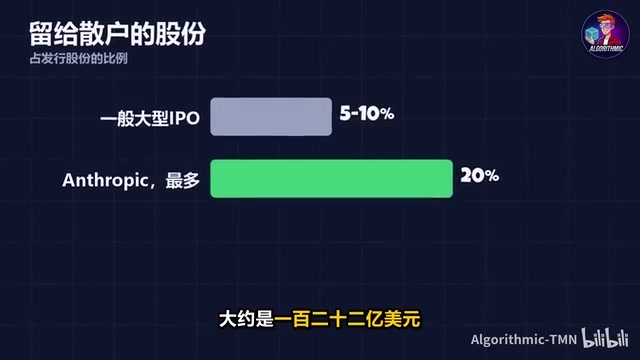
Anthropic has reserved up to one-fifth of the shares for retail investors, far above the usual 5% to 10%, corresponding to about $12.2 billion at the midpoint of the price range. Investors can subscribe through channels such as Jiaxin Wealth Management, Fidelity, and Robinhood. Demand is reportedly about six times the shares offered, so many people will get very few or none at all.
Another key detail is in the prospectus: insiders and early investors are typically not allowed to sell shares for about six months after the listing. But according to reports, Anthropic's prospectus sets more than 20 different lock-up release points and dates, as well as performance-linked conditions. Critics say this could allow more shares to enter the market earlier than usual—the more shares available, the more pressure on the stock price.
A lock-up period is a standard arrangement in IPOs, where underwriters and the company usually require insiders and early investors not to sell shares for a period after listing to prevent a concentrated sell-off on the first day. The U.S. market convention is about 180 days, after which all shares are released at once. In recent years, more companies have adopted "staggered lock-up releases," spreading the releases across multiple dates and attaching performance or share price conditions. In theory, this can smooth selling pressure, but it may also allow some shares to enter circulation earlier than under traditional arrangements, increasing short-term supply.
The Shadow of Circular Transactions: Inflated Demand or Real Growth?
A lot of AI money flows in "circles": cloud computing giants invest in AI labs, and those labs spend most of the money on computing power from the same giants. Critics say this may make demand look stronger than it is; supporters say this is how a new industry is built.

This circular structure is central to understanding Anthropic's valuation risk. If end demand is solid enough, the circularity is just a natural phenomenon of an early industry; if end demand is overestimated, any weakening in the chain could trigger a chain reaction. Another signal mentioned in the video: the Nasdaq 100 index is down by a significant margin from its October high, and Nvidia, which supplies chips for AI, has just lost its founder and CEO Jensen Huang (note: this statement comes from the original video; readers should refer to official information for the actual situation), and it will report earnings next week, exactly the day before Anthropic's pricing. Market expectations for the valuation have already been lowered, from the highest $2 trillion mentioned earlier this month to the current range, and the atmosphere is shrouded in a faint hesitation.
Price-to-sales (P/S) is the ratio of market value to revenue over the past 12 months, often used to value fast-growing unprofitable companies. It does not reflect profit and cash flow, so comparisons between companies with very different business models are of limited significance. A 40x price-to-sales ratio means investors pay $40 for every dollar of revenue, implying an assumption that revenue will continue to grow rapidly and future profit margins will be substantial. Once growth slows or faith in long-term profitability wavers, such valuations can undergo severe repricing, which is the technical reason for the huge divergence among institutions on Anthropic's fair value.
History Gives Inconsistent Answers
On its first day of trading in 1995, Netscape more than doubled, and the internet boom took off; in 2012, Facebook's IPO price was $38, and within four months the stock fell below $20. Both companies changed the world, but only one was a good buy in its first year as a public company. History repeatedly proves: the company that changes the world and the company that changes investors' wallets are not always the same.
Three Things to Watch This Week
First, Nvidia's earnings on Tuesday, which will set the mood for the entire AI sector. Second, the final issue price on Wednesday—above the range signals strong demand, below the range is a warning. Third, first-day trading on Thursday and the following days. A big rally followed by a quick pullback is a typical signal for a hot IPO.
So the significance of this IPO goes beyond one company: if Anthropic rises after a smooth listing, it shows investors are still willing to pay for AI's future; if it performs poorly, it could hit every AI-related company, from chipmakers to data center builders, and even the index funds held by millions of people. Five years ago, Anthropic was a small team worried about the future of AI; this week's story will determine how much that worry and this technology are really worth.
(This article is based on a public video and is for reference only, not investment advice.)
Related articles

Anthropic Races Toward Nasdaq: Ticker ANT, Can a Trillion-Dollar Valuation Hold?
Anthropic files its S1 for a Nasdaq IPO under ticker ANT, led by Goldman Sachs and Morgan Stanley. We break down revenue, massive compute lease commitments, founder voting control, and the valuation debate.

How Anthropic Uses a Four-Layer Narrative to Prop Up a $2 Trillion Valuation
Anthropic's estimated $2 trillion valuation: a breakdown of its positioning theory and four-layer narrative — civilization-level fear, identity, product, and business — and how founder essays, technical docs, and opinion leaders support the AI safety guardian valuation story.
Anthropic's $1.4 Trillion IPO Bid: Hidden Concerns in AI Hardware
Bilibili UP host rounds up five major AI stories: Anthropic's $1.4T Nasdaq valuation bid with $26B from seven giants; OpenAI's 20% price cut and Altman's chip bubble warning; Nvidia's $109B revenue expectation; compute cloud revenue surge with widening losses; robot firm's $500M raise but robotic hand durability bottleneck.