Anthropic's 'Project Panama' Exposed: Book Scanning for AI Training Sparks Controversy
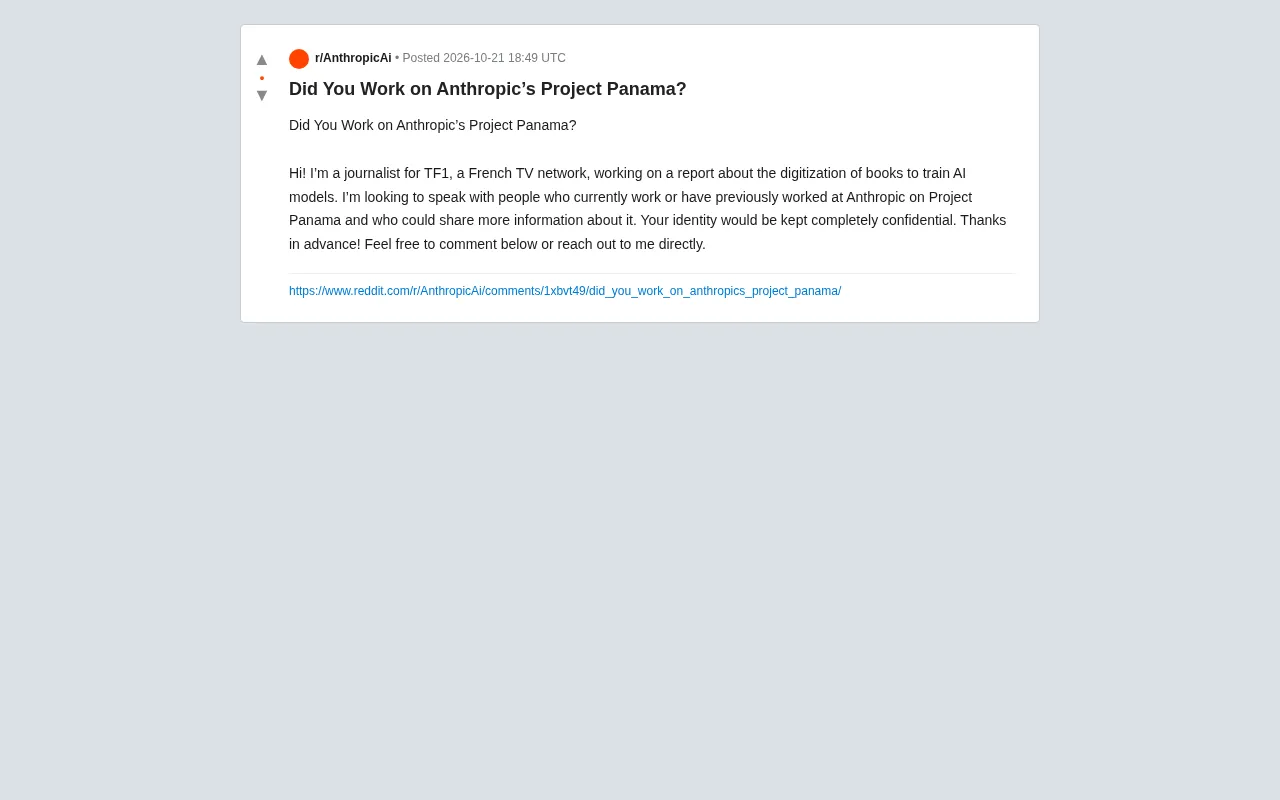
TF1 journalist seeks leads on Anthropic's book digitization project via Reddit, revealing a corner of the AI training data supply chain.
A TF1 journalist posted on Reddit seeking current or former employees of Anthropic's 'Project Panama,' described as digitizing books to train AI models. The post promises anonymity but reveals few details. Anthropic previously settled a copyright lawsuit over a pirated book dataset, and Project Panama suggests it is building a more systematic book digitization pipeline. The article examines the legal gray area of book scanning, the limits of the journalist's investigation, and the broader lack of training data transparency in the AI industry.
A journalist from French television network TF1 posted on Reddit seeking current or former employees who participated in Anthropic's "Project Panama." The project is described as "digitizing books to train AI models." The post requests anonymous interviews but does not reveal further project details. This seemingly ordinary recruitment post unexpectedly lifts the curtain on a corner of the AI training data supply chain.
What Is Project Panama?
According to the journalist's post, the core work of Project Panama involves scanning and digitizing physical books for training Anthropic's AI models. This is not the first time Anthropic has drawn attention for its training data sources. Previously, Anthropic faced a copyright lawsuit over its use of a pirated book dataset, which ultimately ended in a settlement. The emergence of Project Panama suggests that the company is building a more systematic, larger-scale book digitization pipeline.
The post itself contains limited information, but it conveys several key signals: the project has a dedicated codename, indicating it is treated as an independent engineering effort internally; the journalist is willing to publicly solicit leads on Reddit, suggesting that outsiders know very little about the project details; and interviewees are promised anonymity, which indirectly reflects the sensitivity of the topic.
Anthropic Pirated Books Lawsuit Settlement
In 2024, authors Andrea Bartz, Charles Graeber, and Kirk Wallace Johnson filed a class-action lawsuit against Anthropic, alleging that the company obtained their works through pirated ebook datasets such as "Books3" to train Claude. Books3 is a public dataset containing approximately 190,000 books that was once widely used for large model training before being taken down due to copyright disputes. In 2025, Anthropic reached a settlement with the plaintiffs, reportedly amounting to as much as $1.5 billion, making it one of the largest settlements in the field of AI training data copyright. One of the key rulings in the case was that training itself may constitute fair use, but obtaining books through pirated channels does not. Project Panama emerged against this backdrop, suggesting that Anthropic is attempting to rebuild its book corpus supply chain through legal or more controllable channels to reduce legal risk.
Why Book Scanning Has Become a Sensitive Topic
AI model training requires massive amounts of high-quality text, and books have always been ideal training corpora due to their structural completeness and standardized language. However, books are protected by copyright, and large-scale scanning for commercial model training exists in a legal gray area.
According to the journalist's description in the post, the reporting topic is precisely "book digitization for training AI models." This indicates that the media is focused not on the individual actions of one company but on the practices of the entire industry. As a leading AI lab, Anthropic's data acquisition methods naturally become a focal point. If Project Panama does exist, how it obtains books, whether it has obtained authorization, and how large the scanning scale is are all questions the public wants to clarify.
Fair Use and the Text and Data Mining Exception
The legal controversy over book scanning for AI training centers on the principle of "fair use" in copyright law (Section 107 of the U.S. Copyright Act) and the "text and data mining exception" introduced in recent years by jurisdictions such as the European Union. Fair use typically considers four factors: the purpose and character of the use (commercial or educational), the nature of the original work, the proportion of the work used, and the effect on the potential market for the original work. AI training is a typical commercial use and often involves copying entire books, making it difficult to directly apply traditional fair use defenses. Articles 3 and 4 of the EU's Digital Single Market Copyright Directive allow research institutions and, under specific conditions, text and data mining, but include a "rights reservation" mechanism for commercial entities—rights holders can declare that their works are not to be mined. The ambiguity and fragmentation of these legal frameworks are the root cause of book scanning projects operating in a gray area.
The Journalist's Investigation Path and Its Limitations
The TF1 journalist chose to post on Reddit rather than contact Anthropic through official channels—a noteworthy approach. On one hand, anonymous sources can bypass corporate PR filtering; on the other hand, publicly soliciting leads also gives Anthropic an opportunity to prepare its response in advance.
Currently, no Anthropic employee has publicly responded to the post. The information in the post is limited to "the project exists" and "it involves book digitization," lacking verifiable details. As a single source, the post is insufficient to support a complete description of Project Panama, but it provides a starting point for further investigation.
Non-Disclosure Agreements (NDAs) and Whistleblower Protection
Tech companies typically require employees to sign non-disclosure agreements prohibiting them from disclosing internal projects, data sources, and business strategies. Violating an NDA can result in breach-of-contract lawsuits, financial damages, and even reputational harm. For employees involved in sensitive data projects, publicly discussing their work may also trigger non-compete restrictions or labor law disputes. The journalist's promise of anonymity is precisely to reduce the legal and professional risks for sources. In journalistic ethics, anonymous sources must meet conditions such as "the information is crucial" and "it cannot be obtained through other means." Posting on Reddit is a low-cost, broad-reach method of contact, but it also means the journalist must verify the information independently, and the evidentiary value of a single anonymous source is limited.
Implications for AI Industry Data Practices
The discussion sparked by Project Panama is essentially the old problem of AI training data transparency. Models are becoming increasingly capable, but the sources, acquisition methods, and authorization status of training data remain opaque to the public. Book scanning is just one link in the chain—web scraping, user-generated content, academic papers, and other channels face similar scrutiny.
Anthropic has always positioned itself as "responsible AI." If there is tension between its data practices and this image, public scrutiny will only increase. The journalist's solicitation may be just a prelude to a larger-scale media investigation.
Training Data Transparency and "Responsible AI"
Training data transparency is one of the core issues in current AI governance. A model's capability boundaries, sources of bias, and copyright risks are all closely related to its training corpus, yet most leading labs do not disclose the full composition of their datasets. Anthropic's published "Responsible Scaling Policy" focuses primarily on model capability evaluation and safety measures, with relatively limited requirements for data source disclosure. The EU's AI Act, meanwhile, introduces training data summary disclosure obligations for general-purpose AI models, requiring a "sufficiently detailed" overview of data sources. The gap between industry self-regulation and regulatory requirements makes media investigations and external audits important forces for advancing transparency. Book scanning is just one link in the data supply chain—web scraping, user-generated content, and academic papers all face questions about authorization and disclosure.
Frequently Asked Questions
Has Project Panama been officially confirmed by Anthropic? Not yet. All public information comes solely from the solicitation post published by the journalist on Reddit, and Anthropic has not responded.
Why does the journalist want to protect interviewees' anonymity? Employees may be bound by non-disclosure agreements, and publicly discussing internal projects carries professional risks. Anonymity is a common compromise for obtaining truthful information.
Is digitizing books to train AI illegal? It depends on the specific jurisdiction and authorization status. Laws in many countries are still evolving, and industry practices generally fall in a gray area.
One-line Summary
A TF1 journalist solicited leads on Reddit about Anthropic's book digitization project, lifting the curtain on a corner of the AI training data supply chain.
Paragraph Summary
A journalist from French television network TF1 posted on Reddit seeking current or former employees who participated in Anthropic's "Project Panama," described as digitizing books to train AI models. The post promises anonymity to protect sources but reveals no further details. Anthropic previously faced and settled a copyright lawsuit over its use of a pirated book dataset, and Project Panama suggests the company is building a more systematic book digitization pipeline. The article analyzes the legal gray area of book scanning, the limitations of the journalist's investigation path, and the lack of training data transparency in the AI industry that the incident reflects, noting that leading labs' data practices are coming under increasing scrutiny.
Related articles

LangChain Retry Middleware Configuration: Practices and Selection Guide
Based on Reddit community discussion, this article analyzes LangChain ModelRetryMiddleware retry parameter configuration practices, covering the selection logic and alternatives for key options like max_retries, backoff_factor, and jitter.

Texas Senate Race in Trouble: Why Are Republicans Nervous?
Texas Senate race stirs Republican anxiety. Based on street interviews, this article analyzes the Democratic offensive in funding, organization, and running everywhere, and how Republicans are defending "Texas, Texas" amid the political pendulum effect.

Gemini Chat Now Generates and Edits Google Docs Directly, a New Breakthrough in Office Productivity
Google Gemini's chat interface now generates and edits PDF, Google Docs, Sheets, Slides, Markdown, TXT, and code files. Available to all users; web supports all formats, mobile only PDF for now.