AP Tensor Neural Networks Solve 3D High-Field Kinetic Equations

Tensor decomposition plus moment-constrained loss enables 3D3V kinetic equation training in half an hour on a single GPU.
High-dimensional kinetic equations face the curse of dimensionality and multi-scale coupling. The proposed Asymptotic-Preserving Tensor Neural Network (APTNN) applies CP decomposition to keep the equation residual decomposable, turning high-dimensional loss integrals into 1D combinations and reducing computational and storage costs from exponential to polynomial growth. It adds first-order moment equations to the AP loss to constrain flux closure in the high-field limit. A 3D3V VPFP problem with multiple random inputs trains in under 30 minutes on a single GPU with improved accuracy and lower memory. Systematic comparisons with traditional solvers and robustness under complex boundary conditions remain to be validated.
Numerical solution of high-dimensional kinetic equations has long been plagued by two major difficulties: the "curse of dimensionality" and multi-scale coupling. A recent study proposes an Asymptotic-Preserving Tensor Neural Network (APTNN) that combines tensor decomposition with physics-constrained loss, compressing the training time for the 3D3V Vlasov–Poisson–Fokker–Planck problem to under half an hour on a single GPU, offering a new technical pathway for plasma and semiconductor device simulation.
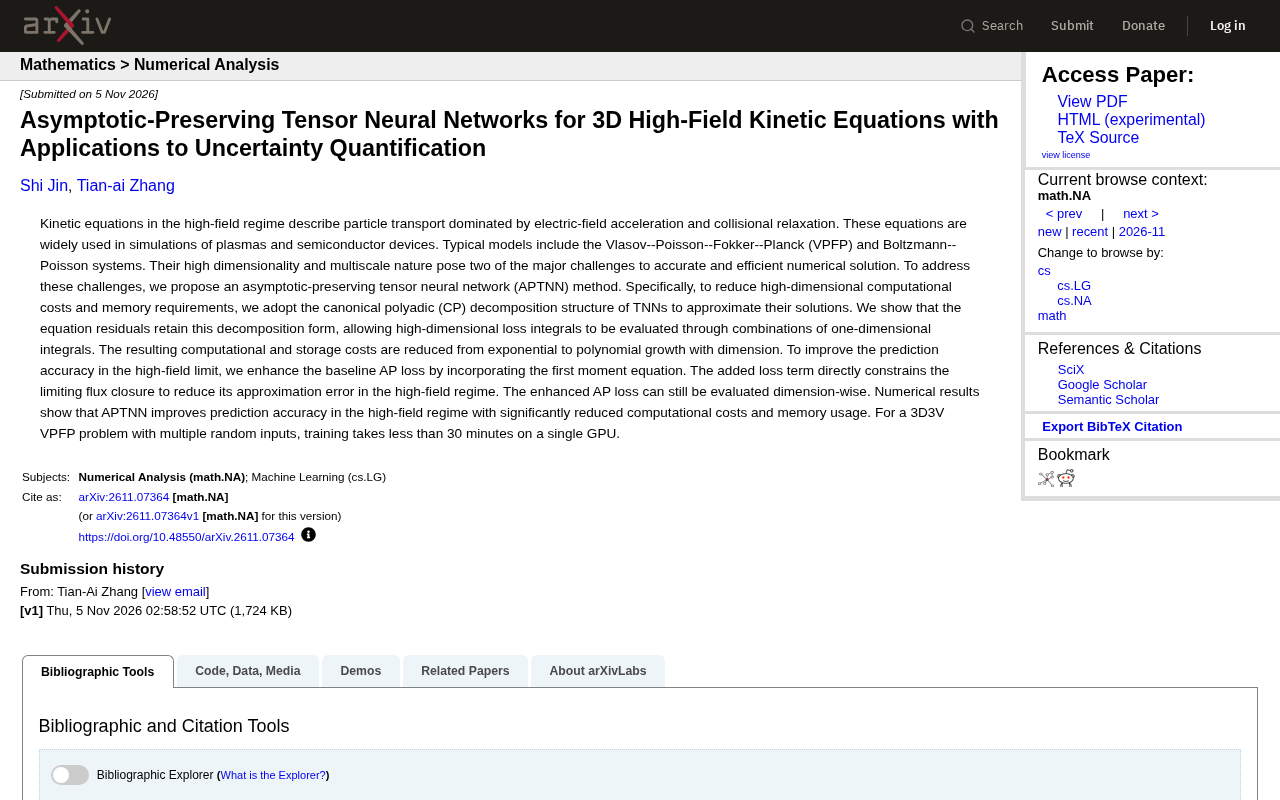
Problem Background: The Dual Challenge of High-Field Kinetic Equations
In the high-field regime, kinetic equations describe particle transport dominated by electric-field acceleration with collisional relaxation as a secondary effect. The Vlasov–Poisson–Fokker–Planck (VPFP) and Boltzmann–Poisson systems are typical representatives of such problems, widely used in plasma physics and semiconductor device simulation.
The trouble lies at two levels: first, extremely high dimensionality—three spatial dimensions plus three velocity dimensions (3D3V) means a six-dimensional phase space, and the memory and computational cost of traditional grid-based methods grow exponentially with dimension; second, multi-scale behavior—in the high-field limit the system approaches the hydrodynamic limit, and numerical schemes that do not preserve asymptotic properties either waste computing power on fine grids or lose accuracy on coarse grids.
Asymptotic-Preserving (AP) schemes are the core numerical concept for handling multi-scale kinetic equations. Taking the high-field VPFP system as an example, when the collision frequency tends to infinity, the solution of the equation converges to the hydrodynamic limit (such as the Euler or Navier–Stokes equations). A numerical scheme without asymptotic-preserving properties either wastes computing power resolving an extremely small Knudsen number on fine grids, or fails to correctly capture the limiting behavior on coarse grids and becomes inaccurate. The design goal of AP schemes is to automatically preserve this continuous limit at the discrete level, so that coarse-grid computations still converge to the correct hydrodynamic limit solution. APTNN migrates this idea from traditional discrete schemes to neural network training, maintaining limit consistency through the structural design of the loss function.
Core Design of APTNN: Keeping the Residual Decomposable
The research team's approach is to introduce the canonical polyadic (CP) decomposition structure of Tensor Neural Networks (TNN) into the approximate representation of the solution. The key insight is that under this representation the equation residual still retains the CP decomposition form, so the high-dimensional loss integral can be decomposed into a combination of one-dimensional integrals for computation.
This property directly changes the cost curve—computational and storage costs go from exponential growth with dimension to polynomial growth. For six-dimensional problems, this difference is at the order-of-magnitude level.
Enhanced Asymptotic-Preserving Loss: Constraining Flux with First-Order Moment Equations
A decomposition structure alone is not enough. Near the high-field limit, the constraining power of the baseline AP loss is relatively weak, and prediction accuracy declines. The authors' approach is to additionally incorporate first-order moment equations into the loss function, so that the added loss term directly constrains the limiting flux closure, thereby reducing approximation error in the high-field regime.
As a detail, the enhanced AP loss can still be evaluated separately by dimension, without breaking the efficiency advantage brought by the CP decomposition. This is the key to whether the method can be deployed—the addition of physical constraints does not come at the cost of losing computational feasibility.
Tensor Neural Network (TNN) is a network structure that represents a high-dimensional function as a sum of tensor products of several one-dimensional functions, whose mathematical form is closely related to the canonical polyadic (CP) decomposition in tensor decomposition. Specifically, a d-dimensional function can be approximated as a sum of products of outputs from several one-dimensional networks, each independently handling one coordinate direction. The advantage of this structure is that high-dimensional integrals can be decomposed into products of one-dimensional integrals, thereby avoiding gridding or Monte Carlo sampling in high-dimensional space. TNN has been used to solve high-dimensional elliptic PDEs and the Schrödinger equation, with accuracy weakly dependent on dimension. The key contribution of APTNN is to verify that the residual of the VPFP equation still retains the CP form under the TNN representation, reducing the computational complexity of the loss function from exponential to polynomial order.
Experimental Results: Simultaneous Improvement in Accuracy and Efficiency
Numerical results show that APTNN achieves significantly improved prediction accuracy in the high-field regime, while computational cost and memory usage drop substantially. The specific example given in the paper is a 3D3V VPFP problem with multiple random inputs, with training taking less than 30 minutes on a single GPU.
The significance of this number lies in engineering feasibility: six-dimensional phase-space problems previously often required large-scale parallel clusters, whereas now a single card can complete training within hours. For uncertainty quantification (UQ) applications, this means repeated training under multiple random inputs becomes practically feasible.
It should be objectively noted that the paper currently reports training time and accuracy improvements, but has not yet provided a systematic efficiency comparison with representative traditional solvers at equivalent accuracy; complete benchmarking in this direction remains to be supplemented by future work.
Uncertainty Quantification (UQ) in kinetic simulation typically refers to examining how random perturbations of input parameters (such as initial conditions, collision coefficients, boundary data) propagate to the output. Traditional methods require re-running the discrete solver for each sample, with computational cost proportional to the number of samples, often unaffordable in high-dimensional problems. The CP decomposition structure of APTNN allows the network to accept random inputs as additional dimensions, so that a single training yields a parametric solution mapping, greatly reducing the marginal cost of UQ. The "3D3V VPFP problem with multiple random inputs" in the paper refers to this setting: the network simultaneously learns the dependence of the solution on physical variables and random parameters, and after a single training can be rapidly evaluated within the parameter space.
Why It Is Worth Noting: A Feasible Path for PINNs on High-Dimensional Problems
Physics-Informed Neural Networks (PINNs) have long faced the bottleneck of "the loss integral cannot be computed" on high-dimensional problems. The value of APTNN lies in providing a structural solution: rather than bypassing high-dimensional integrals through sampling tricks, it keeps the integrand itself decomposable, eliminating exponential dependence at the root.
At the methodological level, the two components of this work—the CP-decomposed TNN representation and the moment-equation-based enhanced loss—both possess a certain generality. The former applies to other high-dimensional PDE solutions with low-rank structure, while the latter suggests an idea: embedding macroscopic moment constraints into the training objective of microscopic kinetic models may be an effective means of handling multi-scale problems.
For practitioners in plasma and semiconductor EDA, if the method can maintain accuracy under more complex collision operators and boundary conditions, its value as a complementary tool to traditional discrete solvers will be quite clear.
Physics-Informed Neural Networks (PINNs) have as their core idea incorporating the PDE residual as part of the loss function, training the network to approximate the solution by minimizing the residual. The standard approach is to randomly sample collocation points within the computational domain, compute the residual via automatic differentiation, and then perform Monte Carlo estimation of the squared residual. However, in high-dimensional problems this strategy faces a fundamental difficulty: the number of points required for uniform sampling grows exponentially with dimension, while sparse sampling leads to excessive variance in the loss estimate and unstable training. APTNN circumvents this dilemma—it does not rely on sampling tricks to approximate high-dimensional integrals, but instead makes the integral itself exactly decomposable through tensor decomposition. This distinction is structural: the former is a statistical approximation, the latter an algebraic identity, and therefore does not degrade as dimension increases.
Limitations and Outlook
The rank selection of the CP decomposition, the weight balance of the enhanced loss term across different parameter regions, and extension to more complex geometries and boundary conditions are all issues not yet fully elaborated in the abstract. From research to engineering deployment, its robustness still needs to be verified in real device simulation scenarios.
Nevertheless, the result of training a 3D3V VPFP problem on a single GPU in half an hour is itself enough to prompt the high-dimensional kinetic simulation field to re-examine the positioning of neural network methods.
One-line Summary
Tensor decomposition plus moment-constrained loss enables 3D3V kinetic equation training in half an hour on a single GPU.
Paragraph Summary
High-dimensional kinetic equations face the dual challenges of the curse of dimensionality and multi-scale coupling. A recent study proposes the Asymptotic-Preserving Tensor Neural Network (APTNN), which introduces the CP decomposition structure of Tensor Neural Networks into the approximate representation of the solution, keeping the equation residual decomposable and thereby transforming high-dimensional loss integrals into combinations of one-dimensional integrals, with computational and storage costs growing polynomially instead of exponentially. To address accuracy degradation in the high-field limit, the method adds first-order moment equations to the baseline AP loss to constrain the limiting flux closure, and the enhanced loss can still be evaluated by dimension. Numerical experiments show that a 3D3V VPFP problem with multiple random inputs trains in under 30 minutes on a single GPU, with significantly improved accuracy in the high-field regime and greatly reduced memory. The method provides a structural solution for PINN-type approaches to high-dimensional multi-scale problems, but systematic efficiency comparisons with traditional solvers and robustness under complex boundary conditions remain to be verified.
Related articles
 Tech Frontiers
Google Omni 1.2 Flash: 15-Second AI Video at Just $0.07 per Second
Google DeepMind releases Gemini Omni 1.2 Flash: 15-second video, 720p at $0.07/sec (30% cheaper), multi-turn editing without regeneration, draft upscaling to 4K.
 Tech Frontiers
No AI Ghostwriting: Writer's Quarter Reinvents Novel Writing with a Visual Workbench
The Writer's Quarter is an AI-free novel writing and planning tool that unifies character building, story planning, and manuscript writing in one visual workbench. This article analyzes its positioning, target users, and differentiated value amid the rise of AI writing tools.
 Tech Frontiers
Fleeep: A Unified Inspiration Collection Notes App for Creatives
Fleeep is a notes app for creatives that unifies screenshots, bookmarks, saved posts, and inspiration into one calm, cross-device, offline-capable space. This article analyzes its positioning, differentiation, and target users.