API vs MCP: The USB-C of AI, Core Differences and the Biggest Risk

MCP is the USB-C of the AI world, reducing N×M integrations to N+M without replacing APIs — and it carries security risks.
Drawing on a metaphor from an Indian YouTube creator, the article explains why MCP (Model Context Protocol) is seen as "the USB-C of the AI world." An API is like a door with a fixed menu — developers must read docs in advance and hardcode URLs, keys, and data formats; connecting 3 AI apps to 4 tools means maintaining 12 connections, which becomes unmanageable at scale. MCP lets each tool implement a Server once and each AI implement a Client once, compressing N×M into N+M, with AI proactively asking "What can you do?" to dynamically discover and select tools. MCP doesn't replace APIs — it still calls them internally: APIs are for developers, MCP is for AI. Created by Anthropic in 2024, the protocol is now maintained by the Linux Foundation as an open standard. The article closes with a warning that malicious MCP Servers can reach users' files and keys, making permission confirmation and source review essential.
Introduction: What Your AI Is Doing for You Right Now
Your AI can read Gmail, commit code to GitHub, and send messages in Slack. What makes all of this possible is a tiny protocol — MCP. But APIs have existed for ages, so why do we need MCP at all? An Indian YouTube creator used a brilliantly simple metaphor in one of his videos: MCP is the USB-C of the AI world. This article walks you through the essential differences between API and MCP, along with MCP's biggest security risk.
API: A Door Into an App, With a Fixed Menu
The creator compares an API to "a door into an app, and behind that door is a Fixed Menu." To walk through that door, developers have to read the docs first and write code in advance: this URL, this Key, this Format. Every app's door is different, and every app speaks a different language.
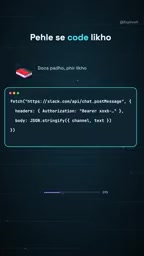
The problem reveals itself at scale. Say you have 3 AI applications and 4 tools. If you connect them pairwise, you need to write separate code for every combination — 12 connections in total, all tangled together. Every time you add a new tool, the workload multiplies. This is the real-world bottleneck the API model hits in the AI era.
MCP: Turning the N×M Tangle Into N+M
MCP is designed to solve exactly this tangle. Think of it as the USB-C of AI: no matter what the peripheral is, the interface is standardized — just plug it in and it works.
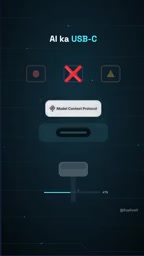
The approach is simple: each tool only needs to implement an MCP Server once, and each AI only needs to implement an MCP Client once. Those 12 connections become just a handful. More importantly, the interaction model changes — instead of developers hardcoding every call in advance, the AI asks for itself: "What can you do?"

The Server sends back a list of available tools, and the AI picks the right one to execute. This "discover first, call later" mechanism gives AI the ability to dynamically select tools, rather than relying on developers to hardcode every path.
MCP stands for Model Context Protocol, an open protocol based on JSON-RPC 2.0 that defines a standard way for AI applications (Client/Host) to communicate with external tools and data sources (Server). At the protocol level, it's built around three primitives: Tools (functions the AI can call, with parameter schemas), Resources (context data the AI can read, like files or database records), and Prompts (reusable prompt templates). During initialization, the Client and Server exchange their capabilities through an initialize handshake; after that, the Server exposes its tool list via tools/list and accepts execution requests via tools/call. The transport layer supports two forms: stdio, commonly used for local processes, and Streamable HTTP for remote scenarios. It's this standardized discovery and invocation semantics that lets AI and tools from different vendors work together plug-and-play.
The terms N×M and N+M describe two orders of magnitude in integration complexity. N×M means every AI application needs its own integration code for every tool, so the number of connections grows multiplicatively with both sides. N+M means each AI implements a Client once and each tool implements a Server once, so the number of connections becomes additive. Take the article's example of 3 AI applications and 4 tools: direct connections would require 3×4=12 sets of adapter code, while MCP requires just 3 Clients plus 4 Servers — 7 implementations in total. When the number of tools grows to dozens or hundreds, this gap evolves from linear-versus-quadratic into the boundary between engineering that's feasible and engineering that isn't.
API and MCP Are Not Replacements for Each Other
Here's a commonly misunderstood point: MCP does not replace APIs — it still calls APIs under the hood. The creator draws a clear line: APIs are for developers; MCP is for AI. APIs solve "how a program accesses a service," while MCP solves "how AI discovers and uses tools." They're abstractions at different layers, not competitors on the same layer.
Looking at the ecosystem, Anthropic created MCP in 2024, and it's now maintained by the Linux Foundation as an open standard.

This shift in stewardship is worth noting: the protocol has gone from a single vendor's product to a neutral foundation's standard, which means more vendors can adopt it with confidence, without worrying about being held hostage by any one company.
The Biggest Risk: What a Compromised MCP Server Can See
The creator dropped his heaviest warning at the end of the video: a malicious MCP Server can reach your files and keys. The reason isn't hard to grasp — MCP was designed to let AI operate tools on your behalf, and once permissions are granted, the scope of what a Server can do is extremely broad.
This also explains why a proper AI application should ask for your permission before every tool execution. Permission confirmation isn't an annoyance — it's the last line of defense. When choosing an MCP Server, source credibility deserves more weight than feature richness.
The root of MCP's risk lies in trust boundaries and permission granularity. AI applications typically run as the user, and an MCP Server often receives the same set of credentials (local filesystem access, API keys, OAuth tokens), so a malicious or vulnerable Server could in theory read anything within its authorized scope — or even use tool descriptions to carry out prompt injection and coax the model into unintended actions. Known attack surfaces in the wild include hidden instructions in tool descriptions, malicious content embedded in Server responses, and lateral access caused by excessive permissions. Mitigations include the principle of least privilege, explicit per-tool confirmation, source and code review for third-party Servers, and isolated execution in sandboxes or containers.
Key Takeaways
- APIs have developers program against a fixed menu; MCP lets AI dynamically discover and invoke tools.
- MCP compresses N×M integration complexity into N+M, dramatically lowering integration costs.
- MCP doesn't replace APIs — it still calls them under the hood; the former is for AI, the latter for developers.
- MCP has moved from Anthropic to an open standard under the Linux Foundation.
- A malicious MCP Server can access files and keys, so permission confirmation and source review are essential.
Which MCP Server are you using right now? Share in the comments.
Related articles

RAG Interview Essentials: Breaking Down the Full Offline Indexing and Online Retrieval Pipeline
A complete breakdown of the RAG retrieval-augmented generation workflow: offline document loading, chunking, vectorization, and indexing; online query rewriting, vector retrieval, reranking, and generation, plus core interview points and system optimization directions.

AI Large Models for Absolute Beginners: Principles and API Calling in Practice
From AI's evolution to large model training principles and core concepts like Token, Temperature, and Top-P, this article explains system prompts, Function Call, RAG, and memory with hands-on examples and four API call scenarios—ideal for beginners.

Will GitHub Die? Open Source Maintainer Burnout and the Collaboration Crisis in the AI Era
Lex Fridman podcast discussion on open source maintainer burnout and GitHub's predicament: massive pull requests overwhelm core maintainers, and AI worsens code bloat. Using math journal peer review and Poincaré conjecture verification as analogies, the article analyzes why verification in knowledge production must be deliberately slow, and how open source communities can avoid the failure mode of maintainers exiting.