Apple Lowers Taiwan App Store Commission to 26%: What Changes Should Developers Watch For?

At the request of the Taiwan Fair Trade Commission, Apple lowered the standard commission for the Taiwan App Store from 30% to 26%, effective October 31, 2026.
Apple announced that starting October 31, 2026, it will lower the standard commission for in-app purchases and paid app transactions on the Taiwan App Store from 30% to 26%. The adjustment stems from discussions with the Taiwan Fair Trade Commission, and developers can automatically benefit from the new rate without signing new terms. Apple has also revised its developer agreement, with a translated version to be released within one month. The rate reduction may affect developers' revenue models and regional market strategies and may create reference pressure on platforms such as Google Play. Against the backdrop of tightening global regulation, Apple is demonstrating a flexible strategy through negotiated concessions, and developers need to pay attention to regional differences and prepare for localized compliance planning.
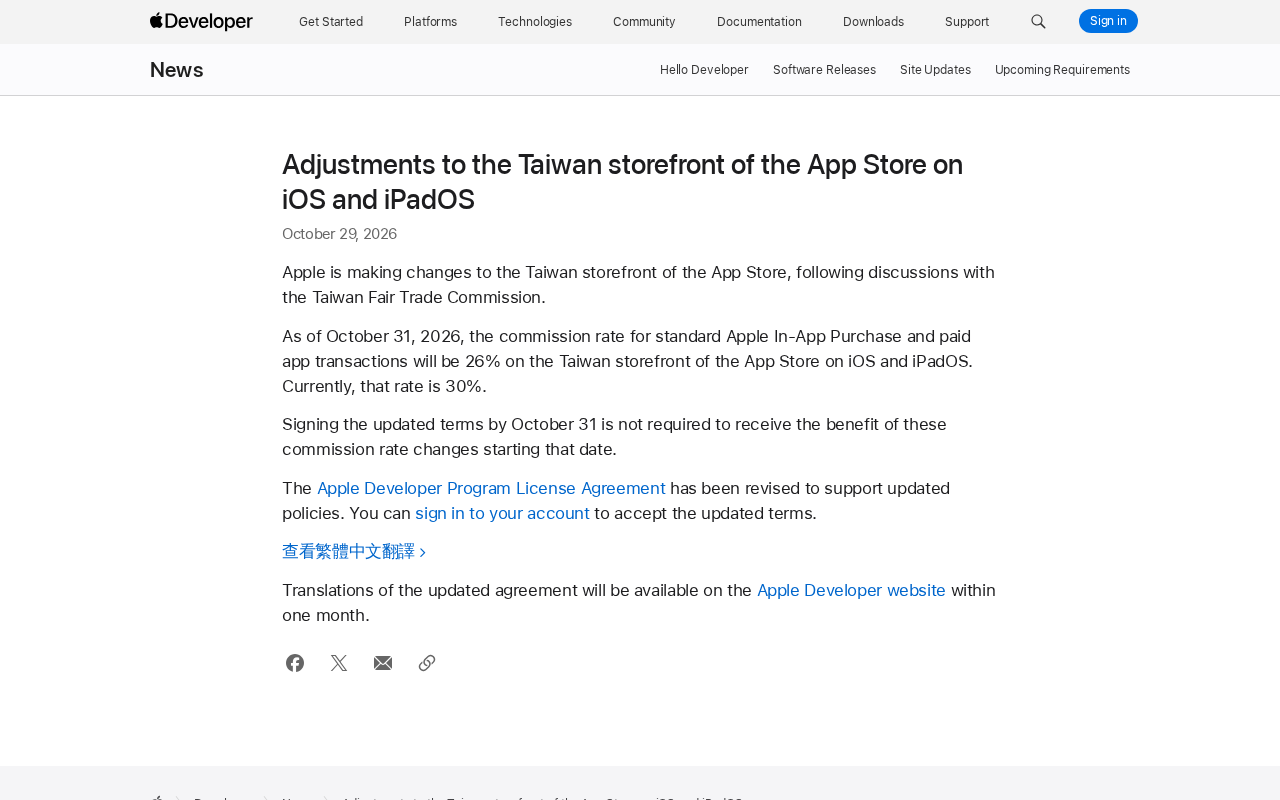
Apple recently announced that, following discussions with the Taiwan Fair Trade Commission, it will adjust the fee structure for the App Store in Taiwan. Starting October 31, 2026, the standard commission rate for in-app purchases (In-App Purchase) and paid app transactions on the Taiwan store for iOS and iPadOS will drop from 30% to 26%. This change directly affects developers operating in the Taiwan market and reflects how regional regulatory pressure continues to reshape the rules of the platform economy.
Specifics of the Fee Adjustment
According to the announcement on Apple's developer website, this adjustment targets the "standard" commission rate—the base tier applicable to most developers. After the change, the rate for the Taiwan store goes from 30% to 26%, a reduction of 4 percentage points. For developers who rely on in-app purchases or paid downloads for revenue, this means a lower revenue-share cost on each transaction.
The announcement also clarifies that developers do not need to sign the updated terms before October 31 to benefit from the new rate. Apple states that even if developers do not sign before the deadline, the new commission rate will automatically apply starting from that date. This arrangement reduces the operational burden on developers and avoids revenue losses caused by delays in signing the terms.
In-App Purchase (IAP) is the transaction system Apple provides to developers, allowing users to purchase virtual goods, subscription services, or paid content within an app. Apple takes a percentage of each transaction as commission, with the standard rate typically being 30%. Paid app transactions refer to Apple's share when users purchase an app directly. The "standard commission rate" adjusted in Taiwan this time applies to the base tier for most developers and does not involve preferential rates for small businesses or subscription services (such as the 15% rate applicable to developers with annual revenue under $1 million). Therefore, the new 26% rate applies only to transaction types that previously fell under the 30% tier, and developers need to confirm whether their business falls under the standard tier.
Background of the Negotiations with the Taiwan Fair Trade Commission
In its announcement, Apple acknowledged that this adjustment was the result of "discussions with the Taiwan Fair Trade Commission." Although the specific details of the discussions were not disclosed, this wording indicates that regional competition regulators' attention to app store commission policies is having a real impact. In recent years, regulators in multiple countries and regions have been scrutinizing the app store commission rules of platforms such as Apple and Google, and Taiwan's adjustment is part of this global trend.
Based on public information, the Fair Trade Commission has not published the specific terms of any settlement or ruling, nor has Apple stated whether there are other additional commitments. But the rate reduction itself sends a clear signal: after communicating with regulators, the platform is willing to make concessions on commercial terms.
The Taiwan Fair Trade Commission (TFTC) is the competent authority in Taiwan responsible for competition law and consumer protection, with duties including investigating monopolistic conduct, restrictive competition agreements, and unfair competition practices. In recent years, regulators in many countries around the world have launched antitrust investigations into Apple's App Store commission policies—for example, the EU's Digital Markets Act requires opening up third-party payments, and South Korea has legislated to prohibit mandatory use of in-app payments. The Taiwan Fair Trade Commission's attention to Apple is also part of this trend, and its "discussions" with Apple may involve whether the conduct constitutes abuse of a dominant market position. Although the specific settlement details have not been made public, the rate reduction shows that regulatory dialogue has produced substantive results and also provides a reference case for regulators in other regions.
Actions Developers Need to Take
For developers listed on the Taiwan store, the most direct change is revenue settlement. Although the rate takes effect automatically, Apple has simultaneously revised the Apple Developer Program License Agreement to support the updated policy. Developers can log in to their accounts to accept the updated terms.
Apple states that translated versions of the updated agreement will be published on the developer website within one month. For non-English speakers, this provides a window to understand the changes in the terms. Developers are advised to carefully read the relevant terms after the translated version is released to confirm whether their business models are affected by other related implications.
Potential Impact on the Regional Market
With the Taiwan store rate dropping from 30% to 26%, the local market becomes one of the lower-commission markets in Apple's App Store. For small and medium-sized developers, a 4-percentage-point difference can be quite significant at scale. More importantly, this adjustment may encourage more developers to direct resources toward the Taiwan market or reassess their pricing strategies in the region.
From a competition perspective, Apple's concession may also create reference pressure on Google Play. However, there is currently no information indicating that other platforms will follow with similar adjustments. Whether the Taiwan Fair Trade Commission will extend this model to other platforms is worth continued observation.
Google Play is the main app store in the Android ecosystem, and its commission structure is also often 30% (with preferential treatment for some subscriptions or small businesses). Apple's fee adjustment in Taiwan may create competitive pressure: if developers compare costs across the two platforms, Google may face pressure to follow with lower fees or offer better terms. However, Google's fee policies are influenced by local laws and its own strategy in each region and may not immediately follow suit. In addition, local developers in Taiwan may reassess cross-platform distribution strategies and direct more resources toward iOS. Regulators may also view Apple's concession as a model that can be promoted, prompting other platforms to proactively adjust their terms to avoid investigations. This dynamic is worth continued attention.
Apple's Strategy Under the Global Regulatory Trend
Apple's adjustment this time is not an isolated event. Globally, app store commission models and payment rules are facing increasing legal and regulatory challenges. Apple's choice to adjust rates in Taiwan through negotiation rather than waiting for a mandatory ruling shows that it adopts a flexible response strategy in different jurisdictions.
For developers, understanding these regional differences is becoming increasingly important. The same app may face different rates, terms, and compliance requirements in different stores, and global operations require more detailed localized financial and legal planning. Taiwan's fee change this time is the latest stroke in this complex picture.
Overall, the reduction of Apple's Taiwan App Store commission to 26% is a commercial terms adjustment driven by regulatory dialogue. Developers should pay attention to the release of updated terms and translated versions and assess the impact of the fee change on their revenue models. As the global regulatory environment continues to evolve, similar regional adjustments may continue to appear.
One-line Summary
At the request of the Taiwan Fair Trade Commission, Apple lowered the standard commission for the Taiwan App Store from 30% to 26%, effective October 31, 2026.
Paragraph Summary
Apple announced that starting October 31, 2026, it will lower the standard commission for in-app purchases and paid app transactions on the Taiwan App Store from 30% to 26%. The adjustment stems from discussions with the Taiwan Fair Trade Commission, and developers can automatically benefit from the new rate without signing new terms. Apple has also revised its developer agreement, with a translated version to be released within one month. The rate reduction may affect developers' revenue models and regional market strategies and may create reference pressure on platforms such as Google Play. Against the backdrop of tightening global regulation, Apple is demonstrating a flexible strategy through negotiated concessions, and developers need to pay attention to regional differences and prepare for localized compliance planning.
Related articles

RAG Interview Essentials: Breaking Down the Full Offline Indexing and Online Retrieval Pipeline
A complete breakdown of the RAG retrieval-augmented generation workflow: offline document loading, chunking, vectorization, and indexing; online query rewriting, vector retrieval, reranking, and generation, plus core interview points and system optimization directions.

AI Large Models for Absolute Beginners: Principles and API Calling in Practice
From AI's evolution to large model training principles and core concepts like Token, Temperature, and Top-P, this article explains system prompts, Function Call, RAG, and memory with hands-on examples and four API call scenarios—ideal for beginners.

Will GitHub Die? Open Source Maintainer Burnout and the Collaboration Crisis in the AI Era
Lex Fridman podcast discussion on open source maintainer burnout and GitHub's predicament: massive pull requests overwhelm core maintainers, and AI worsens code bloat. Using math journal peer review and Poincaré conjecture verification as analogies, the article analyzes why verification in knowledge production must be deliberately slow, and how open source communities can avoid the failure mode of maintainers exiting.