Apple's Top-End Touchscreen MacBook Pro Priced at $14,549, OLED Display the Main Driver of Price Increase

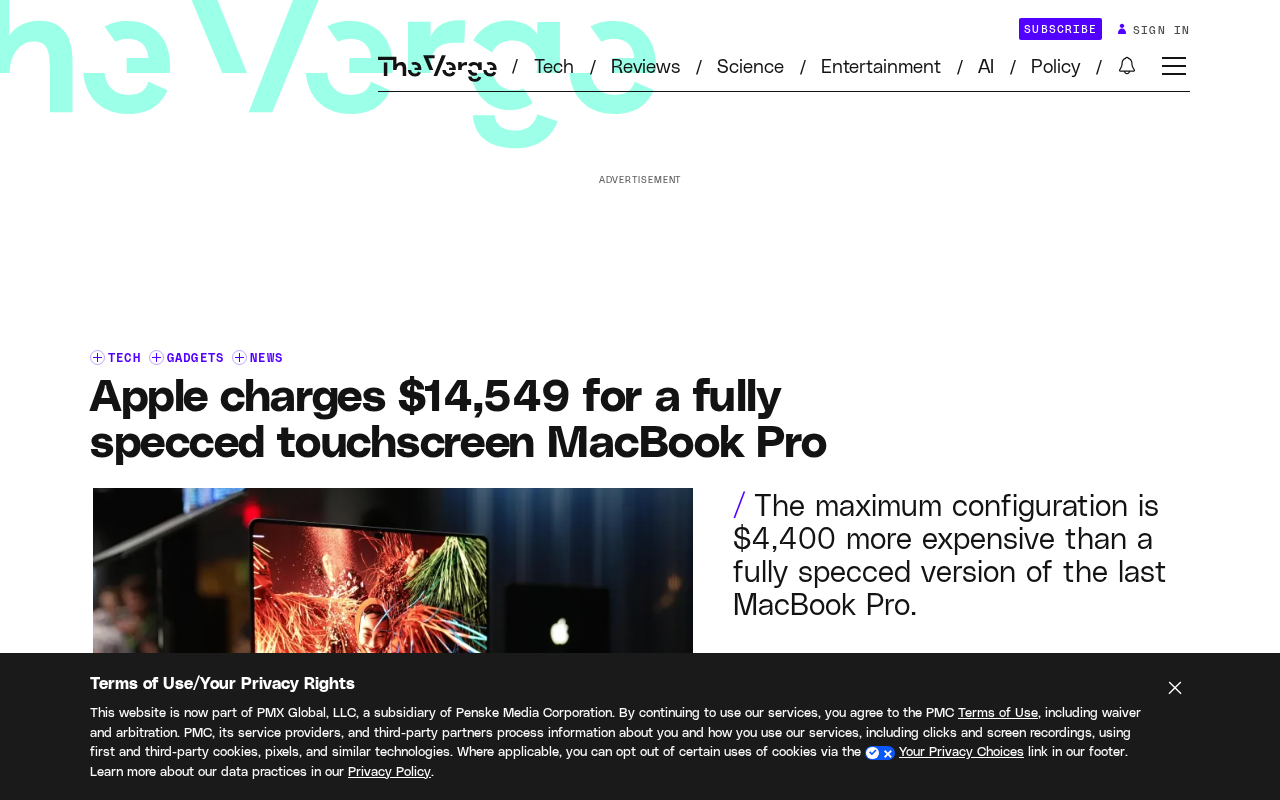
Apple's new touchscreen OLED MacBook Pro is priced at $14,549 for the top configuration, starting at $2,899 for the base model, with the price hike drawing market attention.
Apple's latest MacBook Pro lineup has seen a significant price increase due to the addition of OLED displays and touch functionality. The 14-inch base model starts at $2,899, the 16-inch at $3,399, and upgrading all hardware options to the max configuration brings the price up to $14,549, far exceeding models from earlier this year. The article analyzes the pricing structure, noting that the cumulative cost of options such as storage, memory, and screen coating is extremely high, continuing Apple's pricing strategy of "affordable base models, luxurious top-end configurations." OLED and touch indeed bring experience upgrades, but they also raise questions about the premium, as touchscreen laptops in the Windows camp are generally lower priced. For professional users, the top-end price is enough to buy multiple high-spec Windows workstations or a mid-range car, which may prompt some users to turn to third-party external solutions or wait for refurbished models. Whether the market can accept this strategy still needs to be observed through sales data and user feedback.
Apple's newly released MacBook Pro lineup has seen a significant price hike due to the addition of OLED displays and touchscreen functionality. According to an RSS source, the 14-inch base model starts at $2,899, the 16-inch base model starts at $3,399, and upgrading all hardware options to the max configuration brings the price up to $14,549. This price far exceeds the MacBook Pro models released earlier this year, highlighting Apple's pricing strategy for high-end hardware.
Pricing Structure and Upgrade Options
The new MacBook Pro's base configurations are already more expensive than previous generations, with the 14-inch and 16-inch models each rising by several hundred dollars. But the real price leap comes from stacking every premium hardware option. Although the original source did not list all upgrade items one by one, the gap between the top-end price of $14,549 and the base price of $2,899 shows that the cumulative cost of options such as storage, memory, and screen coating is extremely high. This pricing model continues Apple's long-standing strategy of "affordable base models, luxurious top-end configurations," but the addition of touchscreen and OLED has pushed the top-end threshold to a new level.
According to the RSS source's analysis, this price increase is not unexpected, as the rise in material costs brought by OLED display panels and touch layers is an industry consensus. Nevertheless, the absolute price of $14,549 still puts pressure on many professional users.
OLED and Touchscreen: Experience Upgrade or Premium Excuse?
OLED screens outperform traditional LCDs in contrast, response speed, and energy efficiency, while touch functionality brings an iPad-like interaction style to the Mac. These two upgrades do enhance the product's use cases, especially for creative professionals and users who need handwriting input. However, some argue that Apple's introduction of touchscreens to the MacBook Pro is testing the market's acceptance of high-priced features.
From an industry perspective, touchscreen laptops in the Windows camp have long been widespread, but their price ranges are generally lower. Leveraging its ecosystem advantages and brand premium, Apple positions the touchscreen MacBook Pro as an ultra-high-end product, which may further widen the price gap with competitors.
OLED (organic light-emitting diode) and LCD differ fundamentally in that OLED pixels emit their own light: each pixel switches independently without needing a backlight layer, enabling near-infinite contrast, faster response times (typically under 1 millisecond), and lower power consumption. However, OLED has burn-in risks and lifespan degradation issues on large panels. Apple's use of a tandem OLED structure on the MacBook Pro is precisely to improve brightness and durability, which directly drives up panel costs. As for the touch layer, adding touch to a laptop screen requires additional sensor films and glass layers, slightly increasing thickness and weight while affecting screen transmittance. Apple needs to balance display quality and touch sensitivity.
From a cost structure perspective, the per-unit-area cost of OLED panels is still significantly higher than Mini-LED or LCD of the same specifications. Combined with the touch module and driver IC, the material cost of the entire screen assembly may be several hundred dollars higher than the previous generation, which is one of the direct reasons for the several-hundred-dollar increase in the base model's starting price.
Impact on Professional Users and the Market
For professional users in video editing, 3D rendering, and music production, the performance and screen quality of the top-end MacBook Pro are attractive, but the price of $14,549 is enough to buy multiple high-spec Windows workstations or a mid-range car. This may lead some users to turn to third-party external solutions such as Blackmagic Design, or to wait for refurbished models.
On the other hand, Apple may lower the purchase threshold through installment payments and education discounts, but the target customers for the top-end model remain well-funded enterprises and high-end creators. Market reaction will depend on whether the actual performance gains justify the price increase.
Blackmagic Design is a company known for professional video hardware and software, with a product line that includes DaVinci Resolve color grading software, ATEM switchers, UltraStudio external capture boxes, and eGPU solutions. The mention of "turning to third-party external solutions such as Blackmagic Design" refers to professional users possibly no longer buying top-end all-in-one machines, but instead using a lower-cost MacBook Pro paired with external capture/acceleration hardware to handle high-load work. The advantage of such solutions is that they can be upgraded as needed and reused across machines; the disadvantage is reduced portability and the need for additional power and cooling. For video editing and color grading users, external I/O devices can also provide more professional interfaces and monitoring outputs, so "external solutions replacing top-end configurations" is indeed a realistic path in professional workflows.
Conclusion
Apple's new touchscreen MacBook Pro sets a new upper limit for laptop pricing with its $14,549 top-end price. OLED and touch are the main selling points and the core factors behind the price increase. The base model starts at $2,899, but users who want the full experience must pay several times the premium. Whether this strategy will be accepted by the market remains to be seen through subsequent sales data and user feedback.
Related articles

Microsoft Fabric Database Agent in Action: From Reactive Firefighting to Intelligent Detective
A deep dive into the Microsoft Fabric Database Agent: how to enable it, supported monitoring scenarios, a blocking-issue demo, and the roadmap from reactive to autonomous operations.

Zendesk Uses ChatGPT Enterprise to Build a Sales Agent with 1,000 Daily Active Users
Zendesk opened ChatGPT Enterprise to all employees, who built about 600 apps themselves, including a sales expansion agent with about 1,000 daily active users. This article analyzes how it turns internal data into sales opportunities and its "don't wait" implementation strategy.

Google Releases Gemini 4 Carbon: Its Strongest Model Yet, Debuting with a Cybersecurity Focus
Google releases Gemini 4 Carbon, calling it its strongest model, with a cybersecurity focus. It tops the third-party composite ranking at 59 points but leads by only one or two. This article analyzes its security test results, staged rollout, token pricing, and the divergence between self-reported and third-party tests on hallucinations.