AROMA: Solving the Causal Control Challenge in Vision-Language Models

AROMA decomposes VLM control into five independent subproblems—localization, actuation, reachability, target, and deployment—achieving stable gains with few edits.
The paper notes that in VLM interpretability research, mechanistic localization is not equivalent to effective control: causal sensitivity may account for only a tiny fraction of activation energy (e.g., 89.82% sensitivity vs. 9.52% energy), causing traditional local interventions to fail. AROMA decomposes control into five dimensions: where to intervene, geometry and gain, how to reach the target, which target to pursue, and when to act. Via magnitude-normalized causal subspace actuation and Iterative Minimal-Effort Actuation (MEA), MEA reaches 81.25% of the oracle target under matched steps, far above the 15.18% of a frozen direction. Under a strict frozen protocol, editing only 63 inputs raises overall accuracy from 65.153% to 65.741%, demonstrating selective deployment's potential.
Research into the internal mechanisms of vision-language models (VLMs) often runs into an awkward situation: even precisely locating the key attention heads does not mean you can effectively control model behavior. A paper titled AROMA: Adaptive Representation-Oriented Multimodal Actuation for Vision-Language Model Control confronts this contradiction head-on, proposing a framework that completely separates "localization" from "control."
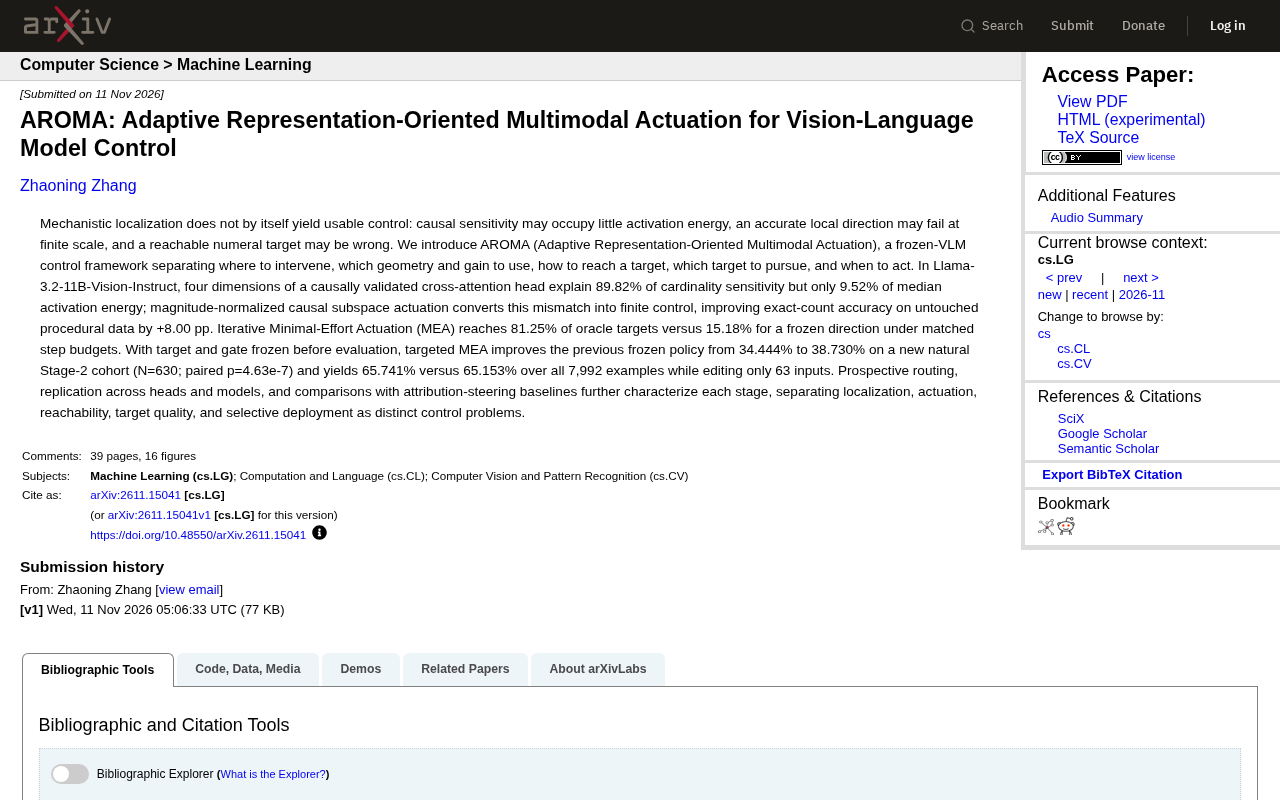
Localization Is Not Control: The Mismatch Between Causal Sensitivity and Activation Energy
The paper opens by pointing out a core observation: "localization" in mechanistic interpretability does not by itself produce usable control. There are three reasons—causal sensitivity may occupy only a tiny fraction of activation energy; an accurate local direction may fail at limited scale; and a reachable numerical target may be the wrong one.
Experiments on Llama-3.2-11B-Vision-Instruct quantify this mismatch: four dimensions of a causally validated cross-attention head can explain 89.82% of cardinality sensitivity, yet account for only 9.52% of median activation energy. This means the model's sensitive response to "quantity" is highly concentrated, but the energy driving that response is extremely dispersed. This mismatch directly causes traditional intervention methods based on local directions to fail at limited scale.
Causal sensitivity refers to the degree of causal influence of a certain internal dimension (such as a direction in an attention head) on output behavior, as measured through intervention experiments. A common approach is activation patching: replacing the activation value of that dimension with a counterfactual value and observing changes in output probabilities. Activation energy refers to the actual activation magnitude of that dimension during natural forward propagation (e.g., L2 norm). A mismatch between the two means that even if a dimension is highly sensitive to behavior, its everyday activation energy may be very small, so interventions based on that direction require an extremely large gain to take effect—and a large gain in turn disrupts other representations. The 89.82% versus 9.52% comparison in the paper is precisely a quantification of this phenomenon.
The AROMA Framework: Decomposing Control into Five Dimensions
AROMA decomposes VLM control into five independent problems: where to intervene (where), which geometry and gain to use (which geometry and gain), how to reach the target (how), which target to pursue (which target), and when to act (when).
To address the energy mismatch, AROMA employs magnitude-normalized causal subspace actuation, turning the mismatch into bounded control. On process data that was left untouched, this method improved exact counting accuracy by 8.00 percentage points.
Another key technique is Iterative Minimal-Effort Actuation (MEA). Under a matched step budget, MEA can reach 81.25% of the oracle target, whereas a frozen direction reaches only 15.18%. This reveals that "reachability" is itself a challenge independent of localization quality.
Magnitude-normalized causal subspace actuation: Traditional interventions often add a fixed step directly along the causal direction, but if the activation energy in that direction is small, a fixed step is either ineffective or overshoots. Magnitude normalization first projects the activation onto the causal subspace, then scales according to the magnitude of the current activation, so that the intervention amount matches the actual energy distribution and effective control can be achieved under limited gain. Iterative Minimal-Effort Actuation (MEA) treats reaching the target as an optimization problem: at each step it selects the minimum-norm update direction and iteratively approaches the target activation state, rather than making a one-shot jump along a frozen direction. This allows MEA to get closer to the oracle target under the same step budget, because each step re-adjusts the direction based on the current state.
Target Quality and Selective Deployment: Edit Less, Improve More
Under a strict evaluation protocol in which both the target and the gate are frozen in advance, targeted MEA on a brand-new natural Stage-2 cohort (N=630) raised the accuracy of the previously frozen policy from 34.444% to 38.730% (paired p=4.63e-7). Across all 7,992 samples, editing only 63 inputs raised accuracy from 65.153% to 65.741%.
The key to this set of numbers is "selective deployment": rather than intervening on every input, edit only a very small number of samples when necessary. The paper further systematically characterizes the independent properties of the five stages—localization, actuation, reachability, target quality, and selective deployment—through prospective routing, reproduction across attention heads and across models, and comparison with attribution-guided baselines.
The core of selective deployment is learning a gating function that determines whether the current input requires intervention. The paper adopts prospective routing: predicting in advance during generation whether an intervention will bring benefit, and performing edits only on samples predicted to be positive. This differs from post-hoc filtering because the routing decision is based on the internal state before intervention. Paired p-values (such as p=4.63e-7) come from a paired test of accuracy before and after intervention on the same batch of samples, used to rule out interference from differences in sample difficulty. Editing only 63 of 7,992 samples yields an overall improvement, indicating that most inputs require no intervention and that selective deployment can reduce side effects and improve system stability.
Implications for VLM Interpretability and Control Research
AROMA's contribution is not another intervention trick, but rather decomposing the gap between "mechanistic localization" and "behavioral control" into subproblems that can be optimized separately. The mismatch data of 89.82% versus 9.52% shows that the concentration of causal sensitivity and the distribution of activation energy are not aligned, which explains why many localization-based intervention methods perform unstably in real scenarios.
The combination of magnitude normalization and iterative MEA shows that actuating a causal direction requires considering both geometric scale and stepping strategy. And the small number of edits and stable improvements brought by selective deployment suggest that the design focus of future VLM control systems may shift from "how to intervene" to "when to intervene."
The paper also leaves open questions: the breadth of cross-model reproduction, the generalization boundaries of routing strategies, and the performance of target-quality evaluation on more complex tasks all require further verification. But at the very least, AROMA provides a clear decomposition framework for fine-grained control of VLMs, so that localization, actuation, and deployment are no longer conflated.
One-line Summary
AROMA decomposes VLM control into five independent subproblems—localization, actuation, reachability, target, and deployment—achieving stable improvements with few edits.
Paragraph Summary
The paper points out that in interpretability research on vision-language models, mechanistic localization is not equivalent to effective control: causal sensitivity may account for only a tiny fraction of activation energy (e.g., 89.82% sensitivity corresponding to 9.52% energy), causing traditional local interventions to fail. The AROMA framework decomposes the control problem into five dimensions: where to intervene, geometry and gain, how to reach the target, which target to pursue, and when to act. Through magnitude-normalized causal subspace actuation and Iterative Minimal-Effort Actuation (MEA), MEA reaches 81.25% of the oracle target under a matched step budget, far exceeding the 15.18% of a frozen direction. Under a strict frozen protocol, editing only 63 inputs raises overall accuracy from 65.153% to 65.741%, demonstrating the potential of selective deployment.
Related articles

Programmers in the AI Era: How Deep Should You Learn Legacy Tech?
How should programmers transform under AI's impact? How deep should legacy tech be learned? Drawing on a Bilibili creator's share, this breaks down the levels of embracing AI, the shift from process-driven to project-driven learning, and how lower technical barriers affect junior and mid-level roles.

OpenAI Releases GPT-6.2 Dual Models Astra and Sol, API Price Cut by 20%
OpenAI releases GPT-6.2 Astra and Sol, with Astra's API price cut 20% to $8/$40 per million tokens and ranking second on the Artificial Analysis Intelligence Index. This article analyzes the dual-model strategy, price-cut impact, and developer selection advice.

Perplexity Computer Launches Multiagent: 16 AI Agents Cross-Validate Each Other
Perplexity launches Multiagent mode for Computer: a lead agent orchestrates up to 16 sub-agents on Claude, GPT, and Gemini, sharing findings and cross-validating work with effort above Ultra.