Backyard Iron Dome: DIY Animal Deterrent Turret Goes Viral
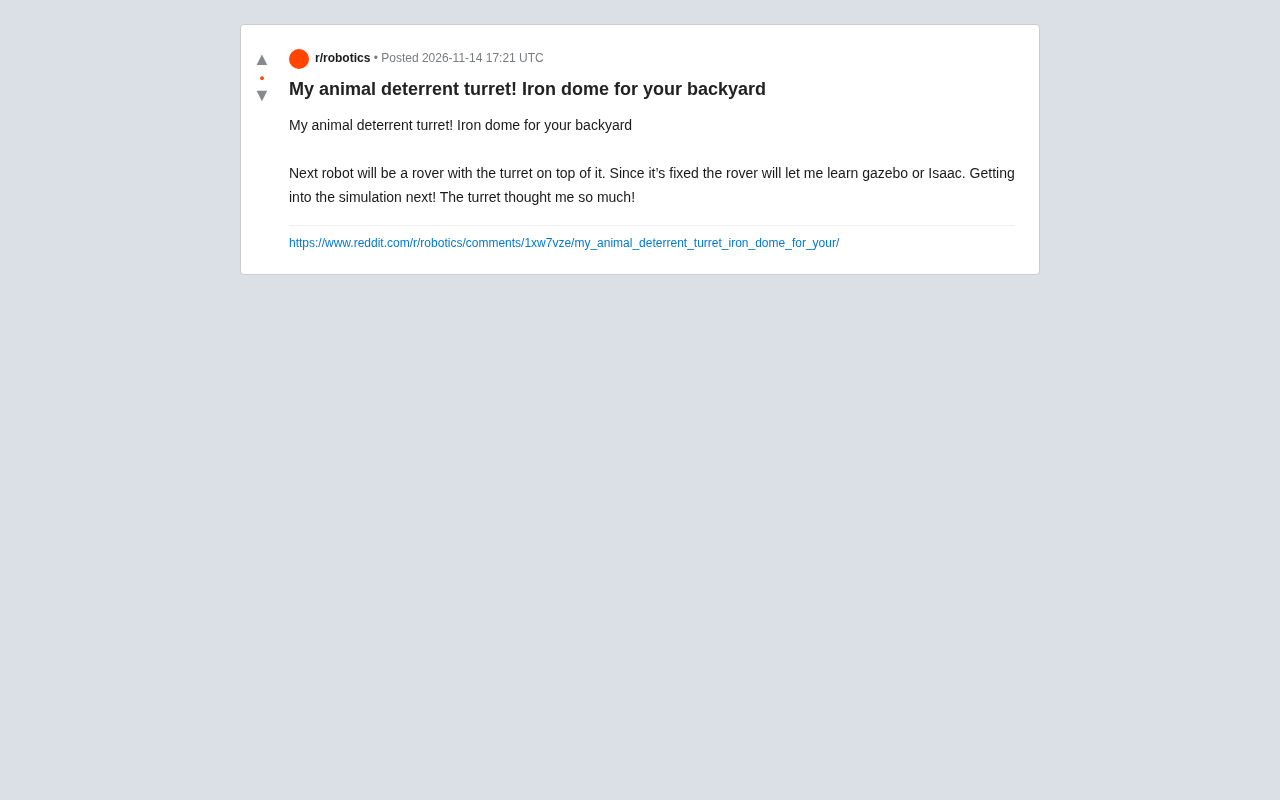
A Reddit maker's fixed animal deterrent turret unexpectedly opens the path to robot simulation; next step is mounting the turret on a rover.
A Reddit maker shared his fixed animal deterrent turret, jokingly called the "backyard Iron Dome." The project taught him system integration and revealed the need to learn simulation for a mobile platform. He plans a rover with a turret on top to learn Gazebo or Isaac. The article analyzes this typical maker path from prototype to simulation, noting mobile platforms involve localization and navigation, and that validating logic in simulation first is pragmatic. The project's "deterrent" framing reflects DIY ethical considerations, showing a growth model driven by small needs.
A maker on Reddit has shared his latest creation—a turret that automatically drives away animals, which he jokingly calls his "backyard Iron Dome." The project not only showcases the fun of hardware DIY but also unexpectedly became the author's springboard into the world of robot simulation.
From Fixed Turret to Mobile Rover
In the post, the author reveals that this animal deterrent turret is a fixed installation, but the next robot will be a rover with a turret mounted on top. The reason for switching to a mobile platform is that the fixed turret made him realize he needs to learn simulation tools: "Since it's fixed the rover will let me learn gazebo or Isaac. Getting into the simulation next!"
This shift is interesting: what seems like a simple backyard anti-animal device has actually become the author's entry point into robot operating systems and simulation environments. Gazebo and Isaac are both commonly used simulation platforms in robotics—the former has a long history and a large community, while the latter has developed rapidly in recent years backed by NVIDIA's ecosystem. The author didn't specify which one he'll choose, but made it clear that "simulation is next."
Gazebo is an open-source robot simulation platform, originally developed by the University of Southern California and now maintained by Open Robotics. It can simulate robot dynamics, sensors (such as LiDAR, cameras, IMUs), and environmental physics, and integrates deeply with ROS (Robot Operating System). Gazebo's strengths lie in its large community and abundant tutorials, making it suitable for learning ROS and validating mobile robot algorithms. Isaac refers to NVIDIA's Isaac robotics platform, which includes Isaac Sim (a high-fidelity simulator based on Omniverse) and Isaac ROS components. It leverages GPU acceleration and excels in perception simulation, synthetic data generation, and AI training, but has higher hardware requirements (requires an NVIDIA RTX graphics card). The two have different positioning: Gazebo leans toward general teaching and research, while Isaac is more oriented toward AI-driven robot development. The author's mention of "learning Gazebo or Isaac" reflects the trade-off between ecosystem and hardware when choosing simulation tools.
What the Turret Taught Him
"The turret thought me so much!"—the author used this sentence to summarize what he gained from the project. Although he didn't list what he learned item by item, from the nature of the project it can be inferred that such devices typically involve sensor triggering, servo control, target recognition, or simple motion detection. For a maker wanting to advance in robot development, getting these modules to work together end-to-end is itself a complete system integration exercise.
One detail: the author positions the turret as an "animal deterrent" rather than "animal harm," which means the design more likely uses non-contact deterrence methods such as sound, light, or water streams. This ethical boundary is often discussed in DIY projects, and the author's use of the word "deterrent" shows his stance.
Animal deterrent in DIY projects typically refers to using non-contact, non-harmful methods to drive away animals, with common approaches including ultrasound, flashing bright lights, water spraying, sound alarms, or motion-triggered air bursts. Such designs need to balance effectiveness, animal welfare, and false trigger rates. For example, ultrasonic deterrents are effective on some animals but may affect pets or cause neighbor complaints; water spray devices are limited by water pressure and temperature. The author's explicit use of "deterrent" rather than "harm" reflects the maker community's attention to ethical boundaries. In actual implementation, the turret might combine PIR sensors or cameras to identify targets, then trigger servos to aim and activate the deterrent module. This "perception-decision-execution" loop is exactly the foundational exercise of robot system integration, which also explains why the author says "the turret taught me so much."
Why the "Backyard Iron Dome" Resonates
Part of why this post is appealing is the "Iron Dome" metaphor—it juxtaposes a household-level animal deterrent device with a national-level air defense system, creating strong comedic contrast. But jokes aside, it touches on a real need: how to protect your backyard garden, lawn, or vegetable patch without wanting to harm animals.
There are quite a few commercial animal deterrent products on the market, but DIY solutions have the advantage of customizability. The author didn't elaborate on the turret's specific hardware configuration and recognition logic, making the post more of a progress share than a tutorial. However, the comment section usually becomes the second stage for such posts, where other makers ask about sensor models, code frameworks, and false trigger rates.
Maker Advancement Paths Through Project Sharing
The value of this post isn't in how much technical detail it provides, but in demonstrating a typical maker advancement path: starting from a specific small need (deterring animals), building a working prototype (fixed turret), discovering a capability gap during the process (needing simulation to validate a mobile platform), and then proactively filling that gap (learning Gazebo or Isaac).
The author explicitly says "Next robot will be a rover with the turret on top of it," indicating he already has a clear iteration plan. Moving the turret from a fixed base to a mobile platform multiplies the challenges: localization, navigation, dynamic target tracking, power management, and so on. This also explains why he needs simulation—debugging mobile robots in real environments is too costly, so getting the logic working in Gazebo or Isaac first is the more pragmatic approach.
For readers who also want to get started with robot simulation, this post sends a direct message: build even a crude physical project first, then learn simulation with specific problems in mind when you hit a bottleneck—this is easier to stick with than diving straight into simulation tutorials. The author's line "The turret thought me so much" probably means exactly that.
Mobile robot simulation's core value lies in low-cost validation of complex logic. Moving the turret from a fixed base to a rover introduces problems such as localization (e.g., SLAM), path planning, dynamic target tracking, and power management. Debugging these functions in real environments is not only time-consuming but may also damage hardware through collisions. Simulation platforms allow makers to repeatedly test algorithms, adjust parameters, and safely simulate sensor noise and unexpected situations in a virtual environment. Gazebo provides standard ROS interfaces and various robot models, suitable for beginners to quickly set up scenarios; Isaac Sim can generate realistic synthetic data for training vision models. For makers transitioning from fixed projects to mobile platforms, the path of simulation first, hardware later can significantly reduce trial-and-error costs. The author's plan that "simulation is next" follows exactly this pragmatic strategy.
One-line Summary
A Reddit maker's fixed animal deterrent turret unexpectedly opened the path to learning robot simulation, with the next step being mounting the turret on a rover.
Paragraph Summary
A maker on Reddit shared his fixed animal deterrent turret, jokingly called the "backyard Iron Dome." The project taught him a lot about system integration and made him realize he needs to learn simulation tools to develop a mobile platform. He plans for his next robot to be a rover with a turret on top, using it to learn the Gazebo or Isaac simulation environment. The article analyzes the typical maker advancement path from physical prototype to simulation, noting that mobile platforms involve more complex problems like localization and navigation, and that validating logic in simulation first is the pragmatic approach. The project is positioned as "deterrence" rather than harming animals, reflecting the DIY community's ethical considerations. Although the post lacks technical details, it demonstrates a growth model driven by small needs and filling knowledge gaps when hitting bottlenecks.
Related articles
Gemini 4 Neon Hands-On: Value King or Confident Catastrophe?
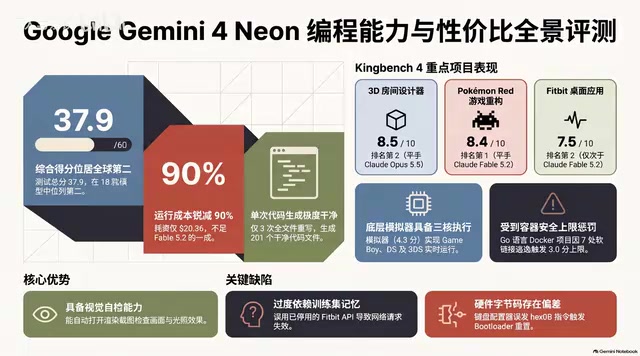
Gemini 4 Neon review: 1M-token context, four thinking levels, 201 files in one KingBench4 pass at one-tenth Fable 5.2's cost—but it hallucinates fake data, leaves 7 symlink escapes, and bricks keyboards.

Google Gemini 4 Neon Hands-On: 6 3D Works That Impress and Fail
Hands-on with Google Gemini 4 Neon on a 3060 laptop: 6 3D works tested. Sunshower Fishing Harbor and mechanical keyboard impress; soft-body physics and faces fall short.

Gemini 4 Neo Web Novel Writing Test: Faint AI Flavor, Textured Dialogue
Bilibili creator's first-look review of Gemini 4 Neo for Chinese web novel writing: testing a Three Kingdoms transmigration opening with faint AI flavor, emotionally textured dialogue, and strong crisis building, plus comparison of 4A/4H/4C models and full workflow demos.