Gemini 4 Neo Web Novel Writing Test: Faint AI Flavor, Textured Dialogue

Gemini 4 Neo web novel test: faint AI flavor and textured dialogue, but 4H wins the creator's favor.
A Bilibili creator's first-look review of Gemini 4 Neo in Chinese web novel writing. The article compares four models in the Gemini 4 series (4A, 4N, 4H, 4C), noting version iteration doesn't guarantee better writing, and the creator prefers 4H's prose. Testing the "Golden Opening Generator" for a Three Kingdoms transmigration opening, the model accurately lands pre-built settings with strong crisis building and textured dialogue, patching historical detail holes. The creator rates Gemini 4's faint AI flavor and pacing above Claude, GPT, and Kimi, but stresses this is subjective. Post-generation, text supports review, correction, de-tracing, and outline-based continuation.
Gemini 4 Neo Web Novel Writing Test: Faint AI Flavor, Textured Dialogue
The Gemini 4 family has a new member. A Bilibili creator did a first-look review of the newly launched Gemini 4 Neo, putting it through a real-world web novel writing scenario. This model sits between 4 Carbon and 4 Hydrogen, and while the company doesn't market it as a "writing-specialized version," hands-on testing shows it still carries the series' consistent strengths in Chinese web novel creation.
How to Choose Among Four Models: Neo Isn't the Only Answer
According to the creator, the Gemini 4 series now includes four different models: 4A, 4N (Neo), 4H, and 4C. One easy misconception is that version iterations necessarily bring improvements in text creation capability. The creator states clearly that for web novel writing, 4H is actually the model that best matches his subjective preference among the four, and the gap between 4N and 4A/4C is "not particularly large." This isn't to say Neo is weak—it's that in a horizontal comparison within the same series, 4H's prose style appeals to him more.
This judgment is clearly subjective, and the creator suggests viewers try their own ideas in the "Brainstorm Generator" or "Golden Opening Generator" with each model to see which fits their expectations better. In other words, there's no standard answer for model selection—it's highly correlated with a creator's genre preferences and sense of language.

The model codenames in the Gemini 4 series (4A, 4N, 4H, 4C) are not official product line names, but rather internal shorthand formed by the community or early testers based on differences in model versions, parameter scales, or training focus. From context, 4H and 4C likely correspond to "Hydrogen" and "Carbon" respectively, while 4N (Neo) and 4A are other variants in the same generation. This codename system is common in the AI community during leaked or informal release stages. Users should note that different codenames may correspond to different context windows, inference speeds, and generation style preferences—not simply "the higher the version number, the stronger."
Hands-On Test: From Pre-built Framework to Three Kingdoms Transmigration Opening
The review follows the "Golden Opening Generator" workflow. The creator set up a historical brainstorm story: protagonist Chu Nan, reincarnated into the Three Kingdoms era, awakens a system entry called "Deprivation," but it only works on female generals; inspiration comes from a transmigrator encountering life-threatening danger amid revelry and awakening the system in crisis; pacing requirements are faster, with dialogue and strong conflict in the opening. Additional information fields can hold more specific ideas, and the associated knowledge base can mount work outlines, detailed outlines, worldbuilding, or even search and link Three Kingdoms reference cards to make generation strictly fit the historical content of the background period. This test made no associations whatsoever—purely testing the model's raw writing ability.
In terms of generation speed, 4N is somewhat slower than the other 4-series versions, but it's moderate—not something that keeps you waiting long.
The "Golden Opening Generator" is a structured prompt template among web novel creation assistance tools. It typically requires authors to fill in fields such as protagonist setup, golden finger (system/entry), opening conflict, and pacing requirements, then hands it to a large model to generate the opening chapter. Its design logic stems from the web novel industry's "Golden Three Chapters" rule—the first three chapters must establish character setup, trigger conflict, and create suspense hooks to retain readers. Such generators lower the barrier to prompt writing through pre-built frameworks, enabling non-technical authors to obtain stable and usable output. However, generation quality still depends heavily on the model's depth of understanding of Chinese web novel corpora.
Text Quality: Faint AI Flavor Is the Core Competitiveness
As soon as the main text comes out, the opening is "Chu Nan, any last words?"—the creator casually demonstrates that such adjectives can be manually deleted. Then Chu Nan opens his eyes, still hungover, his gaze colliding with a face full of killing intent. He discovers the other party is Lü Bu's only daughter, looks down to see he was drinking at the Drunken Immortal Pavilion yesterday, surrounded by several black-armored Bingzhou soldiers. The sense of crisis is built quite thoroughly and accurately lands the settings from the pre-built framework.
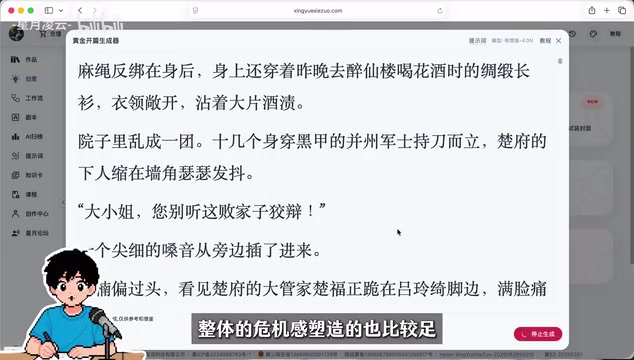
The creator rates this part highly: the historical fiction writing style and the character texture in dialogue are things he, by his own admission as a history novice, couldn't write—but AI can catch the inspiration in his head and even patch up common holes in historical fiction, contextual conflicts, or historically inaccurate issues. The system's appearance timing also hits the mark—just as everyone is discussing and nearly being executed, conditions trigger. There aren't many female general entries, the system only works on female generals, and the presentation of character entry lists also fits the current web novel system.

Overall, the creator believes the Gemini 4 series remains the best choice among all model series for text content like web novels, with comprehensive capability greater than various domestic models including Claude, GPT, and Kimi. His specific basis has three points: AI flavor is basically very faint, character dialogue has emotional texture, and plot pacing control is excellent. It should be noted that this is a single creator's subjective experience under specific prompts and genres, not a rigorous horizontal review—readers should treat it as reference rather than conclusion.
After Generation: Review, Correction, and Outline-Based Continuation
Generation isn't the endpoint. Text can be imported into the work interface for review, correction, de-tracing, and other operations, and also supports outline-based continuation—which the creator sees as a fairly mainstream usage: associate all the polished golden three chapters, then provide subsequent direction, or directly let the model derive based on preceding text. In testing, the model outputs panel-style derivations and gives ten-operation optimization suggestions. You can optimize the outline yourself based on suggestions, then look at the direction of chapters two and three, such as chapter hooks like "the female general weakens and loses composure, the Marquis urgently summons her to the manor." The creator believes the results directly generated from outline-based continuation are already usable—even just taking the outline and writing it yourself would work fine.
For authors who want to use AI to turn brainstorm ideas into serialized works, this "opening generation—manual refinement—outline-based continuation" pipeline may be more practically meaningful than simply comparing model scores.
"Outline-based continuation" is a workflow in web novel creation: first break existing chapters into detailed outlines or plot nodes, then let the model derive subsequent developments based on these nodes. Compared to direct continuation, outline-based continuation better controls plot direction, avoiding character breakdown or logical breaks caused by the model's free improvisation. In testing, the model's "panel-style derivations" typically present chapter hooks, character state changes, and conflict escalation paths in table or bullet-point form, allowing authors to quickly judge whether subsequent pacing is reasonable and then decide whether to adopt or manually adjust.
One-line Summary
Gemini 4 Neo web novel writing test: faint AI flavor, textured dialogue, but 4H is preferred.
Paragraph Summary
A Bilibili creator's first-look review of Gemini 4 Neo's performance in Chinese web novel writing. The article compares the four models in the Gemini 4 series (4A, 4N, 4H, 4C), noting that version iteration doesn't necessarily mean improved writing capability, and the creator subjectively prefers 4H's prose. The test uses the "Golden Opening Generator" to create a Three Kingdoms transmigration historical fiction opening—the model accurately lands pre-built settings, thoroughly builds crisis, delivers strong dialogue character texture, and patches historical detail holes. The creator believes the Gemini 4 series has faint AI flavor, excellent pacing control, and comprehensive capability superior to Claude, GPT, Kimi, and other models, but emphasizes this is a single-source subjective experience. After generation, text can be imported into the work interface for review, correction, de-tracing, and outline-based continuation, forming a complete creation pipeline.
Related articles
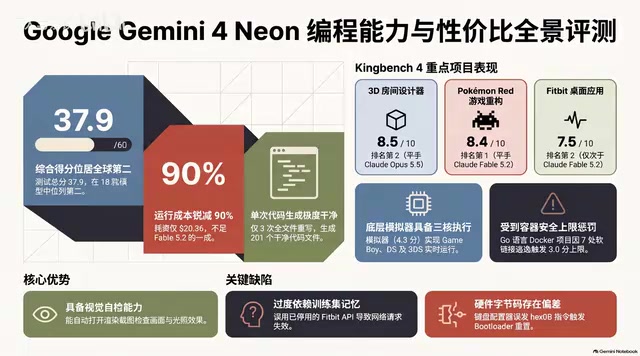
Gemini 4 Neon Hands-On: Value King or Confident Catastrophe?
Gemini 4 Neon review: 1M-token context, four thinking levels, 201 files in one KingBench4 pass at one-tenth Fable 5.2's cost—but it hallucinates fake data, leaves 7 symlink escapes, and bricks keyboards.

Google Gemini 4 Neon Hands-On: 6 3D Works That Impress and Fail
Hands-on with Google Gemini 4 Neon on a 3060 laptop: 6 3D works tested. Sunshower Fishing Harbor and mechanical keyboard impress; soft-body physics and faces fall short.

Gemini 4 Neon Released, Anthropic IPO Priced at $83 in Focus
Google releases Gemini 4 Neon on its API and Anthropic prices its IPO at $83 on Nasdaq. This AI daily roundup covers OpenAI agent data, Tencent and SenseTime updates, and open-source model safety benchmarks.