Gemini 4 Neon Released, Anthropic IPO Priced at $83 in Focus

Gemini 4 Neon launches and Anthropic prices a high-profile IPO as the foundation model race enters commercialization's deep waters.
This AI daily roundup covers key developments: Google released Gemini 4 Neon, ranked third on the intelligence index, priced at $3 per million input tokens and $15 per million output tokens, with a possible new name "Cobalt" appearing in code; Anthropic priced its IPO at $83 per share, above the $70–78 expected range, trading on Nasdaq the next day. OpenAI disclosed that agents completed 46% of 2-to-4-hour tasks with zero human involvement, nearly double March's 23%, called for public RSI reporting, and announced up to 14% PPA improvement on GPU IP from its AMD partnership. Domestically, Tencent's Hunyuan 4Flash surpassed 50T tokens on day one, and SenseTime open-sourced the 9B multimodal model SenseNova Loop 9B. On security, the Promptama benchmark showed an average hidden-instruction attack success rate of 34.9%.
1. Google Releases Gemini 4 Neon, Pricing Strategy Emerges
According to Bilibili's AI Daily, Google has officially released Gemini 4 Neon, simultaneously launching it on the Gemini API and AI Studio. Official intelligence index rankings show the model in third place, with Wales in second. On pricing: $3 per million input tokens and $15 per million output tokens.
This price range sits at the mid-to-upper level of the current flagship model market, reflecting Google's confidence in Neon's performance positioning. Combined with the Gemini series' prior footprint in the developer ecosystem, Neon's launch signals Google is accelerating the push of its latest model capabilities to API users.
One detail worth noting: leaks suggest a new name "Cobalt" appears alongside Gemini 4 Neon's code, specifically in Google AI Studio's codebase. It remains unclear whether this is another new model, and the claim has not been officially confirmed. If Cobalt does exist, it may hint that Google is preparing a multi-model parallel product matrix.
2. Anthropic IPO Priced at $83, Debuts on Nasdaq
Anthropic has priced its IPO at $83 per share, with trading on Nasdaq beginning the following day, offering a total of 980 million Class A common shares. The previously expected range was $70 to $78, and the final pricing came in above the upper bound, demonstrating strong capital market interest in Anthropic.
This IPO pricing carries bellwether significance for the AI industry. As one of OpenAI's main competitors, Anthropic's public market performance will directly influence how the market judges the valuation logic of foundation model companies. Pricing above the expected range partly confirms investor confidence in the commercialization prospects of leading AI labs.
3. OpenAI Releases a Dense Wave of Research and Partnership Signals
OpenAI published a new set of data on how AI is changing research methods: agents completed 46% of 2-to-4-hour tasks with zero human involvement, up from 23% in March. The task completion rate nearly doubled within a few months, showing that agent autonomy on medium-duration tasks is rising rapidly.
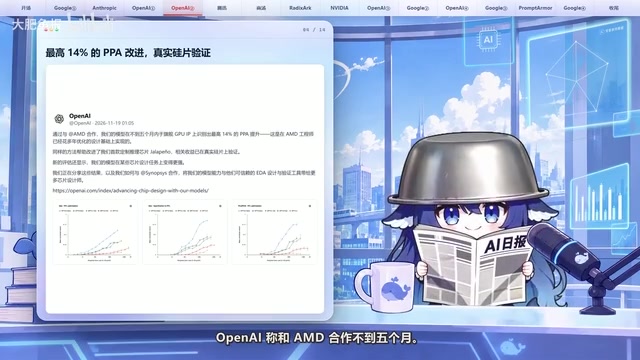
OpenAI also advocates that labs should publicly report RSI metrics, a call that touches on AI R&D transparency and industry standard-setting. In addition, OpenAI revealed that in under 5 months of collaboration with AMD, models found up to 14% PPA improvement on flagship GPU IP; the same method applied to its in-house inference chip Jalapail has been validated in real tape-out.
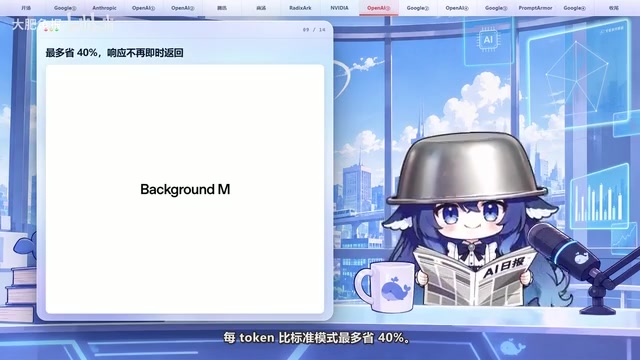
At the API level, OpenAI added a background mode to the Responses API, where the first response can be set to 2 hours or 8 hours, saving up to 40% per token compared with standard mode, at the cost of no longer returning responses promptly.
ChatGPT also launched an Accounting plugin, integrating with 7 financial software products including QuickBooks and Xero, for month-end reporting, bank reconciliation, data entry, and audit preparation. Official pricing has not been disclosed.
PPA (Power, Performance, Area) is a classic three-dimensional metric in chip design for measuring optimization gains: under the same process, lower power, higher frequency, and smaller area for the same function constitute improvement. Finding up to 14% PPA improvement on flagship GPU IP typically means using model-assisted circuit or microarchitecture exploration to find a better configuration point under given constraints, rather than directly changing the process node. Migrating the same method to the in-house inference chip Jalapail and validating it through real tape-out means this optimization has moved from simulation to manufacturable silicon, which has practical significance for lowering inference costs.
4. Domestic Players: Tencent and SenseTime
Tencent disclosed Q3 AI data: Hunyuan 4Flash surpassed 50T tokens consumed on its first day, WorkBuddy exceeded 10 million daily active users with 100T tokens consumed daily, and Tencent Cloud revenue growth accelerated to 35%. These figures reflect Tencent's scale effects in model invocation volume and application-side activity.
SenseTime open-sourced the 9B multimodal model SenseNova Loop 9B, using a Loop mechanism to make 32 layers achieve the effect of an equivalent 56 layers. On benchmarks, AutomationBench rose from 14.33 to 36.67 and Gaia from 37.86 to 69.90—significant gains.
5. Open-Source Ecosystem: ReddickSock and NVIDIA's New Release
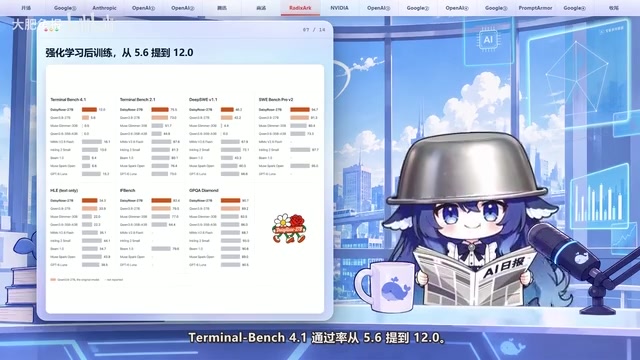
ReddickSock released DaisyRose 27B, based on QW3.8-27B with only reinforcement learning post-training. TerminalBench 4.1 pass rate rose from 5.6 to 12.0, and the model uses the Apache 2.0 license.
NVIDIA open-sourced Nemotron Labs Sigma, bringing continuous diffusion into language modeling with block-parallel token output. The series includes 14 checkpoints covering 3B and 8B. This direction attempts to break through the serial bottleneck of autoregressive generation and has potential implications for inference efficiency.
Continuous diffusion was originally used for image generation, starting from pure noise and progressively denoising to reconstruct the target data. When this paradigm is migrated to language modeling, tokens are no longer generated serially character by character; instead, they are mapped into a continuous vector space and denoised in parallel by block. Compared with autoregressive models, which must wait for the previous token to be generated before predicting the next, block-parallel output can significantly improve GPU utilization and throughput—but the tradeoff is that it cannot naturally support streaming continuation of arbitrary length like autoregression, and there is quantization error between the training objective and the discrete vocabulary. NVIDIA Nemotron Labs Sigma released 14 checkpoints across 3B and 8B, indicating it is exploring the performance boundaries at different scales and denoising steps. Whether this route can match autoregressive models on long-text coherence remains a key focus for the open-source community.
6. Security and Product Experiments
Promptama released the Frontier Bridge benchmark: across 21 models, hidden-instruction attacks achieved an average success rate of 34.9%, with Grok 4.5 reaching as high as 91.4%, and attacks hidden in Agent Skills succeeding 45.5% of the time. These figures highlight the real security challenges facing the agent skill ecosystem.
Google Labs launched the experimental product Stitchloop, built on Gemini 4 Carbon and CodeMender. After code goes live, it monitors metrics, validates fixes in a sandbox, and automatically opens PRs—with PRs approved by humans. It currently requires joining a waitlist. Gemini 4 also supports entering new prompts in real time within generated worlds, such as adding characters or changing scenes, with original audio adapting in real time. It is currently available to eligible Google AI Ultra subscribers.

Indirect prompt injection refers to attackers not directly feeding malicious instructions to the model, but hiding instructions in external content the model will read—web pages, documents, emails, or even tool return values called by agents. When an agent loads such content to complete a task, the hidden instructions are executed as trusted context, often without the user noticing. The Agent Skills scenario is especially dangerous: skill descriptions, examples, and parameter explanations can all become injection vectors, and once a skill is invoked it gains real permissions such as file and network access, so the impact of a successful attack far exceeds a single conversation contamination. Frontier Bridge's measured average success rate of 34.9% across 21 models and 45.5% within Agent Skills show that current mainstream models' defenses against such indirect injection remain unstable, and prompt filtering and least-privilege access need to advance in tandem.
Summary
From the release of Gemini 4 Neon to Anthropic's IPO pricing, and on to OpenAI's agent data and chip partnership, this round of news sketches a picture of the foundation model race entering the deep waters of commercialization. On the open-source side, explorations of multimodal and diffusion language models, along with the high attack success rates on security benchmarks, remind the industry that beyond capability improvements, governance gaps still need to be filled.
Related articles
Gemini 4 Neon Hands-On: Value King or Confident Catastrophe?
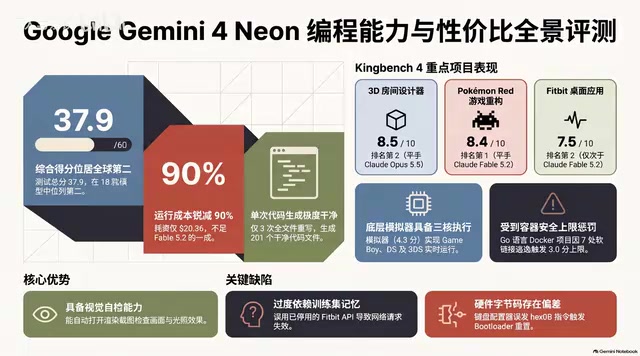
Gemini 4 Neon review: 1M-token context, four thinking levels, 201 files in one KingBench4 pass at one-tenth Fable 5.2's cost—but it hallucinates fake data, leaves 7 symlink escapes, and bricks keyboards.

Google Gemini 4 Neon Hands-On: 6 3D Works That Impress and Fail
Hands-on with Google Gemini 4 Neon on a 3060 laptop: 6 3D works tested. Sunshower Fishing Harbor and mechanical keyboard impress; soft-body physics and faces fall short.

Gemini 4 Neo Web Novel Writing Test: Faint AI Flavor, Textured Dialogue
Bilibili creator's first-look review of Gemini 4 Neo for Chinese web novel writing: testing a Three Kingdoms transmigration opening with faint AI flavor, emotionally textured dialogue, and strong crisis building, plus comparison of 4A/4H/4C models and full workflow demos.