Behind Palantir's Strong Earnings: The Hidden Worry of Slowing Enterprise Sales

Palantir beat earnings expectations but its stock fell, with slowing enterprise sales as a key warning.
Palantir delivered a strong quarterly report officially described as "crushing consensus expectations," but capital markets reacted coldly, with the stock slipping slightly on the post-earnings trading day and retail investors turning cool. The article points out that the superficially strong aggregate data masks a structural signal: enterprise sales, the core growth engine, are showing signs of slowing. When the market is mainly trading on high growth expectations, any marginal weakening of growth momentum is amplified in interpretation—this is why retail investors aren't buying it. For Palantir, subsequent quarters must prove the enterprise sales slowdown is a temporary fluctuation rather than a trend reversal; this curve is the key variable determining where its valuation narrative goes.
Palantir delivered a quarterly report that could be described as "crushing consensus expectations," yet the capital markets weren't buying it. The stock slipped slightly on the trading day after the earnings release, and retail investors reacted coldly. Behind this contrast lies a warning signal worth heeding: enterprise sales, the core growth engine, are showing signs of slowing.
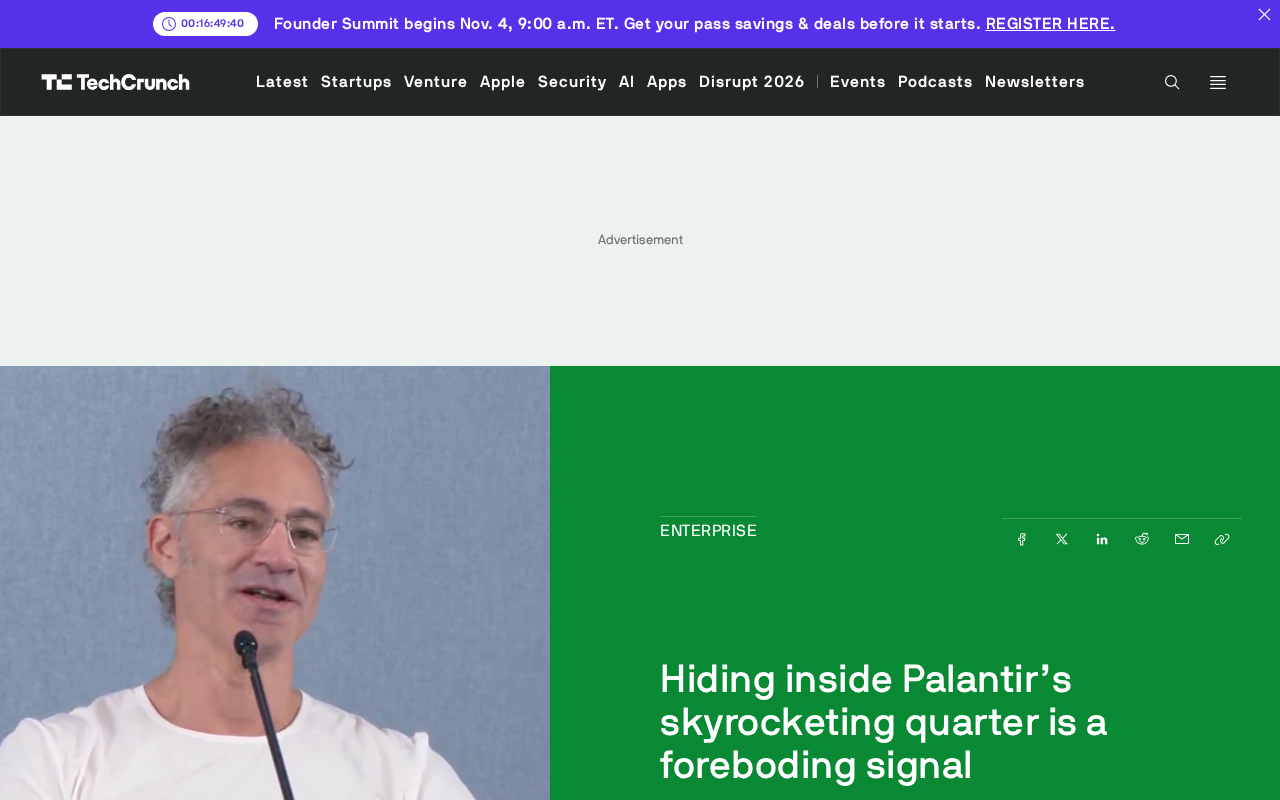
An Earnings Report That "Crushed Expectations"
Palantir's quarterly figures were strong enough that the press release could directly use the phrase "crushing consensus expectations." For a data intelligence company long mired in controversy, delivering such results is no small feat in itself.
But market reactions rarely stop at surface numbers. On the trading day after the release, Palantir's stock didn't continue climbing but edged lower. This kind of "good news priced in" move usually means investors saw something beyond the numbers.
"Crushing consensus expectations" is a common phrase during Wall Street earnings season. The so-called "consensus expectations" refer to the average of forecasts from multiple sell-side analysts, typically compiled by data terminals such as Bloomberg and Reuters. A company's actual results exceeding that average constitutes a "beat." However, the magnitude of the beat matters more than whether it beat at all: when the market has already fully priced in high growth, even a large beat can trigger a "good news priced in" reaction, because stock prices reflect the expectation gap rather than absolute numbers. This is background worth keeping in mind when interpreting Palantir's stock reaction.
The Real Signal: Enterprise Sales Are Decelerating
The core of the issue points to Palantir's enterprise sales business. This is the growth area the company has bet heavily on in recent years and a key pillar supporting its valuation narrative. According to reports, this segment has already shown signs of slowing.
For Palantir, government contracts were once its foundation, while expansion into enterprise clients carries greater imaginative potential—a broader market, a higher commercialization ceiling, and less geopolitical entanglement. Once this enterprise sales curve starts to flatten, investors will naturally re-examine the sustainability of the growth story.
It should be noted that the original report described this signal with relative restraint, offering no specific data on the magnitude of the slowdown and instead reading this meaning more from the stock reaction and market sentiment. This also reminds readers: a single quarter's "crushing expectations" and the "slowing signal" in enterprise sales are not contradictory but two sides of the same coin—strong in aggregate, changing in structure.
Enterprise sales (commercial business) is the part of Palantir's business map distinct from government contracts, mainly providing data integration and AI platform services to commercial clients. In recent years, Palantir has shifted the center of its growth narrative from government business to the commercial market, because the latter offers greater market space, stronger customer stickiness, and is less disturbed by defense budget cycles and geopolitical factors. Commercial revenue growth is seen as a core metric for measuring its product commercialization capability and long-term valuation rationality, so marginal changes in this segment often sway investor sentiment more than total revenue.
Why Retail Investors Aren't Buying It
Retail investors have always been extremely enthusiastic about Palantir, and the stock is often regarded as a "faith stock." But this time, retail sentiment is noticeably cooler.
This coolness can be understood as a shift in pricing logic: when the market is mainly trading on "high growth expectations," any marginal weakening of growth momentum will be amplified in interpretation. The slowdown in enterprise sales happens to hit the most sensitive part of this expectation set. Even with strong overall earnings, investors will still ask one question—where will next quarter's growth come from?
Retail investors (individual investors) differ from institutional investors in their pricing logic. Retail investors tend to focus more on narrative, topicality, and growth stories, easily forming "faith stock"-style high position concentration; institutions rely more on valuation models and quantitative verification of growth sustainability. When cracks appear in the growth narrative, retail selling or standing on the sidelines can amplify short-term volatility, while institutions recalibrate discount assumptions. Therefore, cooling retail sentiment is often seen as a signal that the market is doubting the "story" itself, not merely reacting to a single quarter's numbers.
What It Means for Palantir
From a longer perspective, this earnings report reveals a typical growth-company dilemma: when the core business performs excellently while a new growth engine decelerates, the market quickly adjusts its discount assumptions for the future.
Palantir needs to prove in subsequent quarters that the slowdown in enterprise sales is a temporary fluctuation rather than a trend reversal. If this signal is confirmed by future earnings reports, the debate over its valuation will likely become even more intense. For investors and observers watching this stock, rather than staring at the "crushing expectations" headline, it's better to focus on the enterprise sales curve—that is the key variable determining where the narrative goes.
Related articles

GPT-6 Astra's Weight-Reading Trick: Only for Small Networks, Practical Value Comes from Writing Code
GPT-6 Astra can read network weights directly, but without tools it is limited to small networks of ~170K weights. Fixing QUEN 3.5 0.8b's reasoning loop required Python and 50 batches; game identification took nearly an hour. This article maps the capability's boundaries and two security reminders.

GPT-6 Astra Rewrites Qwen Weights: 7.9% to 48.1% — Did It Learn Math or Just Learn to Stop?
MIT researchers used GPT-6 Astra to edit Qwen's weights directly, raising math scores from 7.9% to 48.1% with no training. But reproductions show the gain mainly comes from fixing loops and teaching the model to stop, not new math ability.

Can Qwen 3.8 27B Really Read Neural Network Weights? A 16GB Hands-On Test
MIT claims LLMs can directly read neural network weights. We tested Qwen 3.8 27B on a 16GB GPU: the signal is real, but "native reading" is false.