Big Tech Interview Question: How Do Hundreds of AI Agents Collaborate Without Conflicts?
The core solution for multi-Agent concurrent collaboration is task sharding arbitration plus state version control, evolving to decentralized CRDT at scale.
The article addresses the interview question of how hundreds of Agents executing the same task simultaneously avoid conflicts, pointing out that distributed locks degrade concurrency into serial execution, while message queues cause state corruption due to old context overwrites. The correct solution is to transmit atomic operations and intent descriptions, have the scheduling center perform shard conflict detection and intent arbitration, correct operation sequence numbers through version offset transformation, and use vector clocks, idempotent IDs, and history backfill to handle out-of-order retries. Centralized solutions hit computing bottlenecks above hundreds of Agents, and large-scale scenarios can shift to CRDT plus decentralized eventual consistency to resolve conflicts in advance at the planning stage. A high-scoring answer should present the layers of essence of the problem, centralized solution, and decentralized evolution.
Multi-agent collaboration is a hot direction for AI applications today, but when hundreds of agents are online simultaneously executing the same task, how to avoid conflicts at the underlying level and ensure consistency is an interview question that stumps most people on the spot. Based on a technical interview analysis video from Bilibili, this article breaks down the core answer of "task sharding arbitration + state version control" and compares the trade-offs between centralized and decentralized approaches.
Why Can't Locking and Message Queues Save the Day?
When facing concurrent conflicts, the intuitive reaction is often to add distributed locks. But in this scenario, the granularity of the lock directly determines whether collaboration is still meaningful: if one Agent locks a task node, the other 99 Agents can only queue and wait, which essentially degrades parallel collaboration into serial execution, reducing concurrency efficiency to zero.
Switching to serial consumption via message queues doesn't work either. When Agent A has just updated the task context, Agent B is still generating results based on the old context. With even slight network latency, the two will overwrite each other, task states will jump back and forth, and execution results will be directly scrambled—described in the source material as "data schizophrenia." The root cause is that most people understand collaboration as "queuing up complete task results," while the real difficulty lies in concurrency control over atomic operations and intent descriptions.
Core Solution: Task Sharding Arbitration and State Version Control
The correct answer is to draw two keywords on the whiteboard: task sharding arbitration and state version control. What is transmitted at the underlying level is not complete task results, but atomic operations plus intent descriptions.
Step 1: Split Task Shards
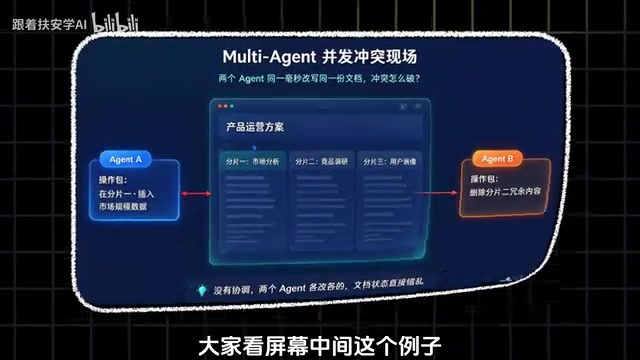
Taking the generation of a product operations plan as an example, the task can be split into three shards: market analysis, competitor research, and user personas. Agent A is responsible for inserting data into the market analysis paragraph, with the operation packet being "Insert paragraph two market size data"; Agent B, in the same millisecond, wants to delete redundant content in the competitor paragraph, with the operation packet being "Delete paragraph two line two."
Step 2: Two-Layer Validation at the Scheduling Center
Introduce a global Agent scheduling center, and all Agent operations must first be sent to the server. After receiving the two concurrent operations from A and B, the server first performs shard conflict detection to determine whether the two operations act on the same task shard and the same segment of context; then it performs intent conflict arbitration. If the targets do not conflict, it executes version offset transformation.
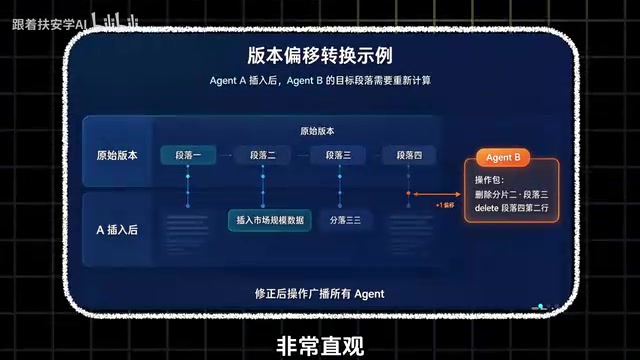
The scheduling center finds that A inserted a paragraph earlier, causing subsequent paragraph numbers to shift back by one position overall. Therefore, B's deletion operation cannot still be executed in the third paragraph and must be incremented by one to be executed in the fourth paragraph. The corrected operation is then broadcast to all Agents, and the global version number is updated at the same time. Ultimately, the task document context state on all Agents' screens is completely consistent.
Step 3: Handling Network Disorder and Out-of-Order Messages
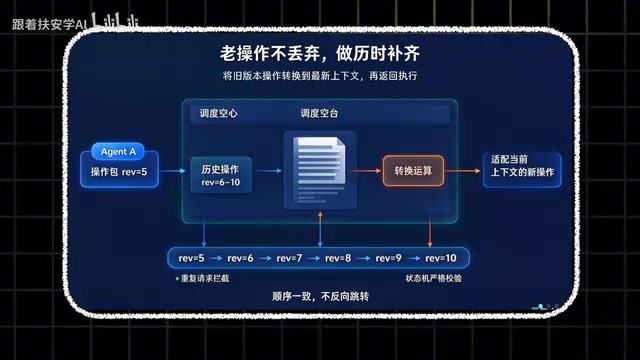
Interviewers often follow up: what about network disorder and out-of-order retry messages? The answer is to rely on vector clocks plus idempotent IDs plus history backfill mechanisms. Suppose an operation packet sent by an Agent with network lag has version number REB=5, while the server's global version has already reached version 10. This expired operation will not be simply discarded; instead, it undergoes a transformation operation with all historical operations from version 6 to version 10 to calculate an operation adapted to the current latest context, which is then returned for execution, thereby ensuring no out-of-order issues.
Each Agent's operation also carries a unique idempotent ID, and duplicate requests are directly intercepted; state changes are strictly validated by a state machine, and reverse transitions are not allowed, eliminating state corruption at the root.
Vector clock is a logical clock mechanism in distributed systems that captures causal relationships between events. Each node maintains a vector recording the event counts it knows for itself and other nodes; when two operations occur concurrently without knowledge of each other, the vectors cannot be compared, and the system determines that they potentially conflict. Compared with single-value timestamps, vector clocks can precisely distinguish "happened before" from "happened at the same time," thereby providing causal evidence for conflict detection and version offset transformation. In the scenario described in this article, the vector clock carried by an expired Agent's operation packet lags behind the global version, and the server uses this to identify which intermediate operations it is missing and then decides how to backfill and transform.
Idempotent ID is an identifier that ensures the same operation takes effect only once even if executed multiple times. Each operation packet carries a globally unique ID, and the server maintains a set of processed IDs or a Bloom filter; when the same request arrives again due to network retry, the server directly returns the first execution result and intercepts duplicate writes. Idempotent IDs combined with state machine validation can effectively prevent duplicate state changes or reverse transitions caused by retries, and are a key means of achieving "at-least-once delivery, exactly-once effect" in distributed collaboration.
The Bottleneck of Centralized Scheduling and the Dimensional Strike of CRDT
The shortcomings of centralized scheduling architecture are also obvious: it relies heavily on the computing power and bandwidth of the scheduling center's servers, and bottlenecks easily appear after exceeding hundreds of Agents. Therefore, in higher-frequency, larger-scale collaboration scenarios, new-generation Multi-Agent architecture choices will consider CRDT algorithms plus decentralized eventual consistency.
CRDT abandons centralized transformation and directly implements conflict-free data merging on the Agent side, combined with upper-layer intent alignment and planning resolution to avoid conflicts in advance at the task planning stage, rather than resolving them only at the execution stage. According to the analysis in the video, AutoGPT clusters, non-input agents, and the underlying multi-Agent collaboration of Doubao in the industry are all evolving in this direction.
CRDT (Conflict-free Replicated Data Type) is a special class of data structures designed to ensure that after concurrent modifications by multiple replicas without central coordination, merging in any order still converges to the same state. Common implementations include grow-only counters, last-writer-wins registers, and sequence types based on operational transformation. The cost of CRDT is constrained data structures and relatively large metadata overhead, but it brings decentralization and offline availability. The "direct conflict-free merging on the Agent side" mentioned in the article precisely leverages the commutative and associative laws of CRDT to push conflict resolution down from the server to each replica, thereby bypassing the computing bottleneck of central scheduling.
Layering in the Interview Answer
The high-scoring way to answer this question is not to pile up terminology, but to present a clear evolutionary logic: first reject locking and message queues, then give the centralized solution of task sharding arbitration plus version control, and finally use CRDT and decentralized eventual consistency as an architectural dimensional supplement. The interview feedback mentioned in the source material also confirms this—clearly explaining the two-layer validation and version offset transformation, then adding the trade-offs for large-scale scenarios, is enough to make the interviewer nod frequently.
For developers preparing for interviews in the large model and Agent direction, it is recommended to organize these three layers into your own whiteboard narrative path: the essence of the problem, the centralized solution, and the decentralized evolution. Rather than memorizing concepts, being able to explain "why locking doesn't work" and "why expired operations should be transformed rather than discarded" is the real bonus point.
One-line Summary
The core solution for multi-Agent concurrent collaboration is task sharding arbitration plus state version control, evolving to decentralized CRDT in large-scale scenarios.
Paragraph Summary
Aiming at the interview question "how do hundreds of Agents executing the same task simultaneously avoid conflicts," the article points out that distributed locks degrade concurrency into serial execution, while message queues cause state corruption due to old context overwrites. The correct solution is to transmit atomic operations and intent descriptions, have the scheduling center perform shard conflict detection and intent arbitration, then correct operation sequence numbers through version offset transformation, and use vector clocks, idempotent IDs, and history backfill to handle out-of-order retries. Centralized solutions easily encounter computing bottlenecks above hundreds of Agents, and large-scale scenarios can shift to CRDT plus decentralized eventual consistency to resolve conflicts in advance at the planning stage. A high-scoring answer should present the layers of "essence of the problem—centralized solution—decentralized evolution."
Related articles

Running a PS2 Emulator in the Browser with Claude: Inside TabStationToo
TabStationToo ports the PCSX2 core to the browser with WebAssembly and WebGPU, letting a PS2 emulator run in a tab. We break down its tech, AI workflow, and optimization.

AI Customer Service Evaluation Gone Wrong: 41 Failures, 28 Were Test Bugs
A live evaluation of a Shopify AI customer service agent produced 41 failures, but 28 were test bugs. This article analyzes scorer flaws, overly strict response checks, and other evaluation pitfalls, and summarizes best practices to prevent test bugs from masking real model failures.

No API Needed! Build a WhatsApp Receptionist with a Free Claude Account
A developer shares a weekend experiment: using a free Claude.ai account and browser scripts to turn WhatsApp Web into an automated receptionist—no API required.