Blackstone: Anthropic May Struggle to Secure Investment-Grade Rating After IPO

Blackstone executives say Anthropic may struggle to obtain an investment-grade rating even after an IPO, and AI companies' debt financing costs may rise significantly.
The article centers on a Blackstone executive's judgment that Anthropic may fail to obtain an investment-grade credit rating even after completing an IPO. The core argument is that an IPO opens the equity financing channel, while a credit rating determines the price and availability of debt financing; the two follow completely different logics—equity markets look at growth narratives, while credit markets look at cash flow stability and debt-servicing capacity. The article analyzes the structural reasons why AI companies struggle to obtain investment grade: heavy computing investment, undefined profitability paths, high asset depreciation pressure, and an unsettled competitive landscape. If ratings remain at speculative grade, AI companies will rely more on equity financing and alternative channels such as private credit, and their expansion pace may be adjusted passively. The article concludes by noting that this judgment is currently only a single institution's view, the original discussion has limited traction, and it does not yet constitute market consensus; what is truly worth tracking is actual post-IPO financing costs and the formal conclusions of rating agencies.
A senior executive at asset management giant Blackstone has noted that even after completing an IPO, Anthropic may not necessarily obtain an investment-grade credit rating. This judgment pushes the financing outlook for leading AI companies from "whether they can go public" to a new level of "at what cost they can finance after going public," and adds another layer of doubt to the funding logic behind today's AI arms race.
Core of the Matter: IPO Is Not the Same as Investment Grade
According to discussion on Hacker News, Blackstone indicated that Anthropic may fail to obtain an investment-grade credit rating after its IPO.
The key here is not "IPO" but "rating." An IPO opens the equity financing channel, while a credit rating determines the price and availability of debt financing. A company can be publicly listed while its bond rating remains at speculative grade—capital markets are no strangers to this—but for AI companies still in a heavy-investment phase, it means the leverage funding needed for expansion will be more expensive and more constrained.
As one of the largest alternative asset managers in the world, Blackstone's judgment carries a credit-market perspective: it is not concerned with model capability leaderboards, but with cash flow, asset structure, and debt-servicing capacity.
Why AI Companies May Fail to Obtain Investment Grade
An investment-grade rating typically requires companies to have stable and predictable revenue, healthy profit margins, and controllable debt levels. Applying these standards to current leading AI companies reveals fairly direct contradictions:
- Revenue growing fast but profitability path undefined: Large-model companies are generally in a heavy-investment phase, with computing power procurement, data centers, and talent costs continuing to rise, putting pressure on income statements.
- Asset structure is relatively "light" and depreciation pressure is high: Core inputs are computing power and R&D, and hardware depreciation cycles are short, which does not align with the heavy-asset, long-cycle cash flow profile favored by traditional rating models.
- Competitive landscape not yet settled: Model generations turn over quickly, and today's leadership position may not translate into long-term pricing power. Rating agencies typically apply a discount to such uncertainty.
In other words, rating agencies are not looking at "how important this company is," but at "whether it can pay interest on time under adverse scenarios." These two things are often conflated in the AI industry.
The dividing line between investment grade and speculative grade: The three major international rating agencies (S&P, Moody's, Fitch) generally divide credit ratings into two broad ranges: investment grade and speculative grade. S&P sets BBB- as the lower bound of investment grade; anything below that (BB+ and below) is speculative grade, commonly known as "junk bonds." Ratings directly determine bond issuance costs—investment-grade companies typically issue bonds at rates 100-200 basis points above comparable government bonds, while speculative-grade issuers often need to pay spreads of more than 400 basis points and may face a closed issuance window during market volatility. For AI companies that need continuous large-scale financing, this dividing line means a difference of hundreds of millions of dollars in annual interest.
Why rating models are unfriendly to tech companies: Traditional credit rating frameworks are built on historical data from industrial and consumer sectors, with core indicators including EBITDA interest coverage, debt/EBITDA ratio, and free cash flow stability. R&D spending at asset-light tech companies is usually expensed rather than capitalized, which depresses book profits; meanwhile, non-cash expenses such as equity incentives also affect the comparability of profit metrics. Although rating agencies have adjusted their models for the tech sector, they remain cautious about companies with low revenue visibility and rapid technological iteration.
IPO and Credit Ratings Are Two Different Logics
When markets discuss AI companies, they tend to treat an IPO as the ultimate milestone. But equity markets and credit markets speak two completely different languages:
| Dimension | Equity Financing (IPO) | Credit Rating |
|---|---|---|
| Focus | Growth, narrative, market share | Cash flow stability, debt-servicing capacity |
| Risk appetite | Can tolerate high volatility | Prefers low volatility |
| Consequence of failure | Share price decline | Default, rating downgrade |
This explains why a company can successfully complete an IPO yet receive a cold reception in the bond market. For companies like Anthropic, if the rating remains at speculative grade, the cost of future bond issuance to support computing expansion will be significantly higher than that of investment-grade peers, and financing channels will also rely more on equity and private credit.
How private credit fills the rating gap: Private credit refers to financing in which non-bank institutions lend directly to companies without going through public bond markets. Its scale has expanded rapidly in recent years to the trillion-dollar level. For AI companies with insufficient ratings, the advantages of private credit are flexible terms, fast approval, and no dependence on public market sentiment; the disadvantages are interest rates significantly higher than public bonds and often stricter covenant terms (such as revenue milestones and senior security rights). Blackstone itself is one of the world's largest private credit managers, and its executive's judgment on Anthropic's rating in a sense also reflects how private credit institutions price such borrowers—the weaker the rating, the higher the cost of alternative debt funding.
Impact on the AI Industry's Financing Structure
If Blackstone's judgment holds, the financing mix of leading AI companies will tilt further toward equity, and the supplementary role of debt instruments will be limited. This brings several chain effects:
- Deeper reliance on equity financing: Continuous financing needs may dilute early shareholders' interests and make companies more sensitive to capital market sentiment.
- Private credit becomes an alternative channel: When ratings are insufficient, non-public market tools such as private credit and structured financing often fill the gap, but at higher cost and with stricter terms.
- Expansion pace may be adjusted passively: Computing investment is rigid; once debt financing is constrained, companies must either slow expansion or accept more expensive funding.
This is not Anthropic's situation alone, but a structural problem faced by the entire capital-intensive AI track. Blackstone's statement is noteworthy because it comes from a supplier of capital, not an industry observer.
Capitalization of computing investment and depreciation pace: AI companies' procurement of GPUs and construction of data centers are capital expenditures, which form fixed assets in accounting and are depreciated annually. Taking Nvidia's high-end GPUs as an example, their effective economic life is generally considered to be 3-5 years, and some cloud providers use shorter depreciation periods to reflect technology iteration risk. Short depreciation cycles mean high annual depreciation expenses recorded on the income statement, directly suppressing book profitability and thereby affecting profit-based rating indicators. This is also a core difficulty rating agencies face when evaluating AI companies: these companies' assets are "heavy" in accounting terms, but technology obsolescence is fast, and collateral value and residual value are difficult to estimate as stably as plant and equipment.
Caution Is Warranted
This judgment is currently only a single institution's view, and public information is limited—the original discussion on Hacker News had only 16 points and 1 comment, not enough to form a market consensus. Credit ratings ultimately depend on formal financial data and independent assessments by rating agencies. The Blackstone executive's statement is closer to a signal about the direction of risk than a final conclusion.
For readers following the AI industry, the truly worthwhile signals to track are: these companies' actual financing costs after IPO, debt terms, and the formal conclusions issued by rating agencies. That is the hard metric for testing whether "AI companies can finance at low cost like mature tech giants."
One-line Summary
A Blackstone executive says Anthropic may struggle to obtain an investment-grade rating even after an IPO, and AI companies' debt financing costs may rise significantly.
Paragraph Summary
The article centers on a Blackstone executive's judgment that Anthropic may fail to obtain an investment-grade credit rating even after completing an IPO. The core argument is that an IPO opens the equity financing channel, while a credit rating determines the price and availability of debt financing; the two follow completely different logics—equity markets look at growth narratives, while credit markets look at cash flow stability and debt-servicing capacity. The article analyzes the structural reasons why AI companies struggle to obtain investment grade: heavy computing investment, undefined profitability paths, high asset depreciation pressure, and an unsettled competitive landscape. If ratings remain at speculative grade, AI companies will rely more on equity financing and alternative channels such as private credit, and their expansion pace may be adjusted passively. The article concludes by noting that this judgment is currently only a single institution's view, the original discussion has limited traction, and it does not yet constitute market consensus; what is truly worth tracking is actual post-IPO financing costs and the formal conclusions of rating agencies.
Related articles
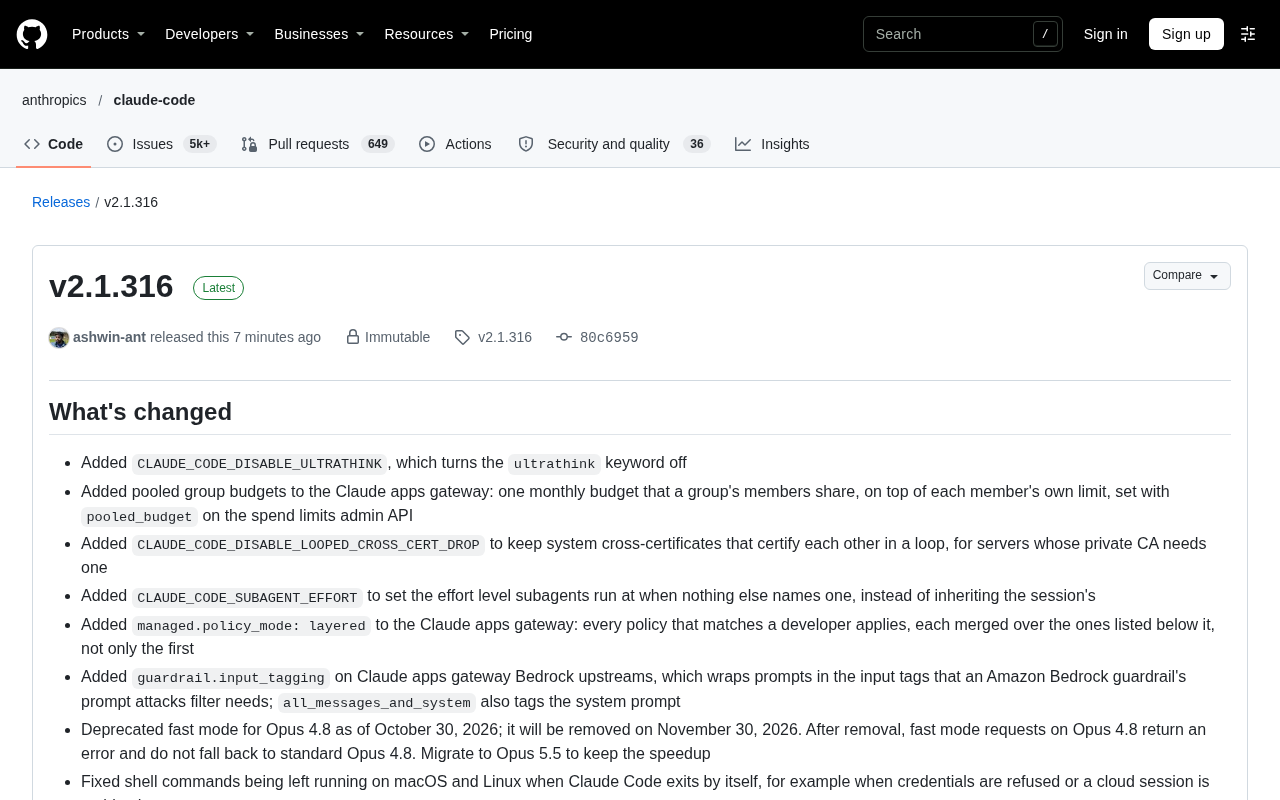
Claude Code v2.1.316 Update Analysis: Enterprise Gateway and Multiple Stability Fixes
Claude Code v2.1.316 released: new enterprise gateway pooled group budgets, layered policy mode, subagent effort control, dozens of Shell, network, and session recovery fixes, and Opus 4.8 fast mode deprecated.

17th-Century British Floods and Doomsday Panic: A New Perspective on Weather History
Based on a Hacker News discussion of '17th-Century British Floods and Foreboding,' this piece explores how extreme weather was given divine and political significance, and what weather history teaches us about contemporary climate communication.

Salesforce Acquires Rune for $375M: AI Logistics Tech Bolsters Defense Business
Salesforce reportedly acquires defense tech startup Rune for $375M. Rune's AI logistics tech will strengthen Salesforce's Missionforce defense platform, continuing its M&A spree.