Borland Turbo Pascal 7: Why Old-School Programming Tools Are Missed
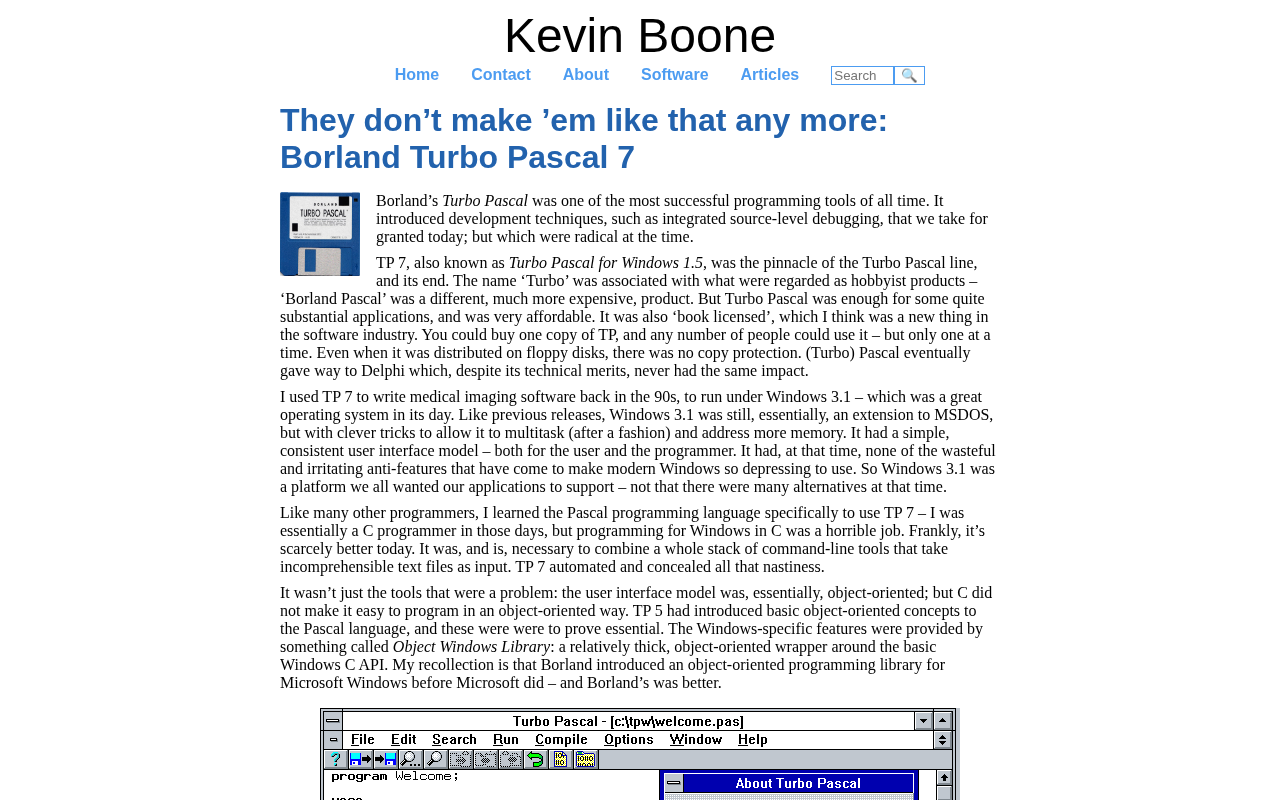
Turbo Pascal 7 sparks HN nostalgia, showing modern tools should treat leanness as an active design goal.
Borland Turbo Pascal 7 received 207 upvotes and 113 comments on Hacker News, triggering collective nostalgia among developers for lean DOS-era tools. The article analyzes its core advantage as toolchain completeness—fast compilation, lightweight IDE, integrated debugging, and minimal generated files—forming an "open and get to work" environment. The nostalgic focus in HN comments isn't language wars but a demand for tool responsiveness and determinism. However, the article notes nostalgia needs a discount: projects back then were smaller, and simplicity partly came from small problem scale, so it can't be directly compared to modern toolchains. The fair conclusion: tool complexity growth should match problem growth, and leanness should be an actively chosen design goal.
A Compiler HN Keeps Nostalgizing About
On Hacker News, an article about Borland Turbo Pascal 7 received 207 upvotes and 113 comments. That number isn't astonishing in itself, but for a thread discussing a DOS-era programming tool from over thirty years ago, it's quite telling. The title of Kevin Boone's article translates literally to "They don't make them like this anymore"—the tone carries obvious nostalgia, but also a technical judgment: Turbo Pascal 7 was, for its time, an exceptionally finely crafted piece of engineering.
The heat in the comments section shows this isn't an isolated case. A generation of programmers who lived through the DOS development era still use "Turbo Pascal" as a benchmark for measuring whether today's development tools are lean enough.
What Exactly Made It So Good
The core appeal of Turbo Pascal 7 wasn't its language features—Pascal itself wasn't particularly radical for its time—but the completeness of the entire toolchain. Compilation was so fast you barely felt the wait, the IDE ran smoothly within extremely limited memory, the debugger was tightly integrated with the editor, and the generated executables were small and had few dependencies. None of these traits is remarkable in isolation, but combined they created an environment where you could "open it up and get to work."
Kevin Boone's article focuses on using Turbo Pascal 7 under Windows and its limitations, which touches precisely on the core contradiction of that transitional era: how a lean DOS-era tool could position itself in the face of a graphical operating system. The article doesn't mythologize Turbo Pascal 7, but places it back within its specific historical and technical conditions.
Turbo Pascal 7's compilation speed was closely tied to its single-pass compiler and highly optimized memory management strategy. Borland's compiler compiled Pascal source directly to machine code without generating intermediate assembly output, and the entire IDE and compiler ran in real mode with direct memory access, free of the overhead of modern operating system abstraction layers. On 80286/386 hardware in the early 1990s, compiling a program of several thousand lines often took just one or two seconds—an immediate feedback loop whose impact on development rhythm was profound. Additionally, Turbo Pascal's integrated debugger allowed single-stepping, setting breakpoints, and inspecting variables within the IDE without switching to a separate debugging tool—a remarkably forward-thinking design for its time.
The Real Demand Behind the Nostalgia
Discussions in the HN comments often reveal more than the original article. Among the 113 comments, the recurring theme wasn't language wars like "Pascal is better than C," but nostalgia for tool responsiveness and determinism. Modern IDEs are powerful, but they start slowly, index heavily, and are complex to configure—setting up a development environment for a medium-sized project can itself consume hours. The Turbo Pascal 7 experience of "press compile, get results immediately" has become a rarity in today's development workflows.
This nostalgia needs a discount. Project scales, dependency complexity, and collaboration patterns back then were completely different from today. Turbo Pascal 7's simplicity was to a considerable extent a dividend of small problem scale, not pure engineering wisdom. Comparing it directly against modern toolchains isn't fair.
But fair comparisons can still yield valuable conclusions: the growth of tool complexity should match the growth of the problems it solves. When some of that complexity comes not from the problems themselves but from the historical baggage of the tool ecosystem, Turbo Pascal 7 serves as an appropriate reference point—reminding developers that leanness is a design goal that can be actively chosen.
The slow startup and heavy indexing of modern IDEs stem largely from the complexity of the Language Server Protocol (LSP) and code indexing engines. Take Visual Studio Code or IntelliJ IDEA as examples: opening a medium-sized Java or TypeScript project requires parsing thousands of files in the background, building symbol tables, and running type checks—work that consumes substantial CPU and memory. This design supports advanced features like code completion, refactoring, and go-to-definition, but the cost is startup latency and resource consumption. Turbo Pascal 7's IDE had none of these features, so it could launch instantly with minimal memory footprint. When comparing the two, it's important to note: modern IDE complexity corresponds to the scale and collaboration needs of modern software projects, not merely engineering regression.
Lessons for Today's Tool Design
The design principles extractable from Turbo Pascal 7 aren't mysterious: ready to use on launch, immediate feedback, minimal dependencies, predictable behavior. These principles still echo in some modern tools today—for instance, the popularity of certain terminal editors and lightweight compilers is in some ways a reaction against over-integrated IDEs.
You may not have noticed, but most people nostalgic for Turbo Pascal 7 don't advocate returning to Pascal or DOS. What they miss is the direct relationship between tool and user—being able to get code running without needing to understand an entire build system's abstraction layers. That demand still holds today, and it's the starting point for many developer tools re-examining their own complexity.
The popularity of terminal editors (such as Vim, Neovim, Helix) and lightweight compilers (such as Go's gc compiler and Zig's built-in build system) reflects developers' ongoing demand for toolchain simplicity. Go was designed from the outset with fast compilation as a core goal, and its compiler can build large projects in seconds—a philosophy in line with Turbo Pascal's engineering approach. Zig goes further by integrating the build system and cross-compilation into a single tool, reducing dependence on external build tools. These modern examples show that the "simplicity first" principle represented by Turbo Pascal 7 isn't outdated nostalgia but a design constraint that can be actively reused in contemporary tool design.
Conclusion
Turbo Pascal 7 is repeatedly brought up not because the Pascal language itself is particularly special, but because it represents a tool philosophy: applying limited computing resources to the most direct productivity. In that HN thread, this nostalgia is both a tribute to the past and a gentle reminder about contemporary tool design.
One-line Summary
Turbo Pascal 7 sparks HN nostalgia, showing modern tools should treat leanness as an active design goal.
Paragraph Summary
Borland Turbo Pascal 7 received 207 upvotes and 113 comments on Hacker News, triggering collective nostalgia among developers for lean DOS-era tools. The article analyzes its core advantage as toolchain completeness: fast compilation, lightweight IDE, integrated debugging, and minimal generated files, forming an "open and get to work" environment. The nostalgic focus in HN comments isn't language wars but a demand for tool responsiveness and determinism. However, the article notes nostalgia needs a discount: projects back then were smaller, and simplicity partly came from small problem scale, so it can't be directly compared to modern toolchains. The fair conclusion: tool complexity growth should match problem growth, and leanness should be an actively chosen design goal.
Related articles
 Tech Frontiers
Edge AI on Microcontrollers: When Is It Actually Worth Deploying?
Drawing on Reddit discussions and Arm case studies, this article analyzes the real-world use cases for edge AI on microcontrollers: when each device needs independent inference, when a gateway or cloud is more reasonable, and the costs and boundaries of specialized hardware.
 Tech Frontiers
Pushing the Limits of Extreme Sudoku on a 16GB GPU: Insights from Depth and Flow Matching
A researcher trained a 16.54M-parameter model on a 16GB GPU to solve extreme Sudoku, finding effective depth breaks the 60% plateau and flow matching with improved sampling pushes accuracy past 99% with ~50× lower layer-evaluation budget.
 Tech Frontiers
AI Agent Approval Workflows: Why Human Confirmations Always Get Mindlessly Clicked
Why do AI agent approval workflows always get mindlessly clicked? A Reddit discussion shows that separating rules from keys, low-frequency high-risk approvals, and GitHub Environments-style gates are the keys to effective approvals.