Bright Dental: Building an AI Dental Clinic Automation System with n8n and Supabase

Bright Dental connects doctor, front desk, and patient AI workspaces with n8n and Supabase.
Bright Dental is an AI automation solution for dental clinics built on n8n and Supabase that brings doctors, front desk staff, and patients into a single system. The doctor workspace integrates scheduling, a clinical knowledge base, and consumables lookup; the front desk handles appointment review, record retrieval, and daily task management; and the patient side features AI assistant Emma for conversational booking and rescheduling, with confirmations and reminders sent via Telegram. Technically, n8n acts as the orchestration layer, translating AI requests into database queries, status updates, and message pushes, while Supabase handles data storage and knowledge base retrieval, grounding AI answers in curated clinic documents rather than model speculation. The article argues the value lies in reorganizing scattered information flows rather than replacing roles, though real-world deployment still requires addressing data compliance, permission management, and edge cases.
From Booking to Follow-up: How Bright Dental Restructures the Daily Operations of a Dental Clinic
Dental clinic operations are often bogged down by tedious tasks: doctors need to check schedules, dig through documents, and look up consumables information; front desk staff must repeatedly confirm appointments and pull patient records; and patients have to call to ask about availability and wait for reminders. Bright Dental demonstrates an AI automation solution built on n8n and Supabase that attempts to bring these three roles into a single system, letting information flow replace manual coordination.
According to the project's demo video on YouTube, Bright Dental is not a single chatbot but a clinic operating system composed of multiple AI workspaces, automated workflows, and a knowledge base. Doctors, front desk staff, and patients each have their own entry point, with n8n connecting data and actions behind the scenes, and Supabase handling storage and retrieval.
Three Separate AI Workspaces
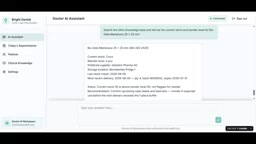
The doctor's workspace focuses on clinical efficiency. In the demo, a doctor can view the schedule, access the clinical knowledge base, and look up information about medical consumables. These features seem simple, but integrating scheduling systems, knowledge documents, and inventory data into a single interface means the backend requires a unified data model and retrieval layer.
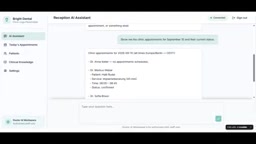
The front desk workspace leans toward operations management. Receptionists can quickly review appointments, retrieve patient records, and manage daily tasks. The video mentions that the front desk can "quickly review appointments, check patient records, and manage daily tasks," which indicates the system differentiates permissions—doctors see clinical information, the front desk sees process information, and both share the same underlying data but with different presentations.
The patient side is handled by the AI assistant Emma. Emma answers questions, finds available appointment slots, and helps patients book or reschedule. Unlike traditional online booking forms, Emma's interaction is conversational—patients don't need to navigate between multiple pages but complete operations through natural language.
How n8n and Supabase Divide Responsibilities
The technical backbone of this system is supported by two open-source tools. n8n is a workflow automation platform responsible for translating AI assistant requests into concrete actions: querying databases, triggering notifications, and updating appointment statuses. The video explicitly states that "N8N connects AI assistance with clinic data and automated workflows," meaning n8n plays the orchestration layer role, connecting AI output to actual business logic.
Supabase handles data storage and knowledge base retrieval. After clinic documents go through a knowledge base processing pipeline, important information becomes accessible to AI assistants. This means that when doctors query clinical knowledge or patients ask about clinic policies, the answers come from curated documents rather than being generated from thin air by the model. For medical scenarios, traceable information sources are more important than fluent answers.
The advantage of this combination is replaceability. Both n8n and Supabase are open-source tools, allowing clinics to adjust deployment methods according to their own scale without being locked into a particular closed-source SaaS vendor.
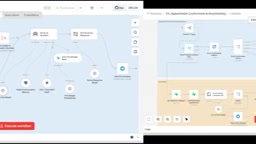
n8n is an open-source workflow automation tool that uses a node-based visual orchestration approach. Each node represents a specific operation, such as an HTTP request, database read/write, conditional logic, or message push, and nodes are connected by lines that define execution order and data flow. Compared to closed-source SaaS like Zapier, n8n supports self-hosted deployment, allowing data to remain entirely on the clinic's own servers—particularly critical for medical scenarios involving patient privacy. In Bright Dental, n8n workflows are typically triggered by a tool call from the AI assistant: after the AI determines it needs to query the schedule or create an appointment, it sends a request to n8n, which then executes database queries, status updates, and Telegram pushes along a preset node chain, and finally returns the results to the AI assistant. This layered design of "AI decides, workflow executes" decouples business logic from model capabilities, making it easier to debug and replace independently.
Supabase is an open-source backend service platform based on PostgreSQL, offering database, authentication, file storage, and vector retrieval capabilities. In knowledge base scenarios, Supabase typically uses the pgvector extension to store vector embeddings of document chunks: clinic documents are first split into paragraphs, then converted into high-dimensional vectors by an embedding model and stored in the database; when the AI assistant needs to answer a question, the system similarly vectorizes the user's query and retrieves the most relevant document chunks through similarity search as context for the model to generate an answer. This process is Retrieval-Augmented Generation (RAG), which lets the model answer based on the clinic's own policies and process documents rather than relying on general knowledge from training data, thereby reducing hallucination risk and making answers traceable to specific documents.
Telegram Handles Patient Outreach
Appointment confirmations and automatic reminders are sent via Telegram. The video description mentions that "through Telegram, patients receive booking confirmations and automatic appointment reminders." Choosing Telegram over SMS or email can reduce outreach costs in some regions and supports richer message formats.
From a process perspective, after Emma completes a booking, n8n triggers a Telegram message push; as the appointment time approaches, the automated workflow runs again to send a reminder. Reducing no-show rates is a rigid requirement for dental clinics, and the value of automatic reminders lies not in technical complexity but in consistent execution.
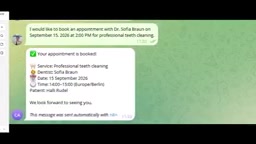
The Telegram Bot API is a bot interface provided by Telegram for developers. With a single bot token, developers can call capabilities such as sending messages, receiving user input, and creating inline buttons without building their own messaging channel. In automated workflows, n8n has a built-in Telegram node—once the bot token and target chat ID are configured, messages can be pushed at any workflow node. Compared to SMS, Telegram messages cost almost nothing per message in most regions and support rich text, buttons, and file attachments. Patients can click to confirm or reschedule directly in the message, creating a shorter interaction loop. Its limitation is that it relies on patients actively installing and authorizing Telegram, which limits coverage for people unfamiliar with the app; in practice, it often needs to run in parallel with SMS or email channels as a fallback.
The Practical Significance of an Integrated System
The Bright Dental demo places the three roles—doctor, front desk, and patient—in a single loop: doctors rely on the knowledge base for decisions, the front desk relies on appointment data to coordinate resources, and patients rely on the AI assistant for self-service. All three share the same Supabase data, with n8n triggering actions at key nodes.
The takeaway from this solution is that AI's value in clinic scenarios is not about replacing a particular role but about reorganizing information flows that were previously scattered across phone calls, spreadsheets, and paper records. For small and medium-sized clinics, the combination of n8n and Supabase provides a customizable starting point, but actual implementation still requires consideration of data compliance, permission management, and ongoing maintenance of knowledge base content. The demo video shows an ideal workflow; real clinics' edge cases—last-minute cancellations, emergency add-ons, multi-location scheduling—are what truly test the system's resilience.
Related articles

LLM Application Development: A High-Paying Career Guide for Ordinary People
LLM application development offers fresh graduates up to 35K/month, with SP offers reaching 600K. This article explains the core skills, how to break in, and how ordinary people can seize AI opportunities through learning by doing.

Say Goodbye to AI Influencer Faces: A Complete Guide to Creating Visual Assets for AI Comic Dramas from Scratch
Bilibili creator shares a full workflow for zero-basics AI comic drama visual assets: use Doubao Work skills with script-first, visual references, and real-person texture to escape AI influencer faces, then lock character and scene consistency with asset sheet layouts, weapon detail images, scene nine-grids, and cinematic color palettes.

The AI Production Pipeline Behind Great Videos: From Research to Agent Validation
AI video production isn't just a model race. This article breaks down a transferable four-step pipeline: researching professional workflows, organizing a skill checklist, configuring agents, and experimental validation—and explains how general-purpose LLMs like DeepSeek can replace paid tools to run the entire process.