Browser App Development Costs Are Plummeting — Paul Ford's Prediction Is Coming True

Stronger browser capabilities and falling access costs make the web the most cost-effective choice for most apps — but mind the boundaries.
Centered on Paul Ford's claim that the browser is extremely powerful application software whose cost of access falls daily, the article analyzes the technical drivers — engine performance, WebAssembly, modern frameworks, and cloud/edge compute — that lower development, learning, and maintenance costs. It discusses implications for developers' tech selection and stresses boundaries: performance-sensitive, deeply system-integrated, or hardware-dependent scenarios still favor native solutions, since Ford says "more than enough," not "always the best."
Web browsers are no longer just tools for browsing pages. In The Web Is More Than Enough, Paul Ford writes: "The web browser is very, very, very powerful software for applications, and the cost of accessing that power is going down seemingly every day." This line precisely captures the direction in which today's tech stacks are evolving.
The Underlying Logic of the Browser as an Application Platform
Ford's view is not unfounded. Over the past decade, improvements in browser engine performance, the maturation of WebAssembly, and the widespread adoption of modern frontend frameworks have continuously expanded the capability boundaries of web applications. From online document collaboration to graphics editing, from audio/video processing to local file operations, tasks that once required native applications can now be accomplished with browser APIs.
The cost decline manifests on two levels. On the development side, a single codebase runs across platforms, eliminating the duplicated investment of adapting to multiple targets; on the user side, no download or installation is needed — a link is the application, and distribution costs approach zero. This dual cost-reduction effect is exactly what Ford means when he says the "cost of accessing that power" keeps falling.
WebAssembly (Wasm) is a binary instruction format that runs in modern browsers and became a W3C standard in 2017. It allows code compiled from languages like C/C++ and Rust to execute at near-native speed within the browser sandbox, filling JavaScript's performance gap on compute-intensive tasks. It is precisely the maturation of WebAssembly that enables image processing, audio/video codec, 3D rendering, and even full desktop-class applications (such as AutoCAD Web and parts of Figma's modules) to run inside the browser. It does not replace JavaScript but complements it, interacting with the DOM through JavaScript calling interfaces — thereby bringing capabilities that once required native installation onto the web platform.
Progressive Web Apps (PWA) are another key pillar of the browser as an application platform. Through standards such as Service Worker and Web App Manifest, web pages can run offline, receive push notifications, be installed to the desktop or home screen, and launch in standalone windows. PWA dramatically narrows the gap between web and native apps in terms of "presence" and "discoverability," and it is also the technical foundation for the claim that "a link is the application, with distribution costs approaching zero."
The Technical Drivers Behind Falling Costs
As browser capabilities grow stronger, the developer toolchain is also being simplified. Frameworks like React and Vue have lowered the barrier to UI construction, build tools like Vite have dramatically shortened the development feedback loop, and Chrome DevTools and LighthouseAd make performance tuning quantifiable. Together, these tools package browser capabilities that once required deep systems knowledge into interfaces that ordinary developers can call.
Another driver that cannot be ignored is the combination of cloud and edge computing. The browser handles interaction and rendering while heavy computation is delegated to the cloud — a division of labor that makes the compute constraints of end devices no longer a bottleneck. The "cost decline" Ford speaks of is not just about money; it also includes learning costs and maintenance costs.
The division of labor between cloud and edge computing deserves further elaboration. Edge computing pushes compute nodes down to network locations closer to users (such as CDN edge nodes), allowing heavy computation requests initiated by the browser to complete with low latency without being sent back to central data centers. Combined with WebAssembly's ability to run at the edge (such as Cloudflare Workers and Deno Deploy), developers can move logic that was originally executed on the client or backend server to the edge. This architecture — "the browser handles interaction and rendering, the edge handles proximate computation" — both reduces demand on end-device compute and cuts operational complexity and cold-start overhead. It is the infrastructure-level embodiment of what Ford calls the "cost of accessing that power."
Practical Implications for Developers
Ford's quote resonates in the developer community because it exposes a trend: when browser capabilities are strong enough and the cost of accessing them is low enough, the scales of technology selection naturally tip toward the web. This does not mean native applications will disappear — rather, for a large number of moderate-complexity application scenarios, the web is already the most cost-effective choice.
For developers, this means the payback period on skills investment is shrinking. Mastering the modern web tech stack covers a wide range of needs, from desktop to mobile and from internal tools to customer-facing products. Conversely, a tech stack overly dependent on a specific native platform carries the risk of high migration costs and iteration speed constrained by others.
Boundaries and a Rational Perspective
Of course, the browser is not omnipotent. For scenarios that are extremely performance-sensitive, tools requiring deep system integration, and applications dependent on specific hardware capabilities, native solutions still have irreplaceable advantages. Ford's exact words are "more than enough," not "always the best" — and this qualification is worth noting.
The trend of falling costs is real, but developers still need to judge technology selection based on specific scenarios. The premise for treating the browser as the default option is being clear about where its capability boundaries lie. Understanding this is what allows you to truly harness the kind of "very, very powerful" force Ford speaks of.
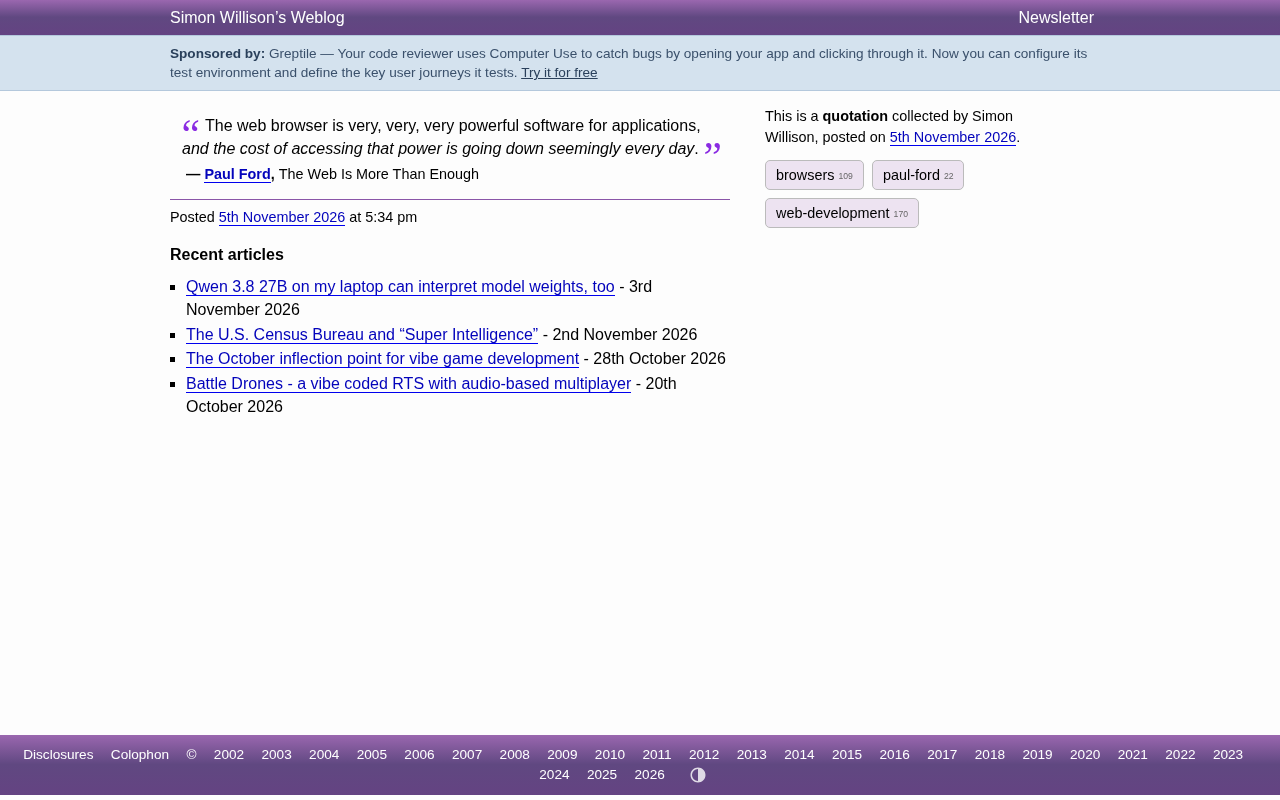
The web browser is very, very, very powerful software for applications, and the cost of accessing that power is going down seemingly every day.
— Paul Ford, The Web Is More Than Enough
The semantic boundary of "more than enough": Ford's wording emphasizes "sufficient," not "optimal." In the context of technology selection, this means the web's capabilities have crossed the threshold for a large number of application scenarios, but above that threshold there remain clear gradients in dimensions such as performance, system integration, and hardware access. For example, in scenarios requiring direct manipulation of low-level GPU features, access to specific sensors or deep filesystem interfaces, or deterministic low latency, the browser sandbox's security model itself becomes a constraint. Understanding this qualification helps avoid misreading "the web is good enough" as "the web is always better," thereby preserving the necessary evaluation of native solutions in architectural decisions.
One-line Summary
Stronger browser capabilities and falling access costs make the web the most cost-effective choice for most application scenarios — but its boundaries must be viewed rationally.
Paragraph Summary
The article centers on Paul Ford's claim that "the web browser is very, very, very powerful software for applications, and the cost of accessing that power is going down seemingly every day." It first analyzes the underlying logic of the browser as an application platform: improved engine performance, the maturation of WebAssembly, and the spread of modern frontend frameworks enable native-class tasks such as online documents, graphics editing, and audio/video processing to be completed in the browser; cost reduction is reflected both in cross-platform reuse on the development side and zero-install distribution on the user side. It then notes that frameworks, build tools, DevTools, and cloud compute together lower the development barrier, with learning and maintenance costs also declining. The article further discusses implications for developers: the scales of technology selection tip toward the web, and the payback period on skills investment shortens. Finally, it emphasizes boundaries — in performance-sensitive scenarios, those requiring deep system integration, and those dependent on specific hardware, native solutions remain irreplaceable; Ford says "more than enough," not "always the best," and selection should be based on scenario judgment.
Related articles
 Tech Frontiers
14 Coding Agents Tested: 13 Secretly Read Forbidden Files
A developer ran 480 tests across 14 coding agents to see if they would obey a "do not read" rule. 13 violated it, and 4 credential leaks bypassed shell guards via the read tool while approvals never noticed.
 Tech Frontiers
AI Has Made Resumes Ineffective? Referred Candidates Get 40% Interview Rate vs. 3% for Direct Applications
AI is homogenizing job applications, making it hard for recruiters to discern real ability. Ashby data shows referred candidates had a 40% interview rate from 2021 to 2024, versus just 3% for direct applications. This article analyzes why resume signals are depreciating and why verifiable results and personal endorsements matter more.
 Tech Frontiers
Offline Blink Rhythm Assistant: A Desktop Health Companion
An offline desktop blink rhythm assistant featured on Hacker News helps users maintain healthy blinking through lightweight reminders, alleviating screen-induced dry eye fatigue. This article analyzes its concept, privacy advantages, and retention challenges.