Calmly Script: An Elegant Screenwriting Software With a One-Time Payment and No Sign-Up
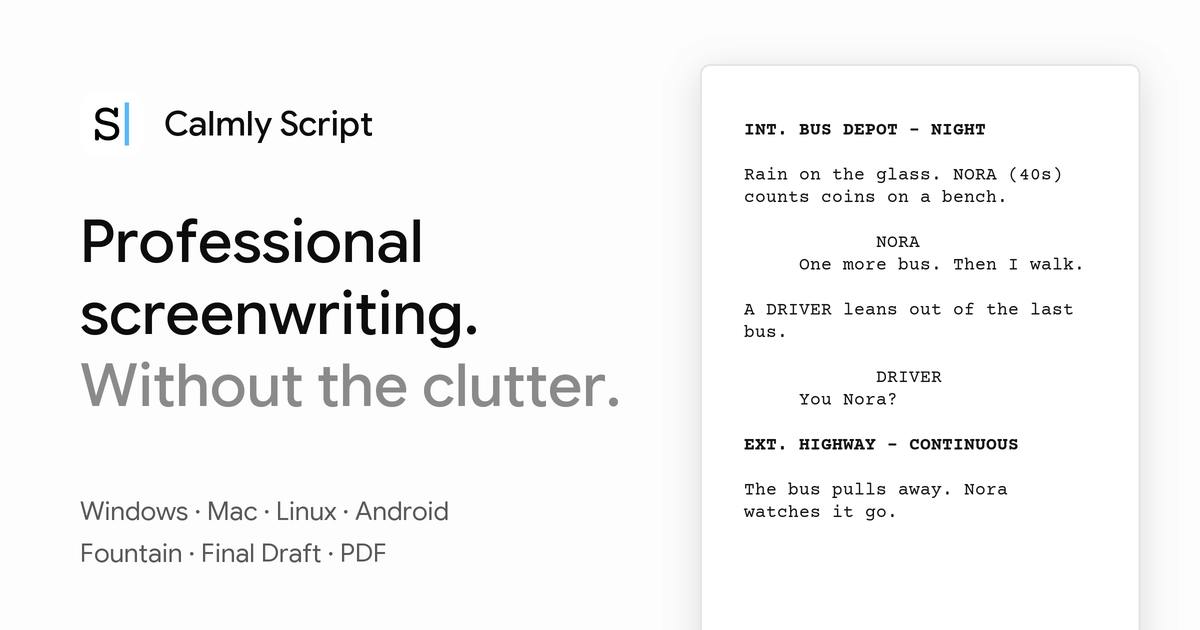
Calmly Script challenges subscription norms with pay-once, no-sign-up, tracking-free cross-platform screenwriting software.
Calmly Script is professional screenwriting software debuting on Product Hunt, with "pay once, no sign-up, no tracking" as its core pitch, contrasting sharply with subscription-based writing tools. It supports Windows, Mac, Linux, and Android, offers industry-standard pages, Final Draft compatibility, and open formats. Its account-free design simplifies use and improves script confidentiality. It received 68 upvotes on Product Hunt (18th), showing moderate attention. The article notes it faces ecosystem barriers from Final Draft and lacks collaboration features, but appeals to independent screenwriters, students, and budget-conscious freelancers.
In an era where subscription models and account systems have become the default rule of the software industry, a product that goes against the grain stands out. Calmly Script appeared on Product Hunt with the tagline "Beautiful screenwriting software. Pay once, no sign-up," receiving 68 upvotes and ranking in the top 20 for the day. The problem it aims to solve is clear: let screenwriters focus on the writing itself, rather than being distracted by accounts, subscriptions, and privacy tracking.
An "Anti-SaaS" Screenwriting Tool
Calmly Script positions itself as professional screenwriting software, but its business model stands in stark contrast to mainstream writing tools today. According to its Product Hunt page, the product uses a one-time payment model, requires no account registration, and does not track users. For creators long burdened by monthly subscription fees, this pricing strategy itself constitutes a value proposition.
More noteworthy is its platform coverage. Calmly Script simultaneously supports Windows, Mac, Linux, and Android—something uncommon in the screenwriting software space, where many comparable products tend to focus on only a single ecosystem such as macOS or Windows. Cross-platform support means screenwriters can complete their primary writing on desktop and revise scripts on mobile devices at any time, without worrying about file compatibility issues.
Professional Features: Industry-Standard Pages and Final Draft Compatibility
A beautiful interface is the first impression of Calmly Script, but its professional capabilities are equally noteworthy. The product description mentions several key features: industry-standard page formatting, support for Final Draft files, and open formats.
Industry-standard pages mean the script's layout conforms to the common conventions of the film and television industry—crucial for screenwriters who need to submit work to producers, directors, or screenplay competitions. Final Draft is a widely used file format in the screenwriting field, and compatibility with it shows that Calmly Script intends to integrate into existing professional workflows rather than requiring users to completely switch ecosystems. Open formats further reduce user migration costs—script data will not be locked into proprietary formats.
This combination of features sends a signal: Calmly Script aims to find a balance between professionalism and ease of use, meeting industry requirements while maintaining a clean and elegant interface.
Final Draft and Script File Formats
Final Draft is the de facto standard writing software in the screenwriting industry, and its proprietary .fdx format has become almost the lingua franca for film and television script exchange—producers, talent agencies, screenplay competitions, and production companies typically accept or require Final Draft files by default. This format not only stores text but also embeds the semantic structure of script elements such as characters, scene headings, dialogue, and transitions, as well as layout information like pagination and margins. For this reason, whether a new screenwriting tool can read and write Final Draft files often directly determines whether it can enter professional workflows. In contrast, "open formats" usually refer to non-proprietary formats such as plain text, Fountain, or public variants of FDX, which facilitate version control and cross-tool migration, preventing scripts from being locked into a single software ecosystem. Calmly Script supports both, meaning it respects the industry status quo while preserving an exit option for users.
Privacy and Focus: The Design Philosophy of No Accounts, No Tracking
"No account, no tracking" is Calmly Script's most intriguing design decision. In an environment where most software requires users to log in, skipping the account system not only simplifies the usage flow but also eliminates users' concerns about data collection.
The deeper logic of this design philosophy is that writing is an activity requiring high concentration, and any additional friction—registration processes, login verification, subscription reminders—can interrupt the creative state. By removing these steps, Calmly Script attempts to create a purer working environment for screenwriters. For professionals handling unreleased script projects, reduced data tracking also means better content confidentiality.
Account-Free Architecture and Local-First Software
"No sign-up" typically corresponds in technical implementation to a local-first architecture: the application stores script files directly on the user's device, with state and data not dependent on remote servers, so no account is needed to identify and sync users. This is the opposite of most cloud-based SaaS writing tools—the latter are account-centric, with data hosted on vendor servers, naturally requiring login, subscription verification, and behavioral analytics. The advantages of the local-first model are offline availability, low startup friction, and clear data ownership; the cost is that cross-device sync and multi-user collaboration require additional mechanisms (such as file sync drives or optional end-to-end encrypted sync) rather than being ready out of the box. This also explains why the product page does not emphasize collaboration capabilities: account-free design and real-time collaboration have some tension at the architectural level, as the latter typically relies on account systems and centralized services to coordinate multi-user state.
Market Positioning and Potential Challenges
Judging from Product Hunt feedback, Calmly Script received 68 upvotes and 2 comments, ranking 18th. This result indicates the product has attracted some attention, but discussion heat is not particularly high. Screenwriting software itself is a relatively niche market, where users tend to have high loyalty to their tools and switching costs are not low.
The challenge Calmly Script faces is: how to persuade professional screenwriters to try a new tool under the ecosystem barriers of mature products like Final Draft. Its advantages—one-time payment, cross-platform, privacy-friendly—are attractive to users tired of subscriptions, but professional users equally value collaboration features, cloud sync, and depth of industry-standard support. The product page does not mention collaboration-related capabilities, which may be a boundary of its current positioning.
However, for independent screenwriters, student creators, or budget-conscious freelancers, Calmly Script offers a choice worth considering: a professional writing environment with an elegant interface, respect for privacy, and transparent pricing. In an era of increasing software subscription fatigue, this "buy once, use forever" model may win a loyal user base.
Frequently Asked Questions
Which operating systems does Calmly Script support?
According to the Product Hunt page, Calmly Script supports Windows, Mac, Linux, and Android.
Does Calmly Script require account registration?
No. The product explicitly states "no sign-up," and users can use it without creating an account.
Can Calmly Script open Final Draft files?
Yes. The product description mentions support for the Final Draft file format, along with open format options.
How does Calmly Script charge?
It uses a one-time payment model rather than a subscription. For specific pricing, refer to the product's official website.
One-line Summary
Calmly Script challenges the subscription mainstream with cross-platform screenwriting software that charges once, requires no registration, and does no tracking.
Paragraph Summary
Calmly Script is professional screenwriting software that debuted on Product Hunt, with "pay once, no sign-up, no tracking" as its core selling point, forming a sharp contrast with today's popular subscription-based writing tools. It simultaneously supports Windows, Mac, Linux, and Android—a coverage range relatively rare among screenwriting software. In terms of professional features, the product offers industry-standard page formatting, Final Draft file compatibility, and open formats, balancing industry workflows with data portability. Its account-free design not only simplifies the usage flow but also enhances the confidentiality of unreleased scripts. It received 68 upvotes on Product Hunt, ranking 18th—moderate attention. The article argues that it faces ecosystem barriers from mature products like Final Draft and does not mention collaboration capabilities, but it is attractive to independent screenwriters, students, and budget-conscious freelancers.
Related articles

Open-Source AI Desktop Robot: Built with a Laptop + Android + Pico
Open-source AI desktop robot PAL9000: a MacBook runs MediaPipe vision and llama-cpp dialogue, an Android phone is the animated face, and a Raspberry Pi Pico W drives a 2-DOF pan-tilt head. Modular design, reproducible piece by piece, with a discussion of anthropomorphic design.

Why Did Your Backtest 'Beat' SOTA? The Weather Covariate Leakage Trap
A backtest showed Timestral's MASE dropping from 0.71 to 0.49, seemingly beating SOTA—but it was caused by weather covariate leakage. After correction, it was only 0.66. This article analyzes the leakage, the archived forecast dilemma, and provides a checklist for time series backtesting.
Ring Enters Robotics: Launching Home Security Drones and Enterprise Patrol Robots
Ring enters robotics with a home security drone and an enterprise rolling patrol robot. This article analyzes its product expansion logic, use cases, and practical challenges.