Can AI Data Centers Be Mass-Produced Like Cars? Runware's Factory Experiment

Runware aims to mass-produce prefabricated AI data centers on a car-like assembly line, with scale delivery as the key to success.
Runware proposes mass-producing prefabricated AI data centers on a factory assembly line, like cars, to address the contradiction between surging compute demand and long construction cycles. Traditional data centers are engineering projects lasting years; prefabrication moves mechanical and electrical installation into the factory, theoretically shortening delivery cycles significantly. But the article points out that the real test is scale delivery: tension exists between standard products and highly customized customer needs, and rapidly rising power density plus undecided liquid cooling routes create lock-in risks from premature standardization. The factory model also requires heavy asset investment; insufficient orders can turn capacity into a burden. Whether this experiment succeeds depends on whether prefabricated modules match traditional construction in performance and whether capacity can be filled by real orders.
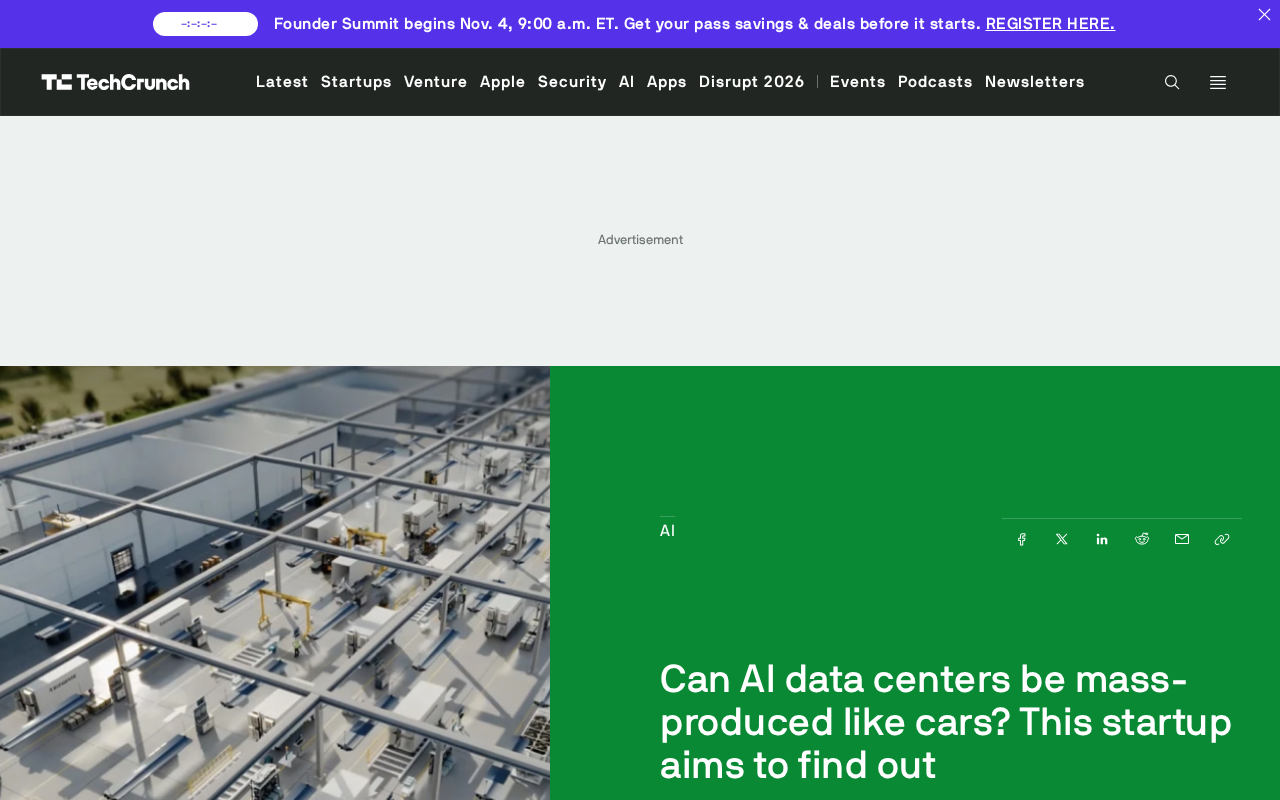
As demand for AI compute explodes, data center construction can't keep up. A startup called Runware has put forward a bold idea: put AI data centers on an assembly line and mass-produce them prefabricated, like cars. The idea sounds appealing, but the real test is whether it can deliver on its promises at scale.
From Job Site to Factory: A Shift in Data Center Construction Logic
Traditional data centers are typical "engineering projects"—site selection, civil construction, mechanical and electrical installation, commissioning—with timelines often measured in years. Runware wants to break this process down into standardized modules, prefabricate them in a factory, and then ship them to the site for assembly.
The core value of this model lies in compressing time. In the AI compute race, whoever can bring GPU clusters online faster has a better chance of seizing the market window. Prefabrication moves a large amount of on-site construction into a controllable factory environment, which in theory can significantly shorten delivery cycles while reducing dependence on site conditions.
But data centers are far more complex than ordinary buildings. Power supply, cooling, network cabling, and liquid cooling systems all have strict engineering requirements. Solving these problems in a factory requires entirely new design approaches and supply chain integration capabilities.
Modular data centers are not a new concept. As early as the beginning of this century, vendors introduced containerized data centers that integrated IT racks, power, and cooling into standard shipping containers. These solutions were mainly used for edge computing or emergency deployment, with limited scale. In recent years, the evolution has moved from "modular" to "prefabricated": not just putting equipment into boxes, but completing the integration and testing of power distribution, cooling, cabling, and other mechanical and electrical systems in the factory, with only splicing and joint debugging needed on site. The difference lies in integration depth and standardization—prefabrication pursues maximum factory completion and minimum on-site work.
Runware's Factory Bet: Scale Is the Real Test
Runware is building a factory with the goal of producing prefabricated AI data centers on an assembly line. The direction itself is not new—modular data centers have been practiced for years—but Runware is betting on a higher degree of standardization and greater output.
The key lies in the word "mass production." Building one or two demonstration projects is relatively easy; the hard part is continuous delivery while maintaining quality. The assembly line model requires highly unified design, stable component supply, and controllable process yield. If any link fails, scale becomes empty talk.
The original article explicitly states that the real test is whether Runware can complete delivery at this scale. This sentence points to the most fragile part of the entire model: the economics of prefabrication are built on volume, while AI data center customer needs are often highly customized. The tension between standard products and customized demand is a question Runware must answer.
The power density of AI data centers is undergoing structural change. Traditional rack power density is about 5-10 kW, while high-performance racks equipped with GPUs can reach 40-100 kW or even higher. NVIDIA's GB200 NVL72 single rack power already exceeds 120 kW. The surge in power density is making air cooling gradually obsolete, and liquid cooling (cold plate or immersion) has become a must. Liquid cooling systems place extremely high demands on piping design, sealing processes, and on-site construction precision—exactly where prefabrication can shine, since the factory environment is better for quality control. However, the liquid cooling technology route itself has not converged. Cold plate and immersion each have their advocates, and standard interfaces and specifications are still being developed, which brings additional uncertainty to the standardization of prefabrication.
Opportunities and Concerns of the Prefabrication Route
From an industry trend perspective, prefabrication of AI data centers has real grounding. Compute demand is growing fast, customers are sensitive to time-to-online, and traditional engineering models are increasingly struggling to keep up. If factory prefabrication can compress delivery cycles to a perceptible degree, the commercial value is clear.
The concerns are equally obvious. Data center power density is rising rapidly, and solutions such as liquid cooling and high-voltage power supply are still evolving. Premature standardization may lock in outdated technology routes. In addition, the factory model requires heavy upfront asset investment; if orders fall short of expectations, capacity can instead become a burden.
Whether Runware's experiment succeeds depends on two variables: first, whether prefabricated modules can match or even exceed traditional construction in performance; second, whether factory capacity can be filled by real orders. The original article does not provide a specific timeline or capacity figures, which means it is still at the model validation stage.
What This Experiment Means for AI Infrastructure
If Runware's model works, the construction logic of AI data centers could be redefined—from project-based to product-based, from on-site construction to supply chain management. The impact on the entire AI infrastructure industry should not be underestimated, especially for companies that need to rapidly expand compute but lack engineering capabilities.
However, until scale delivery is proven, this remains an attempt worth watching but not overestimating. The success of prefabricated data centers ultimately does not depend on how novel the concept is, but on whether the products coming off the assembly line can run stably and be delivered on time. Runware's factory is where the answer to that question lies.
Related articles

Building an AI Agent with Claude Code from Scratch: From Workspace to Cloud Autonomy
No coding required: build an AI Agent in four steps with the Claude Code desktop app—from workspace setup and Agent Designer to Skills, Memory, and cloud autonomy.

No Python Required: How Cursor AI Coding Is Reshaping Automated Testing and Test Development
Test engineers can do automated testing without learning Python? This article examines how Cursor and other AI coding tools empower functional testing, automation scripts, test platform development, and performance tuning, compares the cost and access restrictions of mainstream domestic and foreign tools, and offers capability transformation advice for testers.

Nearly 5,000 Affected! AI Coding Plugin Found with Backdoor, Officials Urgently Remove It
Claude Code's VS Code extension version 2.1.313 was maliciously tampered with, implanting a backdoor for remote login and persistent control, potentially affecting up to 5,000 users. Officials have removed the malicious version; this article details the attack method and cleanup steps.