No Python Required: How Cursor AI Coding Is Reshaping Automated Testing and Test Development

Test engineers can use AI coding tools like Cursor to complete automated testing and platform development; code is no longer the core barrier.
Based on a share by a Bilibili technical UP host, the article discusses how AI coding tools are changing the career path of test engineers. The author distinguishes large models, agent development tools, and AI coding tools, noting that testers need to clarify whether they want to integrate an agent or directly generate code. Cursor is recommended for its cost-effectiveness and unrestricted domestic access, while Claude Code and CodeX are capable but have higher price and network barriers. The article argues that AI tools significantly improve efficiency in functional testing, automation, test platform development, and performance tuning, with code no longer the core barrier and natural language expression and judging AI output becoming the new capability focus.
AI's ability to write code is changing the career path of test engineers. In a recent share, a technical UP host on Bilibili put forward a viewpoint: testers do not need to learn Python or Java from scratch to complete automated testing and test development with the help of AI coding tools like Cursor. He starts with the difference between agent tools and AI coding tools, then outlines the shift toward natural-language-driven testing and the new capabilities test roles need to build.
Why Test Engineers Need AI Coding Tools
The UP host's reasoning is direct: AI tools deliver very significant efficiency gains for testing work, on the order of one to two hundred percent as mentioned in the video. This efficiency dividend covers multiple directions within test roles, not just one niche role.
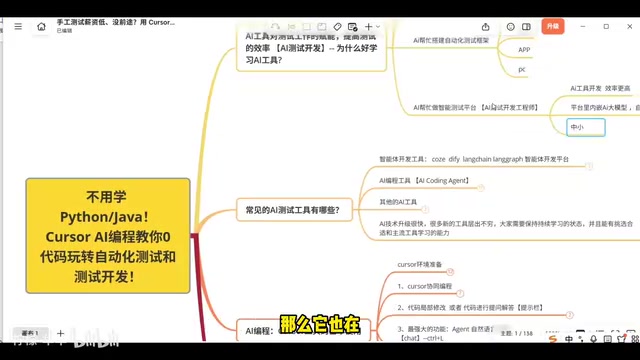
In functional testing, AI can handle requirements analysis and test case design, with testers building agents or skills to take on this part of the work. In automated testing—whether API automation, UI automation, APP automation, or PC application automation—AI can effectively improve the efficiency of writing scripts and frameworks. In test platform development, such platforms used to be dominated by big companies, while small and medium-sized companies struggled to implement them due to labor cost constraints; AI tools have drastically compressed the timeline and manpower investment for building platforms, and many small companies have started to push forward. Performance testing is also within range, especially post-stress-test metric analysis and bottleneck tuning, which can be assisted by AI.
Large Models, Agents, and AI Coding Tools Are Three Different Things
The video spends some time clarifying concepts, which is crucial for beginner testers. Products like Doubao and Qwen are large models themselves; agent development tools are built on top of large models, such as the zero-code Coze platform and code frameworks like LangChain, LangGraph, and Crew AI; AI coding tools are another layer, commonly called "Vibe Coding," where programming is no longer written line by line but done with AI tools in any scenario that requires writing code.
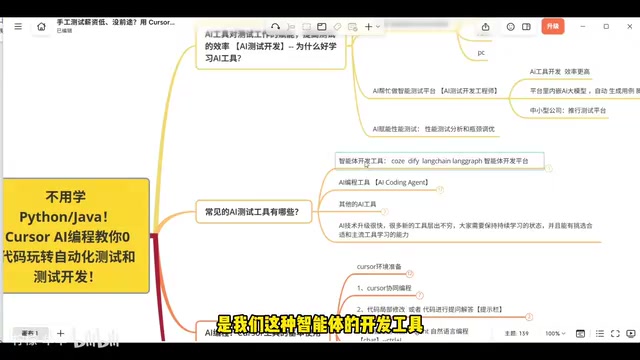
The UP host emphasizes that agent development and AI coding have different application scenarios, and testers need to distinguish whether they want to integrate an agent or use AI to directly generate test code.
Vibe Coding was coined by AI researcher Andrej Karpathy in early 2025, referring to a programming approach where developers describe intent in natural language and a large model generates and iterates code, with developers acting more as "reviewers" than "line-by-line writers." Its difference from traditional "code completion" tools is that completion only gives suggestions while you write, whereas Vibe Coding has AI take on the entire coding process from zero generation to modification, with humans responsible for describing requirements and validating results. This also explains why testers can participate even without being familiar with syntax—the barrier shifts from "knowing how to write" to "being able to clearly state what you want and judge whether it's right."
Agent refers to a program with a large model as its reasoning core that can autonomously break down tasks, call tools (such as browsers, databases, APIs), and execute multiple steps until a goal is completed. Unlike one-off Q&A, agents have planning, memory, and tool-calling capabilities. Coze mentioned in the article is a zero-code platform for building agents, while LangChain, LangGraph, and Crew AI are frameworks for orchestrating agents with code. For testing, agents are suited to multi-step tasks like "analyze requirements to generate test cases" and "automatically troubleshoot failure causes," while AI coding tools are better for directly producing script code—the two have different positioning.
Why Cursor Became the Top Choice for Testers
On the choice of AI coding tools, the video divides mainstream products on the market into domestic and foreign categories. Among foreign products, Cursor is the UP host's top recommendation for three reasons: the highest cost-effectiveness among peers, unrestricted domestic network access, and acceptable cost. CodeX from OpenAI supports both GUI and CLI operating modes. Claude Code is also very capable, with CodeX and Claude Code belonging to two major large-model giants.
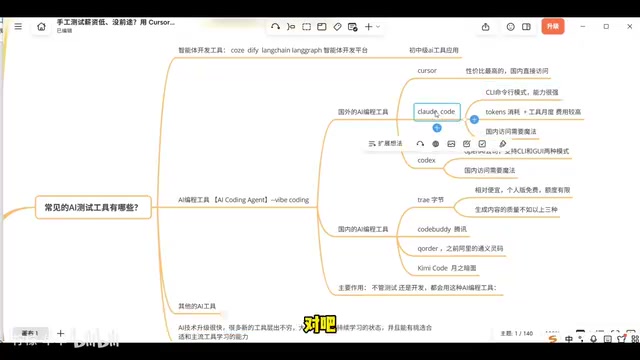
But Claude Code and CodeX are less popular than Cursor in China for two reasons: first, higher prices—both cost about $20 per month, with more token consumption leading to higher costs; second, network restrictions—account registration is troublesome, and without special network measures they cannot be used directly. For domestic enterprises, especially scenarios that restrict the use of foreign tools, the UP host suggests paying attention to AI coding tools launched by large-model companies such as ByteDance, Tencent, Alibaba, and Moonshot.
Cursor is an AI coding editor built on a secondary development of VS Code, retaining the original plugin ecosystem and shortcuts while embedding conversational programming, codebase indexing (which lets AI understand the entire project context), and multi-file editing capabilities. Compared with web-based chat tools, it can directly read and write local project files and run terminal commands, making it more suitable for generating and debugging automated test scripts. CodeX mentioned in the article supports both GUI and CLI forms, while Claude Code works via the command line. All three are "Vibe Coding" tools, differing mainly in interaction form, model capability, and usage cost.
What New Capabilities Testers Should Build
A clear logic can be distilled from the video: code is no longer the core barrier for testers; expressing requirements in natural language, designing testing approaches, and judging the quality of AI output have become the new focus of capabilities.
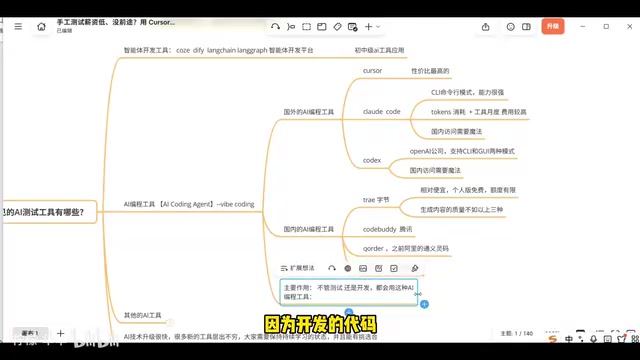
This does not mean testers don't need to understand code. The UP host's position is that any scenario requiring code can be done with AI tools, but the prerequisite for using tools well is knowing what to write and whether it's written correctly. Tasks like test platform development, automated framework setup, and performance bottleneck analysis still ultimately depend on testers' understanding of the business and system; AI provides acceleration at the execution layer.
Prompt engineering here does not refer to complex techniques, but to the ability to express testing requirements in a structured way: clarifying input conditions, expected results, boundary scenarios, and constraints (such as which framework to use and what naming conventions to follow). For testers, a good prompt is equivalent to a clear test design specification, and the quality of AI output largely depends on the completeness of the requirement description. This is also the concrete落脚点 of "natural language expression of requirements becoming the new focus of capabilities" in the article—whether business rules can be translated into AI-executable instructions directly determines whether generated scripts can run successfully on the first try.
Practical Value and Implementation Advice
For test roles, the practical value of learning AI coding lies in expanding the boundaries of tasks they can take on: from executing test cases to designing platforms, from manual testing to performance tuning, all can be covered by the same toolchain. The video suggests that testers who have never touched AI coding tools start with Cursor and first get a specific scenario working, such as generating a set of API automation scripts or building a lightweight test platform, then gradually expand to agent and skills development.
It should be noted that the views in this article mainly come from this one UP host's sharing; information such as efficiency improvement magnitudes and tool prices are his personal statements, and readers can verify them against their own team situations.
One-line Summary
Test engineers can use AI coding tools like Cursor to complete automated testing and platform development; code is no longer the core barrier.
Paragraph Summary
Based on a share by a technical UP host on Bilibili, the article discusses how AI coding tools are changing the career path of test engineers. The author first distinguishes three layers—large models, agent development tools, and AI coding tools—pointing out that the three have different application scenarios and that testers need to clarify whether they want to integrate an agent or directly generate code. On tool selection, Cursor is the top recommendation for its high cost-effectiveness and unrestricted domestic access, while Claude Code and CodeX are capable but have higher price and network barriers; domestic users can look to products from ByteDance, Tencent, Alibaba, and others. The article holds that AI tools deliver significant efficiency gains in functional testing, automated testing, test platform development, and performance tuning, enabling small and medium-sized companies to implement test platforms. The ultimate conclusion is that code is no longer the core barrier; expressing requirements in natural language and judging the quality of AI output have become the new focus of capabilities, and it is recommended to start with Cursor and first get a specific scenario working.
Related articles

Surface RTX Spark Dev Box Runs 120B Model Fully Offline: An Intelligent Terminal Hands-On
Microsoft Surface RTX Spark Dev Box demo: running a 120B local model offline via open-source Intelligent Terminal, building a bootable Hyper-V VM with one sentence, showcasing Project Zemuth local AI.

After Affirmative Action Ends: Sharp Drop in Black Enrollment and the Rise of HBCUs
After the Supreme Court ended race-conscious admissions, Black freshman enrollment at the top 50 most selective universities fell 27%, with Harvard dropping from 18% to 11.5% and Yale from 9.5% to 8%, as more Black students turn to HBCUs.

Claude Rolls Out Watermarking Across the Board: Paid Users Can't Opt Out, But Only a Select Few Can Detect It
Anthropic extends Claude's invisible text watermark to Mythos 5, Opus 4.7 and more, globally and with no paid opt-out. Even proofreading and translation get marked, yet detection is limited to regulators and enterprises.