Can Machine Translation Save Emergency Alerts? The Real Dilemma Facing Frontline Emergency Managers

A nationwide survey reveals emergency managers widely use commercial translation tools but lack quality assessment; the study proposes tiered use and process design.
The article examines how emergency warnings reach people who don't speak the dominant local language, noting that professional human translation is hard to mobilize during emergencies, making commercial translation tools an attractive but quality-opaque alternative. A nationwide survey finds emergency managers frequently use these tools yet lack means to assess output, operating "in the dark." The study evaluates tools against emergency needs, finding conditional practicality, and calls for process design with tiered use, quality checks, and human review.
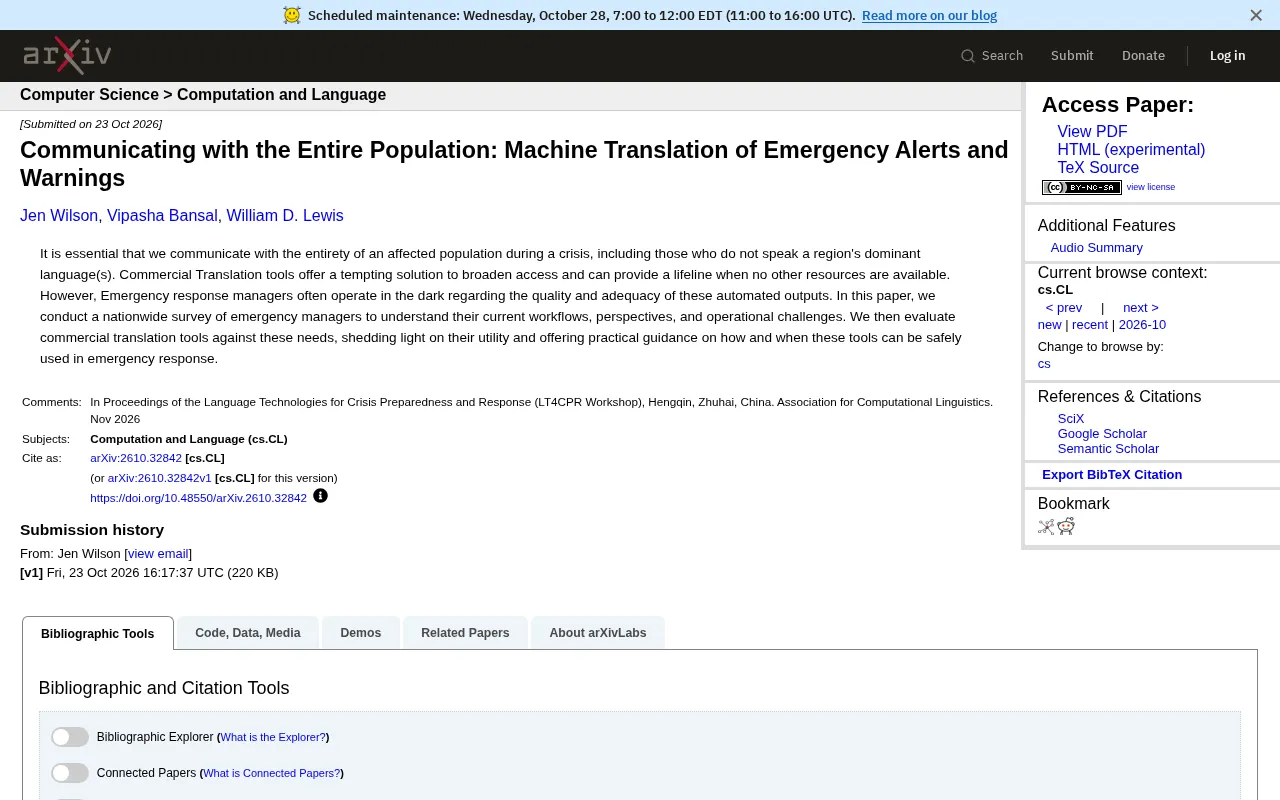
When a crisis strikes, getting warning information to people who don't speak the dominant local language is a life-or-death challenge. Commercial translation tools seem to offer a convenient solution, but emergency managers often know nothing about the quality of their output. A recent paper reveals this contradiction through a nationwide survey and systematically evaluates the actual utility of commercial translation tools in emergency scenarios.
The Overlooked Communication Gap: Warning Challenges in Linguistically Diverse Populations
Disasters don't pick their victims, but information reaches people in a sequence. During hurricanes, wildfires, or public health emergencies, immigrant communities, refugee groups, and non-native speakers often become the weakest link in the warning chain. The paper opens by noting that communicating with every single person in the affected population is a fundamental requirement of emergency response—which naturally includes those who don't speak the region's dominant language.
The real dilemma is that professional human translation resources are nearly impossible to mobilize on the spot during an emergency. Commercial translation tools therefore become a highly tempting alternative—they're readily accessible, low-cost, and when there's no other option, they can even serve as a lifeline. But the problem lies precisely in that "no other option": when machine translation makes a mistake, who catches it?
The Real Workflow of Emergency Managers: Findings from a Nationwide Survey
To understand what frontline emergency managers actually do, the research team conducted a nationwide survey focusing on three dimensions: current workflows, views on translation tools, and operational challenges.
The core contradiction the survey revealed is rather ironic: emergency managers frequently use commercial translation tools but generally lack the means to assess their output quality. Many of them aren't unaware that machine translation can make mistakes—they simply have no choice under time pressure and the imperative need to reach people. They have to "use it first and worry later." This state of "operating in the dark" means errors can silently slip into official warning messages without the publisher ever knowing.
The survey also reflected structural gaps in workflows: there are no standardized quality-check steps for translations, no clear guidelines for tool selection, and no mechanisms for identifying high-risk scenarios. What emergency managers need isn't more tool options but clear criteria for judging "when it can be used and when it can't."
The Capability Boundaries of Commercial Translation Tools: What the Evaluation Results Tell Us
Building on the survey, the research team conducted a comparative evaluation of how commercial translation tools actually perform against emergency managers' needs. The value of this evaluation lies in the fact that it doesn't stop at a vague judgment of "machine translation is good or bad" but attempts to answer a more operational question: under what conditions can these tools be safely incorporated into emergency response workflows?
The paper's conclusion points to conditional practicality. Commercial translation tools can provide effective support at the basic level of information delivery, especially for warning scenarios with high timeliness requirements and relatively simple content. But when it comes to texts involving subtle semantic differences, culturally sensitive expressions, or legal consequences, their limitations cannot be ignored. The research therefore proposes a series of practical guidelines to help emergency managers make informed decisions between tool utility and risk.
This "tiered use" approach deserves attention: rather than universally banning or relying on machine translation, it's better to establish usage standards tied to risk levels, letting tools play to their strengths while preserving room for human review at critical junctures.
The mainstream technical approach in machine translation is neural machine translation (NMT), which trains neural networks on large-scale bilingual corpora to learn probabilistic mappings between source and target languages. The advantage of this approach lies in fluency and generalization, but its output is essentially the result of statistical inference rather than deterministic understanding of meaning. Therefore, error rates in NMT rise significantly for low-resource language pairs, specialized terminology, culture-specific expressions, and texts requiring strict legal wording. Machine translation quality evaluation typically combines human scoring (such as adequacy and fluency dimensions) with automatic metrics (such as BLEU and COMET), but automatic metrics have limited correlation with human judgment—especially in scenarios like emergency warnings where accuracy requirements are extremely high, automatic metrics alone are insufficient to support publication decisions.
From Tools to Processes: The Need for Systems Thinking in Emergency Translation
The most commendable aspect of this research is that it elevates the question from "is the tool good?" to "how should the process be designed?" Commercial translation tools themselves don't cause harm—the real risk comes from usage methods that lack quality control.
For emergency management agencies, this means several concrete actions: establishing rapid verification mechanisms for translation quality, preparing validated template translations for frequently used language pairs, and clearly defining which types of warning messages must undergo human confirmation before publication. For translation tool developers, it means considering how to transparently communicate translation uncertainty to non-expert users—for example, through confidence indicators or high-risk phrase flags.
In a context where multilingual societies are becoming the norm, the translation challenge of emergency warnings is no longer a marginal issue. It tests whether the public safety system truly includes "everyone" within its scope of protection. Commercial tools can be part of the answer, but only if we are clear about where their boundaries lie.
In emergency management, information dissemination typically follows a closed-loop process of "alert—confirm—publish," in which human review is the final gatekeeper ensuring information accuracy. When embedding machine translation into this process, it's necessary to clarify its position in the loop: is it a draft-generation tool for human editing, or a real-time publishing channel that directly reaches audiences? The former has controllable risk, while the latter requires the tool to have high reliability. In practice, the "human-in-the-loop" design principle can be borrowed—preserving human confirmation at key decision points while using templating and pre-translation to reduce the burden of real-time translation. This approach is consistent with the quality management logic of high-reliability industries such as aviation and healthcare: not pursuing zero errors, but ensuring through process design that errors can be promptly detected and intercepted.
One-line Summary
A nationwide survey reveals that emergency managers widely use commercial translation tools but lack quality assessment methods; the research proposes tiered use and process design approaches.
Paragraph Summary
The article examines how emergency warning information can be delivered to people who don't speak the dominant local language, noting that professional human translation is difficult to mobilize immediately during emergencies, making commercial translation tools an attractive alternative—yet their output quality is often unknown to users. Through a nationwide survey, the research team found that emergency managers frequently use commercial translation tools but generally lack the means to assess translation quality, operating "in the dark," with workflows also lacking standardized check steps and tool selection guidelines. On this basis, the research compares the actual performance of commercial tools against emergency needs and concludes they have conditional practicality: suitable for high-timeliness, simple-content warnings, but with obvious limitations in texts involving subtle semantic differences, culturally sensitive expressions, and legal consequences. The article ultimately calls for shifting from tool selection to process design—establishing tiered usage standards, quality verification mechanisms, and human review steps for critical scenarios.
Related articles

LangChain Retry Middleware Configuration: Practices and Selection Guide
Based on Reddit community discussion, this article analyzes LangChain ModelRetryMiddleware retry parameter configuration practices, covering the selection logic and alternatives for key options like max_retries, backoff_factor, and jitter.

Texas Senate Race in Trouble: Why Are Republicans Nervous?
Texas Senate race stirs Republican anxiety. Based on street interviews, this article analyzes the Democratic offensive in funding, organization, and running everywhere, and how Republicans are defending "Texas, Texas" amid the political pendulum effect.

Gemini Chat Now Generates and Edits Google Docs Directly, a New Breakthrough in Office Productivity
Google Gemini's chat interface now generates and edits PDF, Google Docs, Sheets, Slides, Markdown, TXT, and code files. Available to all users; web supports all formats, mobile only PDF for now.