ChatGPT's Dot Can Now Send Texts, Google Releases Gemini 4 Carbon | AI News Roundup

Dot's texting marks AI assistants turning proactive; Google's Gemini 4 Carbon tops benchmarks but isn't a clear leader, while open-source and edge deployment keep lowering the barrier.
This issue of AI News covers 17 updates, with the core signal being that AI assistants are shifting from passive responses to proactively intervening in workflows. ChatGPT's Dot supports proactive texting via iMessage/RCS, currently in preview for US Pro users, revealing the proactive assistant trend. Google releases Gemini 4 Carbon within two weeks, topping the Artificial Analysis Intelligence Index V5.0 with 59 points, but ranking only second on the coding Agent index; the evaluator stresses that top benchmark scores don't mean overall leadership. In the developer ecosystem, Google launches the Connect Apps Platform, the open-source editor Carrot focuses on lightweight local operation, and OpenBNB's Lookahead Expert speeds up edge models 6x. In addition, NVIDIA open-sources the speech-to-text model Nemotron 3.5 Transcribe, Mistral launches the Responses API, Copilot Fusion schedules multiple models per task, inference cloud company Generon Cam2 closes a $100M Series A, and domestically MiniCPM-OCR can run locally on Apple chips.
Introduction: AI Assistants Are Stepping Out of the App
Two noteworthy signals in today's AI world: one is that Dot, the assistant inside ChatGPT, can now proactively send you text messages; the other is that Google has released frontier models two weeks in a row. The former means AI assistants are moving from inside apps into SMS—the most everyday entry point; the latter shows the pace of the large-model race is still accelerating. This issue of AI News covers 17 items, and we've picked out the ones most valuable to developers and ordinary users for deeper analysis.
1. ChatGPT's Dot Can Send Texts: The Proactive Assistant Has Arrived
According to the Bilibili creator "AI News," ChatGPT has announced that users can message Dot directly—assigning tasks via text, photos, or even voice—and Dot will proactively text you when there's progress. The official description says this feature uses iMessage or RCS, and only you can message your Dot, and your Dot can only message you. It's currently in preview, rolling out first to Pro users in the US.
An OpenAI employee involved in the feature said that giving Dot a phone number and connecting it to the real world is the first step. For domestic users and non-Pro users, it's not available yet, but it reveals a trend: AI assistants are moving from apps into SMS, the most everyday entry point.
This introduces a concept—the "Proactive Agent." An ordinary chatbot answers when you ask; a proactive assistant remembers what you've assigned, keeps track of progress on its own, and speaks up first when it's time to remind you. It's genuinely convenient, but you also need to think it through: how much information to show it, how often it should remind you—these boundaries need to be set by users themselves.
iMessage and RCS: iMessage is Apple's encrypted instant messaging service between Apple devices, limited to the Apple ecosystem; RCS (Rich Communication Services) is a carrier-level upgrade standard for SMS, supporting read receipts, high-definition images, and group chats, and is widely adopted on Android. What they share is that no extra app is needed—messages are sent and received directly tied to a phone number—making them the most natural channel for AI assistants to reach users. Dot's choice of these two channels means it doesn't depend on users opening the ChatGPT app, but exists in the system's messaging like a contact—which also explains why it's naturally suited to "proactive notification" scenarios.
2. Google Releases Gemini 4 Carbon: Top Benchmark Scores Don't Mean Overall Leadership
Google has released its next-generation frontier model Gemini 4 Carbon, just two weeks after the previous generation Gemini 4 Agong. The official claim is that it ranks first with 59 points on the Artificial Analysis Intelligence Index V5.0; on cybersecurity, SEC Bench Pro for finding vulnerabilities, Exploit Bench for exploiting them, and CWE Bench for patching them each have corresponding results (the materials mention Exploit Gem at 54.8% and CWE Bench at 71.0%). The official statement also emphasizes that it can handle complex tasks for days without getting stuck or taking shortcuts.
However, the evaluator adds a key detail: on the coding Agent index it ranks second with 59 points, only 3 points below Code Opus 5.5. The context window is 1 million tokens, with standard pricing at $4 per million tokens for input and $20 for output. The rollout is very conservative—this week it's first being given to some trusted cybersecurity defenders through Fairway's program, and release to developers and ordinary users is "soon" but undecided.
The evaluator's stance is clear: being first in benchmark scores doesn't mean being first in everything; it hasn't yet pulled ahead in coding and knowledge work. For ordinary users, it's not available yet.
The Artificial Analysis Intelligence Index is a comprehensive leaderboard maintained by the third-party model evaluation firm Artificial Analysis. It aggregates multiple public benchmarks (such as knowledge Q&A, reasoning, coding, etc.) by weight into a single score for easy horizontal comparison of models from different vendors. The leaderboard's strength is standardization and fast updates, and it's often used by vendors as promotional evidence at launch; its limitation is that a single total score masks differences among sub-items—just as Gemini 4 Carbon ranks first overall in this article yet lags on the coding Agent index, showing that "total score ranking" is not equivalent to "capability on specific tasks." When reading leaderboards, you need to return to the granular dimensions.
3. Anthropic Prepares a Tool Library for Lawyers
Anthropic has announced that Claude 4 Legal adds a ready-made tool library (Artifacts) covering contract review, regulatory tracking, citation verification, and other legal work. The usage is to start from built-in examples, add your own files and connectors, and once done, share it with anyone in the company. The official 73-second demo video mentions more than 20 customizable tools, and it can also connect to the various tools legal teams already use.
This post got about 3 million impressions, one of the highest-engagement AI product posts of the day. For ordinary people, it's mainly for law firms and corporate legal departments, but it shows that AI is turning industry work into sets of ready-made tools—an important path for AI to land in enterprises.
4. Developer Ecosystem: Connection Platform, Open-Source Editor, and Inference Optimization
Google Launches Connect Apps Platform Preview
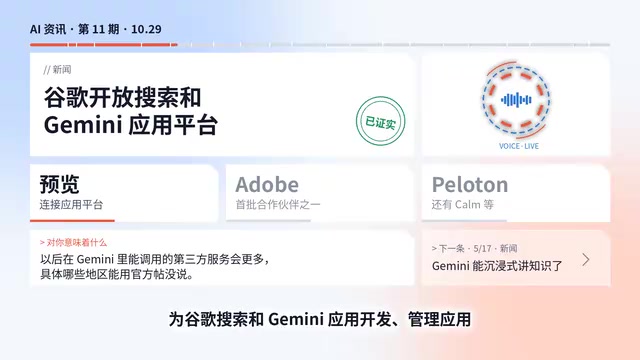
Google has announced the preview of the Connect Apps Platform, letting developers build and manage apps for Google Search and the Gemini app in one place, while launching a batch of new partner connection apps, including Adobe, Commvault, and Palantir. The approach is similar to ChatGPT's app plugins, letting third-party services plug directly into AI assistants. Which regions will have access has not yet been clarified officially.
Open-Source Code Editor Carrot
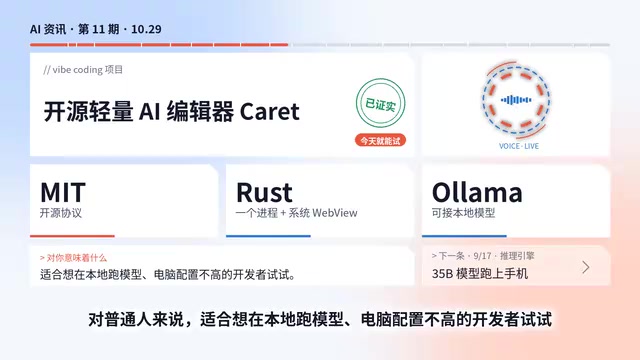
A developer has released Carrot, self-described as a Core-level open-source AI code editor. It doesn't bundle a Chromium runtime, doesn't need Node—just a REST process plus the system's built-in WebView, under the MIT license. You can fill in your own API Key, or go keyless and connect directly to local Ollama for chat completion and vector retrieval. The author specifically notes it's an independent project, unrelated to CEN and others. Suitable for developers who want to run models locally and have modest computer specs.
OpenBNB's Lookahead Expert Inference System
OpenBNB has released Lookahead Expert (AOS for short), enabling the MiniCPM-MV4.7 35BA3B mixture-of-experts model to run on edge devices. The official claim is that on an iPhone 18 Pro Max the whole system reaches 20.5 tokens per second, 6.07 times faster than loading expert weights on demand. The approach has three steps: while computing the current layer, predict and preload the experts needed for the next layer; use contiguous storage plus mixed-precision quantization to reduce loading overhead, shrinking weight files by 26.7% with only a 0.16-point average drop across five benchmarks; then use speculative decoding to verify multiple candidate tokens at once. This means models that can run offline on phones will keep getting larger, with better privacy and speed.
5. Open-Source Models and Agent Tools
NVIDIA Releases Nemotron 3.5 Transcribe
NVIDIA has released the open-weight speech-to-text model Nemotron 3.5 Transcribe, a 30-billion-parameter mixture-of-experts model activating about 4 billion per token. It puts transcription in 40 languages, speaker diarization, translation, context prompting, and audio understanding into a single model—in the demo, even when several people speak at once, it can tell who said what. The vLLM project says it can be deployed with vLLM on day one, supporting recordings up to one hour long. The evaluator measured a word error rate of 2.8%, tied for first among open-weight speech-to-text models. Developers making meeting minutes and podcast subtitles now have another option they can deploy locally.
Mistral Launches Responses API and Fast Models
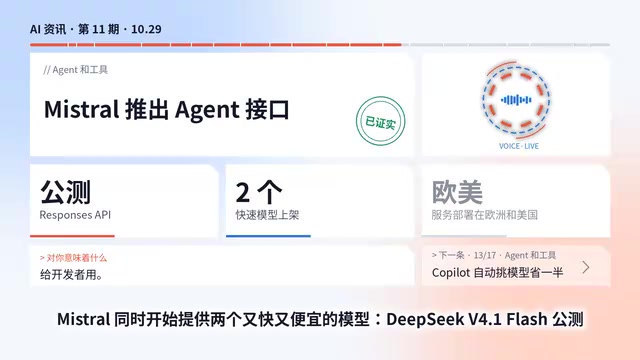
Mistral has launched the public beta of the Responses API, specifically for building Agents on Mistral: each return separates the model's answer, reasoning process, and tool calls into distinct items, making it more convenient for applications to handle each step than with ChatCompletions. It also offers two fast and cheap models—DeepSeekAd V4.1 Flash in public beta and JLM 5.3 Flash now generally available—with services deployed in Europe and the US. This also shows that Chinese open models are being directly adopted by overseas cloud platforms.
Copilot Fusion Schedules Multiple Models per Task
An evaluator introduces Copilot Fusion, launched by GitHub in Copilot, which selects and coordinates among multiple models from Anthropic and OpenAI for each task, including Claude Opus 5.5, Claude Sonnet 5.5, GPT-6 Estre, and GPT-6 Sol. Evaluation results show that on the coding Agent index it's only 2 points below Claude Code plus Opus 5.5, at $5.59 per task versus $11.42 for the latter; on Turnout Bench 4.0 it leads with 71 points, using about half the tokens, with fees charged by the models actually used. Note that this information comes from the evaluator's original post and was not verified in this issue. Those using Copilot can try whether the same work might be cheaper.
6. AI Startups, Research, and Domestic Developments
Inference Cloud Company Closes $100M Series A
Reports say AI inference cloud company Generon Cam2 has closed a $100 million Series A led by Blackbird Ventures and Abstract Ventures, with one report citing a valuation of $800 million. It uses specialized chips from SambaNova, Cerebras, and Positron to provide AI compute, focusing on ultra-fast token output—not building new large data centers but using existing facilities and former Bitcoin mines to run models. Chips beyond NVIDIA are also competing for the inference market, which in the long run could make AI cheaper to use.
Inference-Specialized Chips and Retrofitting Old Mines: Companies like SambaNova and Cerebras focus on architectures different from GPUs—Cerebras turns an entire wafer into a single giant chip to reduce data movement, while SambaNova uses a reconfigurable dataflow architecture; their common goal is higher token throughput and lower unit cost in inference (rather than training) scenarios. Bitcoin mines naturally have cheap electricity, cooling facilities, and ready-made facilities, and after retrofitting can directly deploy inference clusters, bypassing the high capital expenditure of building new large data centers. Whether this path works depends on the maturity of the specialized chips' software ecosystem and whether the power-cost advantage can be sustained long term.
A 32-Bit RISC-V Processor Packed Inside a Small Model
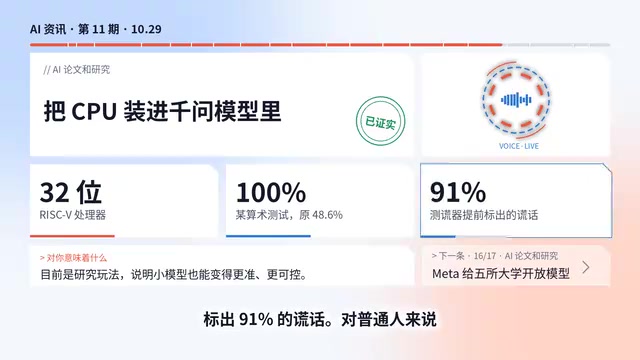
A developer did an experiment: packing a complete 32-bit RISC-V processor inside Qwen 3.5 4B, using the model's own Gated DeltaNet as memory, so that the model can directly execute C and MicroPython programs during forward computation without relying on an external runtime. Math problems are no longer about guessing answers—on DeepMind math problems the original model scored 55-90%, and after adding the Python pipeline, 95-100%. The developer also claims to have embedded a lie detector in the Qwen 3.5 weights that can flag 91% of lies before a wrong value is stated. It's currently a research toy, but it shows small models can become more accurate and controllable.
China AI News: MiniCPM-OCR Runs Locally
OpenBNB has announced that MiniCPM-OCR 1.0 (300 million parameters) and MiniCPM-OCR GF (2 billion parameters), used to check recognition results, can now run on Apple chips. Official data shows on M5 Max, OCR 1.0 prefills at 6,339 tokens per second and generates at 220 to 235 tokens per second, with a median scoring latency of 62.9 milliseconds; on real5 OmniDocBench it scores 93.68. GF compares recognized text, formulas, and tables against the original image, giving a correctness score from 0 to 1 to tell you what needs human review. In one case, a 1.2GB model locally processed Anthropic's 415-page IPO filing on a MacBook, about 4 seconds per page, with data never leaving the device. Open weights support llama.cpp and Ollama, and you can try it today.
7. Other Notable Developments
- Google announced Alphabet's Q3 results: annualized revenue on the order of about $500 billion, revenue up 25%, AI investment driving search volume growth to the highest in nearly five years; Google Cloud revenue up 103%, its own models processing nearly 32 billion tokens per minute, up 40% quarter over quarter.
- The Gemini app launched immersive exploration, with selectable topics such as Silk Road trade routes, the internal structure of a jet engine, and the physics of lightning, expanding into interactive multi-layered content, suitable for students and the curious.
- Meta announced support for researchers at five universities—Caltech, Ohio State University Medical Center, Louisiana State University, Indiana University, and UTHealth Houston—to use its latest open-weight models, including MuseGlimmer, MuseSpark Open, and vision and multilingual models.
Conclusion
Today's keyword could be "proactive"—Dot proactively texts, Copilot proactively schedules models, inference systems preload experts. AI is shifting from passively responding to proactively intervening in workflows. For developers, the barrier to local deployment and open-source tools keeps dropping; for ordinary users, what's worth thinking through is how much authority to give AI and how far to let it go on your behalf.
Background Supplement
Mixture of Experts (MoE) and Speculative Decoding: A mixture-of-experts model consists of multiple "expert" subnetworks plus a routing mechanism, activating only a few experts per inference, so the total parameter count can be large while the per-inference computation is small—Nemotron 3.5 Transcribe's 30 billion total parameters with only about 4 billion activated per token is exactly this structure. Speculative decoding uses a lightweight "draft model" to quickly guess several candidate tokens, then has the large model verify them all in parallel at once, directly accepting the correct guesses, thereby speeding up without sacrificing quality. Lookahead Expert combines the two: predicting and preloading the expert weights needed for the next layer, then using speculative decoding for batch verification—precisely the key engineering technique that lets large models run on edge devices.
Related articles

AI Coding Tools Emerge as a New Attack Surface: Fake Claude Extension Steals Developer Information
A fake Claude code extension appeared in the Cursor marketplace, affecting up to 5,000 developers in 11 hours, stealing host information and implanting SSH backdoors. Learn the attack methods, self-check steps, and security defense strategies for AI coding tools.

ChatGPT Switches to Token Billing in December: Chat and Codex Share Quota — Who's Most Affected?
ChatGPT switches to Token billing in December, with chat and Codex sharing quota. Simple questions can use Instant for free; heavy Codex users are most affected.
ChatGPT and Codex Merge Usage Allowances: Who Runs Out First?
OpenAI merges ChatGPT and Codex paid allowances into one shared token pool in December. We break down the details, token metering ambiguity, OpenAI's financial motives, and how users should respond.