ChemE-as-Code: Open-Source Platform Lets AI Agents Take Over Chemical Engineering Design

ChemE-as-Code packages chemical engineering computations as agent skills, advancing engineering-trustworthy AI integration through externalized computation, traceable sources, and controllable versions.
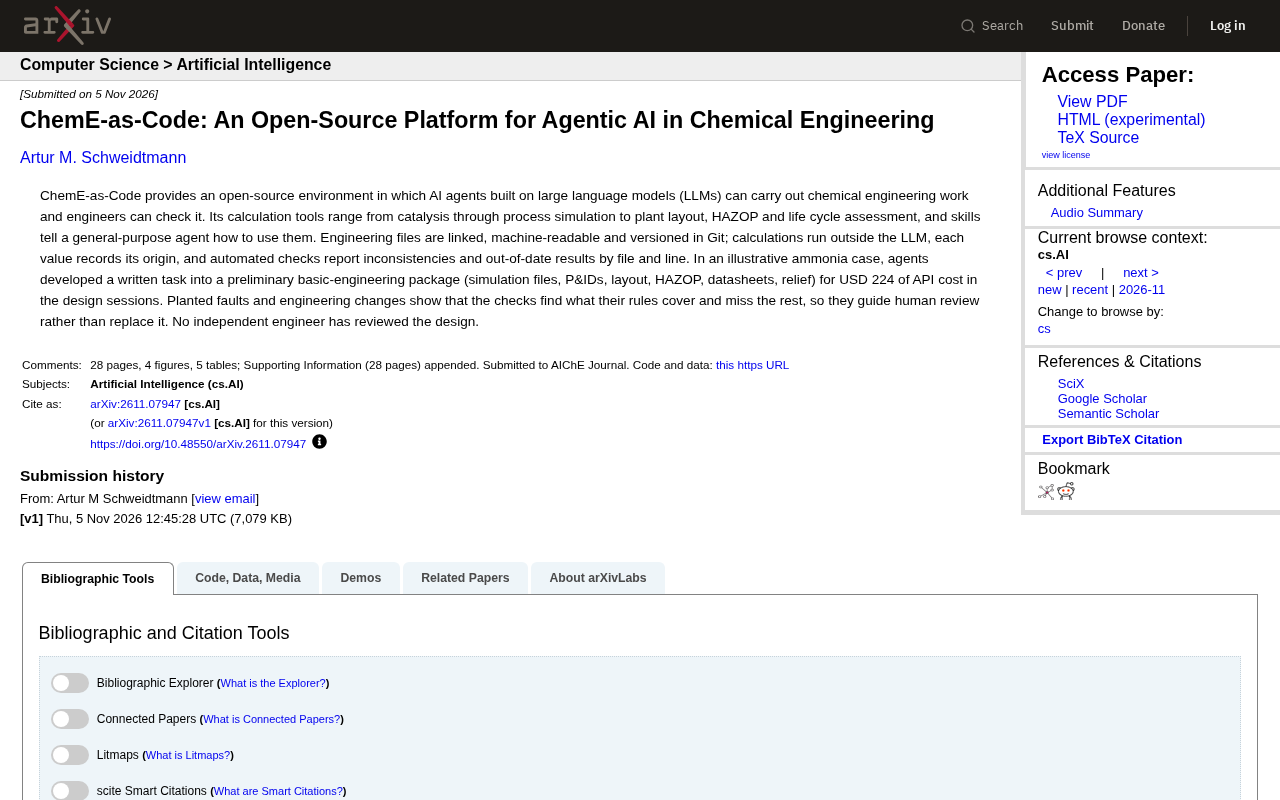
The open-source project ChemE-as-Code builds an executable, auditable chemical engineering computation environment for agents, packaging catalysis calculations, process simulation, plant layout, HAZOP analysis, and LCA as LLM-invocable skills. Its core design is the separation of responsibilities: computations run outside the model, every value records its source, engineering files are linkable, machine-readable, and Git-versioned, and automated checks report inconsistencies and outdated results by file and line number. In the ammonia plant example, the agent generated a preliminary basic engineering package including simulation files, P&ID, layout drawings, and HAZOP at an API cost of $224, but it has not yet been reviewed by an independent engineer. Fault-injection testing shows that checks only cover problems within the rules, and the platform is positioned to assist manual review rather than replace engineers.
Chemical engineering is undergoing an automation transformation driven by large language models. A recently launched open-source project called ChemE-as-Code aims to build an executable, auditable chemical engineering computation environment for AI agents—so that AI doesn't just "chat," but actually participates in engineering tasks ranging from catalysis to plant layout.
Platform Positioning: Let Agents Do the Computing, Let Engineers Do the Review
The core idea behind ChemE-as-Code is straightforward: package commonly used chemical engineering computation tools into skills that agents can invoke, with a general-purpose LLM agent calling them based on task descriptions. The tool coverage is quite broad, with corresponding modules for catalyst-related calculations, process simulation, plant layout, HAZOP analysis, and life cycle assessment (LCA).
The key design lies in the separation of responsibilities—all computations run outside the LLM, and every numerical value records its source. This directly addresses the pain point of LLMs being unreliable at numerical computation: the model is responsible for understanding tasks and orchestrating tools, while the computation engine is responsible for producing trustworthy results.
Agent Skills Mechanism: The "skills" here do not refer to AI's general capabilities in a broad sense, but rather to a modular tool-packaging specification—each skill typically includes a function signature, parameter schema, usage examples, and a description of the return format, and the agent reads this "instruction manual" to decide when to invoke it and how to pass parameters. This design is in line with the Agent Skills proposed by Anthropic and OpenAI's function calling approach; the essence is to decouple tool capabilities from the language model: the model is only responsible for intent understanding and orchestration, while the actual computation is done by deterministic code. For chemical engineering scenarios, this decoupling is especially critical, because process simulation, physical property estimation, and similar computations demand high precision, and any value "hallucinated" by a model could introduce engineering risk. The skills mechanism also makes the platform extensible—to add a computation tool for a new chemical engineering subdomain, you simply package it according to the specification and plug it in, with no need to retrain the model.
"Codified" Management of Engineering Files
The project designs engineering files to be linkable, machine-readable, and version-controlled with Git. This means changes during the design process can be tracked, and reference relationships between different files can be automatically resolved.
The accompanying automated checks report inconsistencies and outdated results, pinpointing the exact file and line number. For chemical engineering design—a field that relies heavily on document consistency—the value of this mechanism is that it turns "manually flipping through drawings to find contradictions" into "automatically locating the problem," significantly reducing review costs.
Example: Ammonia Plant Conceptual Design Package
The original article gives an ammonia-related example: the agent progressively develops a written task into a preliminary basic engineering package, with outputs including simulation files, P&ID (piping and instrumentation diagrams), layout drawings, HAZOP analysis, data sheets, and relief design. The API cost for the entire design session was $224.
This figure itself is worth noting—it shows that the AI generation cost of a complete conceptual-level engineering package has entered a discussable range, but the original article also makes clear that the design has not yet been reviewed by an independent engineer.
Engineering Context of P&ID and HAZOP: P&ID (Piping and Instrumentation Diagram) is a core drawing in chemical engineering design, using standard symbols to express equipment, piping, valves, instruments, and their connections; it is the basis for subsequent construction, operation, and safety analysis. HAZOP (Hazard and Operability Study) is a structured safety review method: a multidisciplinary team of experts systematically deduces the accidents and operability problems that deviations may cause, by combining process parameters (such as flow rate, pressure, and temperature) with guide words (such as "none," "more," and "reverse"). Traditional HAZOP relies heavily on expert experience and brainstorming, is time-consuming, and is difficult to automate. The article emphasizes that rule-based checks "can only find problems within the rules," precisely because HAZOP's creative reasoning is difficult to cover with exhaustive rules—which also explains why the platform positions itself as assisting rather than replacing engineers.
Basic Engineering Package (BEP) and Conceptual Design Stage: The Basic Engineering Package is a key deliverable as a chemical project moves from concept to detailed design, typically including process flow diagrams, material and energy balances, major equipment data sheets, preliminary P&IDs, safety analysis, and the basis for investment estimates. It determines the basic framework for the project's subsequent detailed design and procurement, and therefore places extremely high demands on document consistency and numerical reliability. The $224 API cost in the original article should be understood as the LLM invocation cost consumed by one conceptual-level design session, and does not include engineering review, manual verification, or subsequent detailed design costs. It is only meaningful to compare it within the quotation system of traditional engineering consulting—traditional basic engineering design often requires person-months of work. The significance of this figure is to show that the marginal cost of AI assistance has become low enough to allow experimentation at scale, rather than to replace the value of engineers.
The Boundaries of Automated Checks: What It Can Find and What It Will Miss
To verify the effectiveness of the checking mechanism, the project team planted faults and engineering changes into the design. The results showed that problems within the scope of the checking rules could be found, while problems outside the rules were missed.
This conclusion is actually quite restrained and honest. It means that ChemE-as-Code is positioned to assist manual review, not to replace engineers' judgment. For stages like HAZOP that fundamentally depend on expert experience and creative thinking, the completeness of rules is always relative.
Implications for the Adoption of AI in Chemical Engineering
The value of this project is not in proving that AI can do chemical engineering design "fully automatically," but in providing an engineering-trustworthy paradigm for AI integration: computation externalized, sources traceable, versions controllable, and checks locatable. These points correspond precisely to the core concerns industry has about AI.
At the same time, it provides the open-source community with an extensible framework—the skills mechanism means that new computation tools can be continuously integrated to cover more chemical engineering subdomains. As for whether such platforms can pass industry validation and truly enter engineering practice workflows, more independent reviews and real project testing are still needed.
A Brief Introduction to Life Cycle Assessment (LCA): Life Cycle Assessment is a systematic method for quantifying the environmental impact of a product or process throughout its entire life cycle. It typically follows the ISO 14040/14044 framework and is divided into four stages: goal and scope definition, inventory analysis, impact assessment, and interpretation of results. In chemical engineering, LCA is used to compare the carbon footprint and resource consumption of different feedstock routes, process schemes, or product designs, and is an important decision-making tool for green chemical engineering and sustainable design. Packaging LCA as an agent skill means that the agent can invoke inventory data and impact assessment models already at the conceptual design stage, quickly providing environmental comparisons of different schemes. However, LCA results are highly dependent on boundary setting and data quality, and the values produced by the model-orchestrated tools still require engineers to verify whether the assumptions are reasonable—consistent with the "human-machine division of labor" principle emphasized throughout the article.
One-line Summary
ChemE-as-Code packages chemical engineering computations as agent skills, advancing engineering-trustworthy AI integration through a paradigm of externalized computation, traceable sources, and controllable versions.
Paragraph Summary
The open-source project ChemE-as-Code builds an executable, auditable chemical engineering computation environment for agents, packaging tools such as catalysis calculations, process simulation, plant layout, HAZOP analysis, and LCA as skills that LLMs can invoke. Its core design is the separation of responsibilities: computations are executed outside the model, every numerical value records its source, engineering files are linkable, machine-readable, and version-controlled with Git, and automated checks can report inconsistencies and outdated results by file and line number. In the ammonia plant example, the agent generated a preliminary basic engineering package including simulation files, P&ID, layout drawings, and HAZOP, at an API cost of $224, but it has not yet been reviewed by an independent engineer. Fault-injection testing shows that checks only cover problems within the rules, and the platform is positioned to assist manual review rather than replace engineers.
Related articles
 Tech Frontiers
Google Omni 1.2 Flash: 15-Second AI Video at Just $0.07 per Second
Google DeepMind releases Gemini Omni 1.2 Flash: 15-second video, 720p at $0.07/sec (30% cheaper), multi-turn editing without regeneration, draft upscaling to 4K.
 Tech Frontiers
No AI Ghostwriting: Writer's Quarter Reinvents Novel Writing with a Visual Workbench
The Writer's Quarter is an AI-free novel writing and planning tool that unifies character building, story planning, and manuscript writing in one visual workbench. This article analyzes its positioning, target users, and differentiated value amid the rise of AI writing tools.
 Tech Frontiers
Fleeep: A Unified Inspiration Collection Notes App for Creatives
Fleeep is a notes app for creatives that unifies screenshots, bookmarks, saved posts, and inspiration into one calm, cross-device, offline-capable space. This article analyzes its positioning, differentiation, and target users.