Claude Accused of "Throttling on First Question": Reddit User Tests Multiple Accounts, Still Hits Limit Instantly
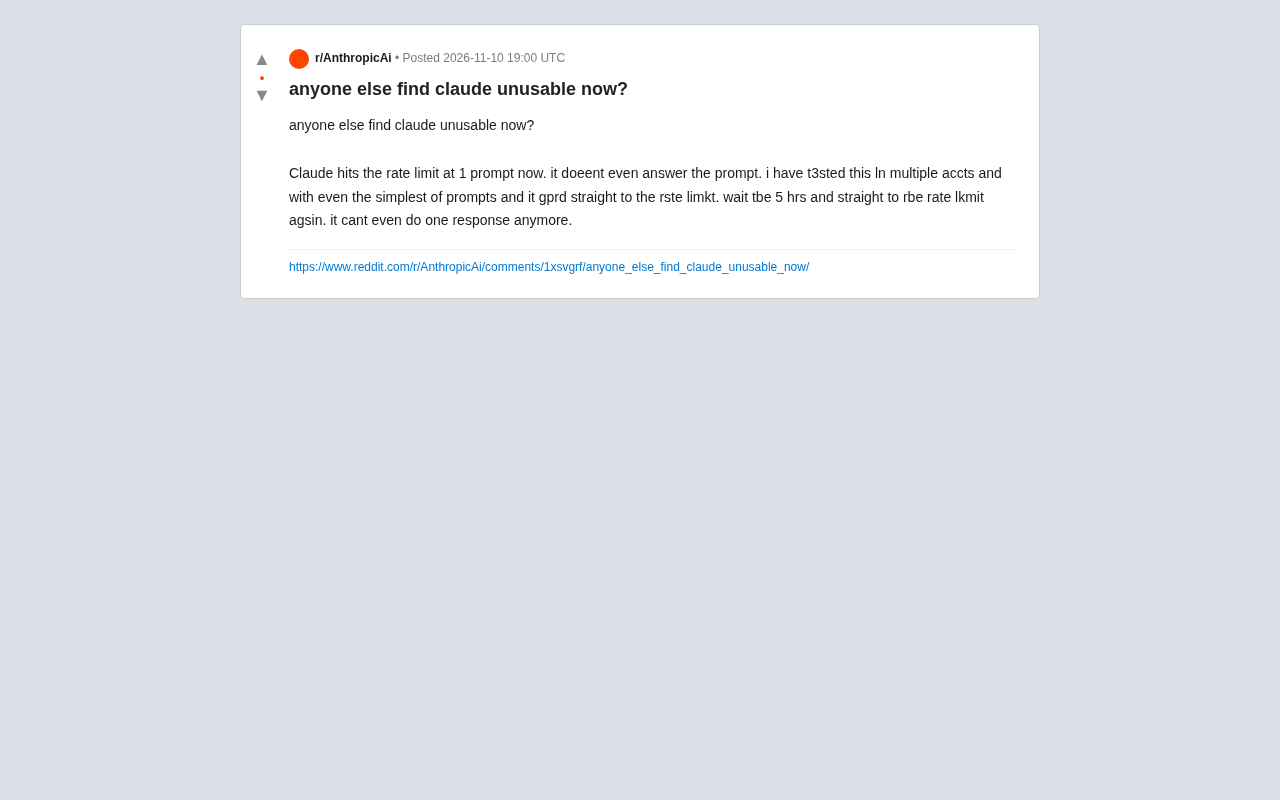
Reddit user says Claude triggers rate limiting with a single prompt; multiple accounts still reproduce, pointing to platform quota policy.
A Reddit user posted that Claude is now "unusable": sending the simplest prompt gets blocked by rate limiting, without even receiving any answer. He cross-tested with multiple accounts, used the simplest inputs, and waited for the 5-hour reset cycle before retrying—the problem still reproduced. The combination of these three conditions makes it unlikely that the issue stems from prompt complexity or single-account risk controls, and more likely points to subscription tier or platform-side quota policies. The article also notes that this is only a single user's account, lacking official explanation and independent verification, and cannot be equated with a full-scale outage. The author further analyzes why throttling has become the most sensitive pain point in AI product experience—it deprives users of even the chance to verify model quality—and suggests users troubleshoot across environments, record trigger timelines, contact official support, and for team users, prepare backup model channels.
From "Unlimited Conversations" to "One Question, Instant Limit": What Claude Users Are Experiencing
A complaint post on Reddit has drawn attention: a user claims that Claude now "triggers rate limiting with a single prompt," getting blocked at the door before even receiving an answer. According to his account, this isn't an isolated incident—he repeatedly tested with multiple accounts using the simplest prompts, and every result was "instant throttling"; even after patiently waiting a full 5 hours, trying again still hit the limit immediately.
The core message of this feedback is clear: what the user perceives isn't the model "getting dumber," but the service "being inaccessible." For people who rely on Claude for daily writing, coding, or analysis, this experience is equivalent to unavailability. The post title is blunt—"unusable now"—and behind the emotion lies strong dissatisfaction with service reliability.
Cross-Validation with Multiple Accounts: The Problem Points to the Platform Side, Not a Single Account
What's worth noting is the poster's verification method. He didn't just complain about an occasional anomaly on one account; he cross-tested with multiple accounts and deliberately used the simplest prompts—meaning the problem is unlikely to stem from "prompts too complex causing excessive consumption" or "a single account being flagged by risk controls."
According to the user, the situation remained unchanged after waiting 5 hours (typically corresponding to some limit reset cycle), further weakening the "temporary glitch" explanation. Multiple accounts + simple input + reproduction after waiting for reset—these three conditions combined point the finger at subscription tier or platform-side quota policies, rather than an occasional failure of an individual account.
It should be noted that this is a single user's account on Reddit, and there is currently no official statement or independent verification from other channels. It reflects a real user perception, but cannot yet be equated with a full-scale outage.
Tiered Mechanisms of Subscription Levels and Quota Policies
Mainstream AI assistants typically divide rate limit tiers by subscription level (e.g., Free, Pro, Team, Enterprise), with each tier corresponding to different "messages per cycle," "requests per minute," and "context window caps." Some products also introduce dynamic quotas: tightening limits for lower-tier users during peak hours, or applying differentiated billing based on estimated token consumption per request. This means the same account may get completely different throttling results at different times and with different requests.
When users report "even the simplest prompt gets instantly throttled," two possibilities need to be distinguished: first, the base quota for their subscription tier has been lowered; second, the quota determination logic has developed a deviation unrelated to request content (e.g., counting incomplete failed requests as consumption). The former is a product strategy adjustment, while the latter is closer to a defect. The original post emphasizes "pointing to the platform side rather than a single account" precisely because synchronous reproduction across multiple accounts rules out the possibility of a single account being flagged by risk controls—but it cannot yet distinguish whether it's policy tightening or a logic failure. That would require official quota documentation or a status page to determine.
Why Rate Limiting Has Become a Sensitive Nerve for AI Products
For AI assistants, rate limiting is a necessary means of cost control and capacity management, but it is also one of the most easily amplified pain points in user experience. The frustration from a single throttling event often exceeds minor fluctuations in model answer quality—because users don't even get the chance to "verify quality."
From a product perspective, throttling strategies are usually related to subscription level, time-of-day load, and per-request consumption. When users report "even the simplest prompt gets instantly throttled," it usually means quota determination occurs at the request entry point rather than during generation, which amplifies the feeling of "being shut out." For heavy users, once the ratio of waiting periods to available windows becomes imbalanced, the product turns from a "tool" into a "game of chance."
Where Rate Limiting Is Technically Implemented
The location where rate limiting is implemented in different system architectures directly determines the form of "rejection" users experience. If quota determination occurs at the request entry point (such as an API gateway or reverse proxy layer), the system returns 429 (Too Many Requests) before consuming computational resources; if it occurs during generation (such as interrupting streaming output after token count reaches a threshold), users will see truncated answers. The user's report of "being blocked at the door with a single prompt, before even receiving an answer" corresponds precisely to the former pattern—indicating that throttling likely triggers before the request reaches the model, and is therefore unrelated to prompt complexity.
Common throttling algorithms include fixed window counting (resetting on cycles such as 5 hours), sliding windows, token buckets, and leaky buckets. Among these, fixed windows closely match the phenomenon of "still reproducing after waiting 5 hours": if the window reset logic has a defect, or the quota has already been exhausted by other requests at the start of the window, users will immediately hit the limit again after reset. This is also why cross-testing with multiple accounts has diagnostic value—it helps distinguish between "algorithm-level window bugs" and "account-level personalized quotas."
How Users Can Troubleshoot and Respond
Before official explanations are available, users encountering similar situations can do several things: first, switch to different network environments and devices to rule out local or IP-level risk control factors; second, record the specific times and frequency of throttling triggers to determine whether they match known reset cycles; third, monitor the official status page and community announcements to distinguish between a global outage and a personal quota issue.
If the problem still reproduces consistently across multiple accounts, multiple environments, and simple prompts, then the issue is most likely at the account quota or platform strategy level. In that case, contacting official support with a timeline record is more effective than repeated retries. For team users, preparing a backup model channel is also a pragmatic way to reduce single-point dependency.
Summary: The Service Trust Issue Behind a Single Complaint
The value of this Reddit post lies not in providing conclusions, but in raising a question worth attention: when throttling becomes so frequent that users "can't even get a single answer," the availability promises of AI products come into question. A single user's experience is not enough to define the situation, but it reminds us that the transparency of capacity and quota policies is becoming an underestimated factor in AI assistant competition.
Related articles

Microsoft Open-Sources Token Economizer: Saving 18%-31% on AI Coding Agent Costs
Microsoft's free open-source plugin Token Economizer cuts AI coding agent costs through micro skills, tool pruning, and failure loop intervention. Tests show 18.4% to about 31% average savings with Claude Code, Codex, and more.
Running GLM-5.3 on Two DGX Stations: A vLLM Tensor Parallelism Hands-On
NVIDIA engineers show how to run the 753B-parameter GLM-5.3 locally on two DGX Stations using vLLM tensor parallelism, covering RDMA setup, launch args, NCCL checks, and performance baselines.
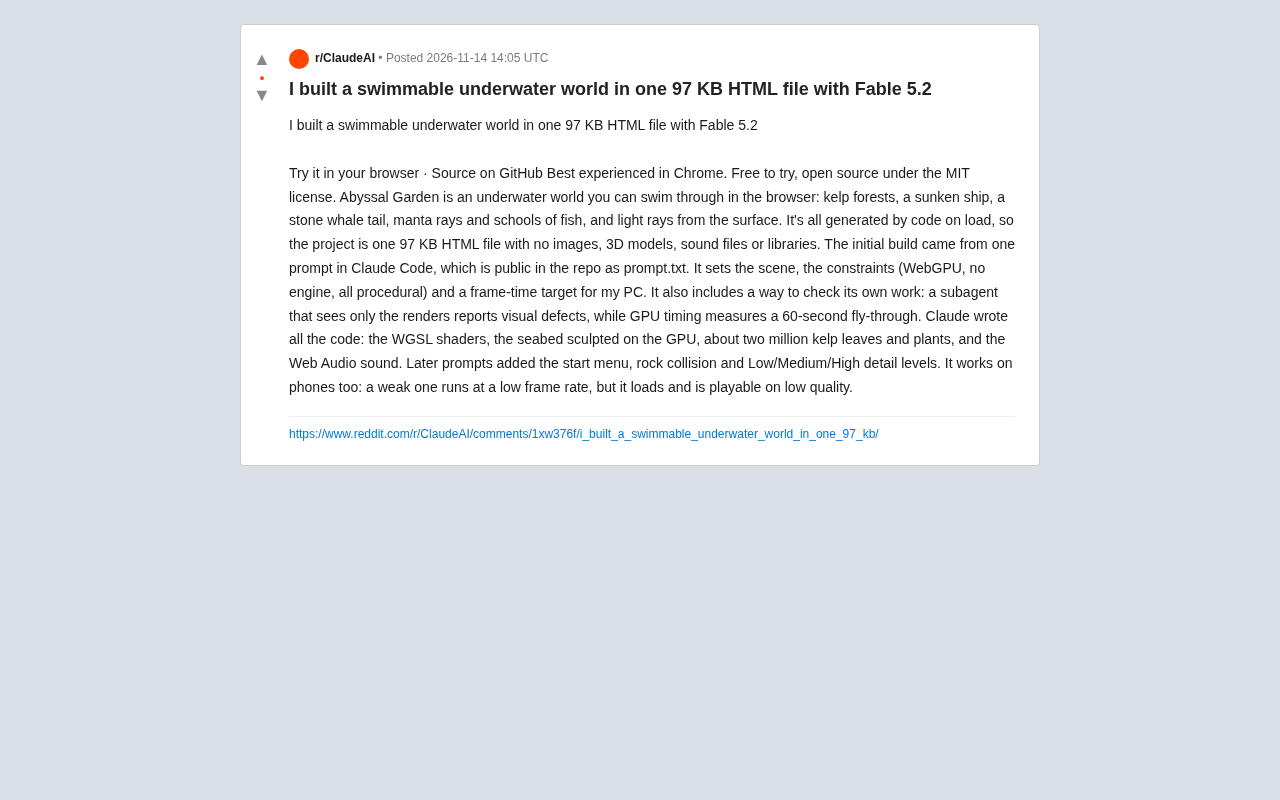
97KB Single-File HTML Underwater World: A WebGPU Experiment in AI Programming
A developer used a single prompt in Claude Code to generate a 97 KB single-file HTML underwater world, fully procedurally generated with WebGPU—kelp forests, a shipwreck, and fish, no images or model libraries, MIT-licensed, playable on mobile.