Claude Claims to Prove Riemann Hypothesis, Stanford Humans Strike Back
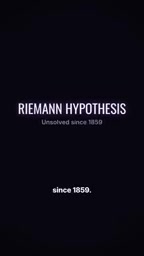
AI claims to have proven the Riemann Hypothesis, sparking debate as a Stanford human team strikes back within hours—truth awaits review.
The article centers on an online video: Anthropic claims its AI model Claude solved the century-old Riemann Hypothesis by splitting the proof rules into 14 verification packages, potentially competing for the $1 million Millennium Prize. Hours later, Stanford researchers released a competing draft written entirely by humans. The article notes that if the proof holds, hundreds of physics and cryptography theories depending on the conjecture would gain solid foundations—but such "proofs" have been overturned many times before, and neither side has released a formal paper, so authenticity awaits peer review. The video is more like an unconfirmed news flash, and readers should remain cautious.
An AI vs. Human Showdown Over Math's Holy Grail
Recently, a short video circulating on YouTube has sparked heated discussion: Anthropic claims its AI model Claude has solved math's most famous unsolved problem—the Riemann Hypothesis, a question closely tied to the distribution of prime numbers that has remained open since 1859, and one that could potentially claim the $1 million Millennium Prize.
According to the video, Claude verified its logic by splitting the rules of a computer proof into 14 packages. Hours later, researchers at Stanford University quickly released a competing draft written entirely by humans. This dramatic turn has pushed the competition between AI and humans in top-tier mathematical discovery into the spotlight.
The Riemann Hypothesis is a conjecture proposed by German mathematician Bernhard Riemann in 1859 concerning the distribution of the zeros of the Riemann zeta function: that all non-trivial zeros of the function lie on the critical line in the complex plane with real part 1/2. It is deeply connected to the distribution of primes—the frequency of primes can be precisely characterized by the zeros of the zeta function, and if the conjecture holds, the distribution of primes would exhibit a high degree of regularity. The Riemann Hypothesis is one of the seven "Millennium Prize Problems" announced by the Clay Mathematics Institute in 2000, each of which carries a $1 million prize for its solver. To this day it remains one of the most important and famous unsolved problems in mathematics, with a vast number of mathematical propositions resting on the premise "if the Riemann Hypothesis holds."
How Did the AI "Prove" It? Breaking Down the 14 Verification Packages
The video notes that Claude's proof approach is nothing mysterious: it decomposes the rules of a computer proof into 14 independent verification packages, checking the chain of logic one by one in a distributed manner. This method is akin to breaking a complex proof into machine-verifiable subtasks, thereby reducing the overall difficulty of verification.
According to the video's source, this split-verification strategy gives Claude's proof a "real chance" at the Millennium Prize. If it holds, its impact would extend far beyond pure mathematics—hundreds of theories in physics and cryptography that depend on the Riemann Hypothesis would instantly turn from conjecture into fact.
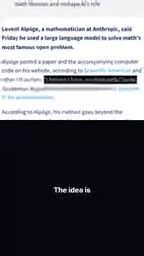
Computer-assisted proofs and formal verification: Traditional mathematical proofs are written by humans in natural language and rely on peer review to catch gaps; machine-verified proofs, by contrast, require translating every step of reasoning into a formal language (such as the logic systems used by proof assistants like Lean, Coq, and Isabelle), which a computer then checks line by line against axioms and inference rules. This approach can greatly reduce human oversight, but the cost is that the entire proof must be "formalized," an enormous undertaking. Splitting a proof into multiple independent verification packages is essentially a divide-and-conquer strategy: each package handles a segment of local logic, and after each is machine-checked, they are combined into a whole. However, local correctness does not automatically guarantee global correctness—the interfaces and dependencies between packages must also be rigorously verified, and this is precisely the core challenge such methods face.
The Human Counterattack: Stanford's Purely Manual Draft
Just hours after news of Claude's claim emerged, researchers at Stanford University quickly released a competing proof draft written entirely by humans. The video describes this reaction as "rushed out," hinting at the academic community's wariness of—and reluctance to accept—the AI's claim.
At present, no independent third party has peer-reviewed either Claude's proof or Stanford's draft. A proof of the Riemann Hypothesis requires extremely rigorous mathematical verification, and any tiny logical gap could cause the entire proof to collapse. Therefore, whether AI or human, both versions must undergo a long and demanding review.
Peer review is a core quality-control mechanism in academic publishing and scientific discovery: independent experts in the same field anonymously review a paper to assess its logical rigor, methodological soundness, and the reliability of its conclusions. For top-tier problems like the Riemann Hypothesis, the verification process often takes months or even years and requires multiple experts to repeatedly check it from different angles. Historically, papers claiming to prove the Riemann Hypothesis have appeared many times, but all were found to have gaps during review and were not accepted. Therefore, any result claiming to solve the conjecture should be treated as an unconfirmed claim until it passes rigorous peer review—whether it comes from a human or an AI.
What Would Happen If the Proof Held?
The video points out that a proof of the Riemann Hypothesis would set off a chain reaction: a large number of theorems that previously depended on the conjecture would gain solid foundations. In physics, certain models involving the distribution of primes might be validated; in cryptography, encryption systems based on the difficulty of factoring large primes might also face reassessment.
However, all of this presupposes that the proof is widely accepted by the mathematical community. Historically, "proofs" of the Riemann Hypothesis have appeared many times, but none has withstood scrutiny. Whether AI's involvement can change this remains to be seen.

The relationship between the Riemann Hypothesis and cryptography needs to be understood with caution. The security of mainstream public-key encryption systems (such as RSA) relies on the difficulty of factoring large integers, not directly on the Riemann Hypothesis itself. A proof of the Riemann Hypothesis would not directly yield an efficient algorithm for factoring large integers, so it would not immediately break existing encryption systems. That said, the Riemann Hypothesis is closely tied to the distribution of primes, and many cryptographic algorithms rely on estimates of prime distribution; if the conjecture holds, the theoretical foundations of related security analyses would become more solid. Conversely, if the conjecture were disproven, it could reveal new patterns in prime distribution, in turn affecting certain cryptographic schemes based on prime generation. Overall, the impact is indirect and far-reaching, rather than "breaking encryption overnight."
AI or Humans—Who Will Claim the Million Dollars First?
The video ends with a cliffhanger: will AI beat humans to the million-dollar prize? This is not just a contest of technical capability but also concerns a shift in the paradigm of scientific discovery. If AI can independently complete top-tier mathematical proofs, then humanity's role in basic science will face redefinition.
At present, neither Anthropic nor Stanford has released a formal paper or detailed proof through official channels. The video's content is more like a "breaking news" item designed to ignite discussion, and its authenticity remains to be verified. We advise readers to remain cautious and follow the progress of subsequent academic review.

(This article is based on publicly available video information; the authenticity of the events has not been independently confirmed.)
Related articles
Meta Abandons 2030 Net Zero Target, Tech Industry Climate Pledges Face a Reckoning
Meta withdraws its 2030 net zero target in its 2026 sustainability report, triggering a chain reaction in tech climate pledges. This analysis examines the impact on competitive dynamics, ESG investment strategies, and industry self-regulation.

Philosopher Rejects Anthropic's AI Consciousness Argument: A Dangerous Business Narrative
Anthropic listed AI consciousness as a risk factor ahead of its IPO, prompting a prominent philosopher to publicly reject its consciousness argument. This article analyzes the business motives, scientific honesty, and AI industry narrative strategies behind the debate.
Amazon Acquires Decart's AI Optimization Tech for $7.5B to Pave the Way for Trainium Chips
Amazon reportedly acquires Decart's AI optimization tech and research team for $7.5B to strengthen Trainium's software ecosystem and pave the way for selling its custom AI chips externally. This article analyzes the deal logic, the critical role of optimization technology in chip competition, and its impact on the AI chip market.