Claude Code Agent Teams in Practice: A Deep Dive into AI Agent Team Collaborative Development

A practical guide to Claude Code Agent Teams: how AI agent collaboration is replacing traditional development workflows.
This article explores Claude Code's Agent Teams feature, explaining how multiple AI agents collaborate like a real development team. It contrasts Subagents (isolated, independent execution) with Agent Teams (real-time collaboration with shared context), covers their ideal use cases, and shares enterprise-level insights on how AI programming is reshaping hiring and development practices.
AI Programming Is Reshaping Enterprise Development
In a recent technical sharing session, a practitioner deeply involved in AI implementation shared his complete experience of independently completing and successfully launching an enterprise-grade web project using Claude Code. The presenter currently serves as an AI technology consultant for five companies and advises graduate students at two universities on related research topics — his insights come directly from frontline enterprise implementation.
The first question he posed was quite impactful: Has your company truly adopted AI programming tools like Claude Code, or are you still stuck writing code manually? In his view, if you're still entirely dependent on manpower to complete project development, that's a rather dangerous signal in today's landscape.
According to his sharing, he has had in-depth exchanges with technical managers and project leads at top-tier companies including Alibaba (Hangzhou Cloud Valley), Tencent (Shenzhen), and ByteDance. A clear trend has emerged: the entire R&D pipeline is essentially completed with AI assistance, and the traditional approach of "throwing more people at it" is rarely used to advance project development anymore.
Deep Shifts in Hiring: From Language Specialization to AI-Compound Skills
The presenter observed a signal that should alarm all developers: companies are generally taking an "out only, not in" approach to personnel, and among the few open positions, there is rarely hiring specifically for a particular programming language anymore.
The days of language-specific roles for Java, frontend, Go, C/C++, etc. are rapidly declining. They're being replaced by AI-related positions — companies need versatile talent who can work across languages and complete project development with AI assistance. This means that deep expertise in a single language is giving way to "comprehensive ability to leverage AI tools effectively."
This assessment set the tone for the entire session: AI Coding is no longer a nice-to-have — it's a core element of enterprise survival and talent competition. From 2024 to 2025, the AI programming field is rapidly evolving from "assistive completion" to "autonomous agents." Beyond Claude Code, products like Cursor, Windsurf, Devin, and OpenAI Codex are all exploring agentic programming paths. Gartner predicts that by 2028, 75% of enterprise software engineers will use AI code assistants, and agentic architecture is seen as the core of the next-generation development paradigm. The underlying driver of this trend is the improvement in model reasoning capabilities — when AI can autonomously plan multi-step tasks, it upgrades from a "tool" to a "collaborator," and companies naturally gravitate toward hiring versatile talent who can harness such tools.
What Are Agent Teams: From Single Tool to Intelligent Agent Teams
The core of this session was Claude Code's Agent Teams. The presenter believes Agent Teams represents a completely new phase in AI programming — it's no longer an isolated AI tool, but rather a team of AIs that can self-evolve, assist each other, and even challenge one another.
This concept was introduced by Anthropic, initially released in experimental form, but the experimental label has since been removed and it's now officially available to users. Anthropic was founded in 2021 by former OpenAI Research VP Dario Amodei and Daniela Amodei, focusing on AI safety research and large language model development. Their flagship Claude model series is known for long context windows (up to 200K tokens), strong instruction-following capabilities, and low hallucination rates. Claude 3.5 Sonnet performs exceptionally well on coding benchmarks (such as SWE-bench), providing a solid model capability foundation for development tools like Claude Code.
In one sentence, the core value of Agent Teams: It allows you to launch multiple AI agents that collaborate on complex tasks like a real development team.
Regarding Claude Code itself, it's a command-line AI programming tool from Anthropic that runs directly in the developer's terminal environment, capable of reading project files, executing commands, and writing and modifying code. Unlike traditional IDE plugin-style AI assistants (such as GitHub Copilot), Claude Code adopts an agentic architecture — it doesn't just complete code snippets but can autonomously plan tasks, browse file systems, run tests, and iteratively modify based on feedback. This design makes it closer to a developer with autonomous action capability rather than a passive code completion tool. Agent Teams is a further upgrade built on this foundation.
Imagine a real development scenario: when facing a complex programming task, instead of fighting alone, you have an entire AI team working in coordination — this is exactly the experience transformation that Agent Teams delivers.
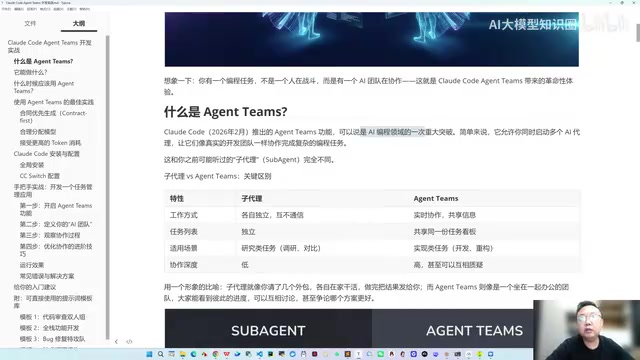
The Essential Difference Between Subagent and Agent Teams
The presenter specifically emphasized that to use this mechanism well, you must first clarify the core differences between Subagents and Agent Teams. These two are often confused, but their working mechanisms are completely different.
Differences in Working Methods
Subagents are independently isolated and do not communicate with each other. In the traditional "one main agent + multiple subagents" architecture, each subagent works in its own independent context, with no communication or sharing between them. After completing their respective tasks, they submit results uniformly to the main agent for orchestration and integration.
Here it's important to understand the key concept of "context": in large language models, context refers to all the text information that the model can "see" and process during a single conversation or task execution. Context windows have capacity limits, and when multiple unrelated tasks share the same context, "context pollution" occurs — where information from different tasks interferes with each other, causing the model to become confused and output quality to decline. This is precisely why the Subagent architecture isolates each subagent in an independent context: physical isolation prevents information crosstalk.
Agent Teams enable real-time collaboration and information sharing. Multiple agents communicate in real-time, collaborate with each other, and share the same task board. This is the most critical distinction between the two — one involves independent tasks with aggregated results; the other involves shared tasks with process-level collaboration.
Comparison of Applicable Scenarios
Each mode has its strengths:
- Subagents are better suited for research-type tasks, such as market research and industry comparisons. Assigning an independent subagent to each research direction effectively avoids context data confusion.
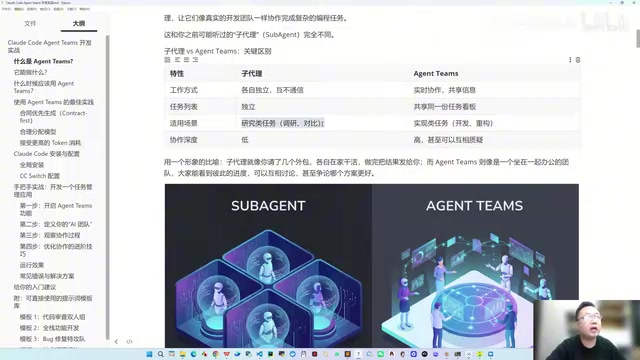
- Agent Teams are better suited for development scenarios requiring shared information, such as feature development and code refactoring. These tasks require deep collaboration among members, and information must flow freely.
Differences in Collaboration Depth
In terms of collaboration depth, Subagents are low — because they simply don't communicate or collaborate. Agent Teams are very high — members can challenge and verify each other. The presenter used the software engineering concept of "cross testing" as an analogy: "I test your module, you test mine" — this mutual verification is exactly what manifests Agent Teams' high collaboration depth.
Cross Testing is a classic quality assurance practice in software engineering, with the core idea that "the author of the code should not be the only one testing it." In traditional teams, this typically manifests as Code Review and cross-validation — the module written by Developer A is tested and reviewed by Developer B, and vice versa. This mechanism effectively discovers defects in the author's blind spots. Agent Teams brings this practice into AI collaboration: multiple agents can review each other's code logic and verify implementation correctness, simulating the quality control process of human teams, thereby significantly improving the reliability of the final delivered code.
A Vivid Analogy to Help You Quickly Understand
To make the concepts more accessible, the presenter offered a vivid analogy:
Subagents are like hiring several freelancers — each working independently from home, packaging their results and sending them to you when done, leaving you to organize and consolidate.
Agent Teams are like a team sitting together in the same office — everyone can see each other's progress, discussing and evaluating which approach is better, like a "brainstorming session."
In short: Subagents mean "distributed work with aggregated results," while Agent Teams mean "shared dashboard with joint collaboration."
Understanding this essential difference is the prerequisite for making the right choice in actual projects — use Subagents for research tasks to avoid context pollution, and use Agent Teams for development and refactoring tasks to leverage collaborative advantages.
Conclusion: From Tool Mindset to Team Management Mindset
The core message conveyed in this session goes beyond technical details — it's about a shift in mindset. When AI programming evolves from "a single tool" to "a collaborating team," developers no longer just need AI to help write a few lines of code — they need to learn how to orchestrate and manage an AI team.
For developers still on the sidelines, rather than debating "whether to use it," it's better to understand the respective positioning of Subagents and Agent Teams early and practice in real projects. As the presenter emphasized, in an era where enterprise hiring increasingly favors "AI-compound capabilities," mastering this collaborative AI programming paradigm may be the key step in navigating industry transformation.
Key Takeaways
Related articles

How Gen Turns Data into Decisions with ChatGPT Work
In an OpenAI user case, business leader Gen shares how ChatGPT Work turns data into decisions: within hours of launch, teams can judge whether integrations and onboarding flows work, shifting decision iteration from hundreds of trial-and-error attempts to a fast feedback loop.

ChatGPT vs. Claude In-Depth Comparison: Strong at Coding but Weak at Research — How to Bridge the Gap?
A user considers switching from ChatGPT to Claude, finding Claude stronger at coding but shallower at research. We analyze the differences and share tips to make Claude's research deeper.

Theranos Whistleblower Warns: The AI Boom Is "a Great Opportunity to Deceive"
Theranos whistleblower Tyler Shultz warns the AI boom is "a great opportunity to deceive" as never-profitable companies raise capital at trillion-dollar valuations. This article examines the real-world context, key differences between AI and Theranos, and practical criteria for investors and practitioners.