Claude Code New Permission Configuration: denyInsteadOfPrompting Explained
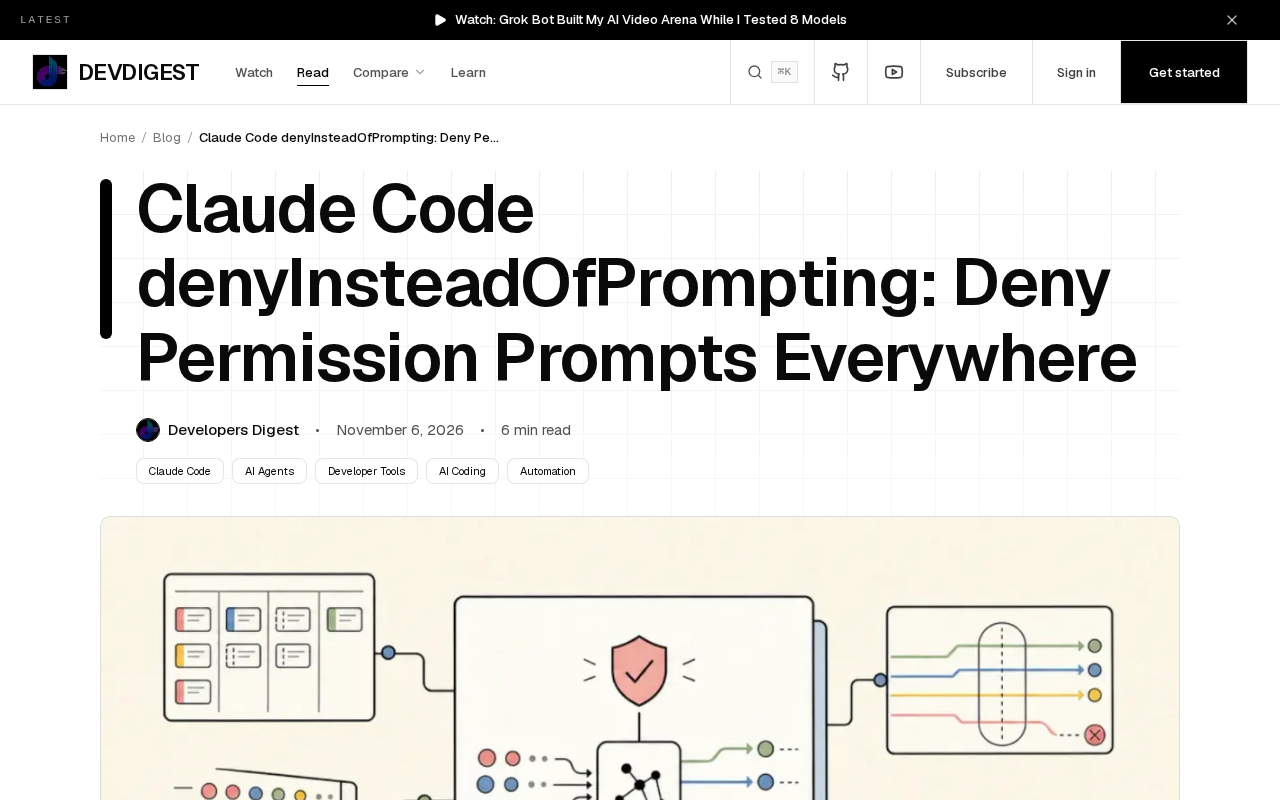
Claude Code's new config turns permission prompts directly into denials, trading them for continuity in automated workflows.
The article introduces the `permissions.denyInsteadOfPrompting` configuration in Claude Code 2.1.319. When enabled, any tool call that would trigger a permission prompt is immediately denied rather than waiting for user confirmation, the turn continues, and subagents follow the same rule, ensuring consistent behavior across the agent tree. It suits highly automated environments like CI pipelines and unattended scripts, avoiding stalls from prompts. The cost is reduced flexibility—the model may abandon viable paths—so it should be paired with tool allowlists and behavior monitoring. For critical operations, traditional prompts remain safer; this config trades controllable denial for workflow continuity.
The Pain Point of Permission Prompts and Its Solution
In automated development workflows, Claude Code's permission prompts often become an efficiency bottleneck. Whenever a tool call requires user confirmation, the entire execution flow pauses and waits. The permissions.denyInsteadOfPrompting configuration introduced in Claude Code 2.1.319 is designed to solve exactly this problem: any call that would trigger a permission prompt is directly denied, while the conversation turn continues executing—subagents included.
How the Configuration Works
This configuration lives under the permissions settings, with the key name denyInsteadOfPrompting. When enabled, Claude Code no longer pops up a confirmation dialog when it encounters an operation that requires user authorization; instead, it immediately returns a denial result to the model. The model can adjust its strategy accordingly and continue advancing the task.
Coordination with Subagents
The original content specifically emphasizes "subagents included"—subagents follow this rule as well. This means that in multi-agent collaboration scenarios, permission checks won't be interrupted by agent hierarchy, and the entire agent tree maintains a consistent behavioral pattern.
Subagents are independent agent instances spawned by the main agent in Claude Code to handle specific subtasks, commonly seen in task decomposition, parallel exploration, or specialized tool invocation scenarios. Each subagent has its own context and execution loop, but at the permission level it is still bound by the parent session. denyInsteadOfPrompting extends this constraint to the entire agent tree, meaning that as long as the main session has this configuration enabled, subagents at any level will be directly denied when they encounter operations requiring authorization, rather than bubbling up as a popup. This "configuration inheritance" feature is especially important for multi-agent orchestration: it guarantees behavioral consistency and prevents some deep subagent from quietly triggering an interactive interruption that breaks the continuity of unattended workflows.
Applicable Scenarios and Trade-offs
This configuration is suited for highly automated environments, such as continuous integration pipelines or unattended scripts. Developers can predefine the scope of allowed operations and deny everything else, thereby avoiding workflow stalls. The cost is reduced flexibility: the model may abandon viable paths due to misjudgment, requiring more refined tool allowlists to complement it.
For critical operations that require human review, the traditional prompt mode remains the safer choice. denyInsteadOfPrompting offers a clear trade-off: controllable denial in exchange for workflow continuity.
Tool allowlists are the allow mechanism in Claude Code's permission system, typically declaring through rules such as permissions.allow which tools or their invocation parameters can execute without confirmation. They form a complementary relationship with denyInsteadOfPrompting: the allowlist handles "precise allowlisting" of safe and high-frequency operations, while the latter serves as a fallback strategy that uniformly denies all other calls that trigger permission checks. The logic of the two working together is to first draw the boundary of trust, then say no to everything outside it—thereby ensuring in automated environments that workflows are not interrupted, while not letting the model completely lose its ability to operate. Without an allowlist, the model may frequently fail because a large number of legitimate calls are denied, which is precisely why the article emphasizes the need for "more refined tool allowlist coordination."
Practical Recommendations
Before enabling, it's advisable to first review commonly used tool calls and allow safe operations through other permission rules (such as allowlists). At the same time, monitor model behavior to confirm that the denial strategy doesn't cause tasks to fail repeatedly. This configuration complements Claude Code's existing permission system, providing finer-grained control for workflows at different levels of automation.
One-line Summary
Claude Code's new configuration turns permission prompts directly into denials, trading them for continuity in automated workflows.
Paragraph Summary
The article introduces the permissions.denyInsteadOfPrompting configuration introduced in Claude Code 2.1.319. When enabled, any tool call that would trigger a permission prompt is immediately denied rather than waiting for user confirmation, the conversation turn continues executing, and subagents follow the same rule, ensuring consistent behavior across the entire agent tree. This configuration suits highly automated environments such as continuous integration pipelines and unattended scripts, preventing workflows from stalling on prompts. The cost is reduced flexibility—the model may abandon viable paths due to misjudgment—so it needs to be paired with tool allowlists that precisely allow safe operations, along with monitoring of model behavior to prevent repeated task failures. For critical operations requiring human review, the traditional prompt mode remains safer; this configuration essentially trades controllable denial for workflow continuity.
Related articles
 Tech Frontiers
Edge AI on Microcontrollers: When Is It Actually Worth Deploying?
Drawing on Reddit discussions and Arm case studies, this article analyzes the real-world use cases for edge AI on microcontrollers: when each device needs independent inference, when a gateway or cloud is more reasonable, and the costs and boundaries of specialized hardware.
 Tech Frontiers
Pushing the Limits of Extreme Sudoku on a 16GB GPU: Insights from Depth and Flow Matching
A researcher trained a 16.54M-parameter model on a 16GB GPU to solve extreme Sudoku, finding effective depth breaks the 60% plateau and flow matching with improved sampling pushes accuracy past 99% with ~50× lower layer-evaluation budget.
 Tech Frontiers
AI Agent Approval Workflows: Why Human Confirmations Always Get Mindlessly Clicked
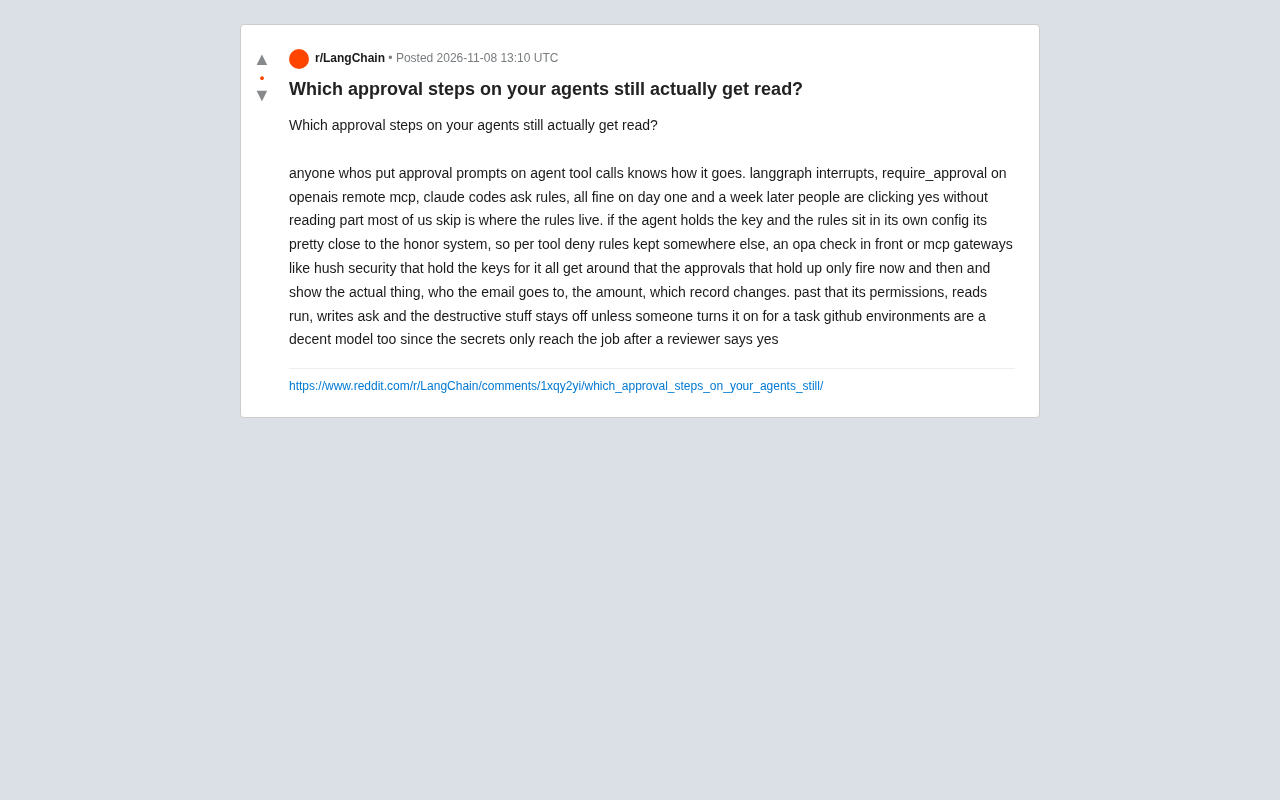
Why do AI agent approval workflows always get mindlessly clicked? A Reddit discussion shows that separating rules from keys, low-frequency high-risk approvals, and GitHub Environments-style gates are the keys to effective approvals.