Claude Code Token-Saving Guide: Say Goodbye to Weekly Limit Anxiety

From diagnosing consumption to compressing context, five moves to reduce Claude Code token usage.
The article compiles several Claude Code token-saving tips from the YouTube channel AI Builder, centered on subtracting from three levers: conversation history, reasoning effort, and context size. Use /usage to pinpoint consumption by percentage; understand that every message resends the full conversation history, and use /clear to isolate irrelevant context when switching tasks; lower /effort for simple tasks to avoid burning tens of thousands of tokens per thinking pass; avoid agent teams (about 7x token consumption) unless necessary; and on large repos, use Graphify code maps instead of reading files one by one, reported to cut usage by up to 70x. The 7x and 70x figures are empirical reports, and these methods only optimize allocation within the limit—they cannot exceed the plan's ceiling.
Title
Claude Code Token-Saving Guide: Say Goodbye to Weekly Limit Anxiety
Meta Description
Claude Code weekly limit running low? This article compiles token-saving methods shared by AI Builder: use /usage to pinpoint consumption distribution, /clear to wipe history between tasks, lower /effort for simple tasks, skip agent teams that consume 7x, and Graphify code maps that cut token usage by up to 70x on large repos.
Article Content
Claude Code's weekly limits are a headache for many developers, especially when a project enters its sprint phase and token consumption often outpaces expectations. A recent short video from the YouTube channel AI Builder offers several practical tips for reducing token consumption, ranging from usage habits to tool-assisted approaches. These methods aren't complicated, but each one targets the real mechanisms behind how Claude Code consumes tokens.
First, Pinpoint the Source: The /usage Command

When the limit is running low, the worst thing you can do is adjust blindly. The video's first suggestion is to run the /usage command, which displays your current token consumption distribution by percentage, letting you clearly see which parts are eating up the limit. This action doesn't save tokens itself, but it puts subsequent optimization on solid ground—you have to know where the money is going before you can save it. Many developers assume that most consumption comes from code generation, but the actual data often points to conversation history or the thinking process.
Resending the Full Conversation Every Round: The Cost Logic of /clear

An easily overlooked mechanism: Claude Code resends the entire conversation history to the model with every message interaction. This means the longer the conversation, the higher the hidden cost of a single message—even if you just follow up with "continue." The video points out that precisely because of this, running /clear to wipe the context when switching tasks costs almost nothing—what's cleared is local history, not the quota already consumed. Isolating unrelated tasks to avoid repeatedly carrying irrelevant context is one of the most direct ways to control consumption.
This mechanism stems from the stateless nature of LLM APIs: the model itself retains no session memory, and the so-called "context" is entirely reassembled and sent by the client with each request. As a result, conversation history, system prompts, and the contents of files already read are all billed repeatedly as input tokens, growing linearly with each round. Common industry countermeasures include context compression (summarizing earlier conversation), on-demand retrieval (pulling only relevant snippets rather than injecting everything), and session isolation. Understanding this makes it clear why the marginal cost of long sessions rises so quickly, and also explains why "clearing context" is a free operation in most tools—it only affects the locally stored message list and doesn't touch billing records already incurred.
Lower Reasoning Effort, Skip Unnecessary Agent Teams
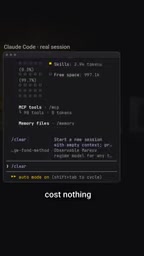
For simple tasks, you can lower the /effort setting. The video notes that the "thinking" phase alone can burn tens of thousands of tokens in a single request. Matching reasoning effort to task complexity avoids paying unnecessary reasoning overhead for something as simple as a formatting rewrite.

Another suggestion is more aggressive: skip agent teams unless absolutely necessary. The video's reasoning is that agent teams consume roughly 7 times the tokens of normal mode. Multi-agent collaboration is valuable for complex tasks, but treating it as a default configuration will drain your limit without you realizing it. For most everyday development tasks, single-threaded interaction is already sufficient.
Reasoning effort is an adjustable parameter introduced by reasoning models in recent years, typically divided into low, medium, and high levels. In high-effort mode, the model generates a longer internal chain of thought before giving an answer, breaking down the problem step by step and self-checking, thereby improving accuracy on complex reasoning tasks; but this thinking content is also billed as output tokens and often accounts for the bulk of a single request. Low-effort mode compresses or skips explicit reasoning, making it suitable for format conversion, simple rewrites, boilerplate code generation, and other tasks that don't require multi-step derivation. In practice, you can tier by task: use high effort for architecture design and tricky debugging, low effort for everyday completions and mechanical edits—avoid using a cannon to swat a mosquito.
Large Repository Scenarios: Use Code Maps Instead of Reading Everything
When working on large codebases, Claude Code needs to read in a large number of files to build context, which is a major drain on tokens. The video mentions a tool called Graphify that first maps the codebase into a structured map, letting Claude read the map rather than going file by file. According to user feedback, this approach can reduce token usage by up to 70 times. This figure comes from user reports rather than official benchmarks, and actual results will vary depending on repository structure and task type, but the idea of "giving the map first, then the details" itself aligns with common sense in context management: reduce redundant input so you can reserve quota for the parts that truly need reasoning.
A so-called "code map" is essentially a structured index: static analysis extracts files, functions, classes, import relationships, and call chains from the repository, then presents them to the model as a condensed symbol table or dependency graph. Compared to stuffing raw source files into the context, symbol-level indexes have much higher token density—a function might need only a single line of signature rather than dozens of lines of implementation. This approach shares the same philosophy as retrieval-augmented generation (RAG), except the indexed object is code structure rather than natural language documents. Common implementations include parsing based on abstract syntax trees (AST), querying via the Language Server Protocol (LSP), and building call graphs for on-demand expansion. The trade-off is that the index must be built and maintained in advance, and it may lag when the repository changes frequently, making it suitable for large projects with relatively stable structure.
Overall Recommendations and Limitations
Looking at these methods together, the core logic is consistent: Claude Code's token consumption is jointly determined by conversation history, reasoning effort, and context size, and optimization means subtracting on these three levers. /usage is for diagnosis, /clear is for isolation, /effort is for matching task complexity, skipping agent teams is for avoiding excess overhead, and Graphify is for compressing the input size of large repositories.
It should be noted that the video content is primarily experience sharing, and the figures of 7x and 70x are both reported values from the creator or users, lacking independent verification. In addition, these optimizations are essentially about allocating more efficiently within the limit—they cannot break through the plan's ceiling. If the weekly limit is frequently maxed out, in addition to adjusting usage habits, you may also need to reassess whether your plan tier matches your actual usage.
One-line Summary
From diagnosing consumption to compressing context, five moves to reduce Claude Code's token usage.
Paragraph Summary
The article compiles several Claude Code token-saving tips proposed by the YouTube channel AI Builder, with the core idea of subtracting on three levers: conversation history, reasoning effort, and context size. First use /usage to pinpoint consumption distribution by percentage so you can target the right areas; understand the mechanism that every message resends the full conversation history, and use /clear to isolate irrelevant context when switching tasks; lower /effort for simple tasks to avoid burning tens of thousands of tokens in a single thinking pass; avoid enabling agent teams—which consume about 7 times the tokens of normal mode—unless necessary; and in large repository scenarios, use Graphify to generate a code map instead of reading files one by one, which users report can reduce usage by up to 70 times. The article also cautions that the 7x and 70x figures are empirical report values, and these methods can only optimize allocation within the limit—they cannot exceed the plan's ceiling.
Related articles
Agents vs. Workflows: Core Concepts of LangGraph Workflow Orchestration
Based on Bilibili creator Lao Xiao's LangGraph tutorial, this article explains the essential differences between workflows and agents: who owns orchestration, how to choose for complex business, the three core components of StateGraph, and the build process, helping developers choose the right architecture.

LangGraph Workflows and Agents: A New Approach to Enterprise AI Orchestration
What is the core difference between LangGraph workflows and agents? This article explains the three elements of the state graph (state, nodes, edges), explores how workflows orchestrate complex AI business, and discusses coordination strategies in LangChain 1.0 enterprise applications.

4 Habits That Are Stealing Your Claude Code Quota (With a Diagnostic Prompt)
Burning through Claude Code quota too fast? Here are 4 common habits that waste it—vague requirements, verbose logs, careless sub-agents, and day-long sessions—plus a diagnostic prompt to find your personal top three.