Claude Haiku 5.5 Hands-On: A Performance Dark Horse at One-Quarter the Price of Sonnet

Claude Haiku 5.5 delivers near-frontier coding results at one-quarter the price of Sonnet, burning just 1% of a weekly quota.
Anthropic's Claude Haiku 5.5 is the most affordable model in the 5.5 family, priced at roughly one-quarter of Sonnet 5.5, with a 1M token context window and a recent knowledge cutoff. Hands-on testing across intensive agentic tasks — C++ skateboarding games, Blender+Godot pool parties, subway FPS — showed standout quality for its tier, with some results described as "close to the frontier from six months ago" and clearly outperforming GPT-6 Luna. The most striking data point: all tests combined consumed just 1% of the weekly quota under a $200/month subscription. The only tradeoff is higher token consumption at max reasoning intensity, but for subscription users this is barely a concern.
Anthropic has added another member to the 5.5 model family — Claude Haiku 5.5. As the most affordable model in the lineup, Haiku had long stagnated without updates, but this upgrade finally makes it worthy of the "5.5" designation. One blogger put it through a series of intensive agentic coding tasks and came away with a striking conclusion: the performance is explosive, and the cost is almost absurdly low.
Pricing Is the Real Killer Feature
Anthropic explicitly positions Haiku 5.5 as a model built for "high-throughput, cost-sensitive tasks." It's not as capable as flagship models like Sonnet or Opus, but its price advantage is enough to change the economics of many use cases.
Specifically, Haiku 5.5 is priced at $0.50 per million input tokens and $2.50 per million output tokens — roughly one-quarter the price of Sonnet 5.5, and half the price of the previous Haiku 4.5. Even more noteworthy: for prompts under 100K tokens, the price drops further to $0.10 per million input tokens and $0.50 per million output tokens.
The most jaw-dropping data point from the hands-on testing: every task run throughout the entire video combined consumed just 1% of the blogger's weekly usage quota (under the $200/month subscription plan). That single number is what prompted him to write "INSANE" in all caps in his title. For developers who need to call models at scale and high frequency, this cost structure is genuinely compelling.
The model's other technical specs are solid too: a 1 million token context window, 128K token maximum output, and a recent June knowledge cutoff — consistent with the entire 5.5 family.
A note on "tokens": Tokens are the basic unit language models use to measure text. Roughly speaking, 1 English word corresponds to about 1–2 tokens, and 1 Chinese character to about 1–2 tokens, depending on the model's tokenizer design. API pricing quoted "per million tokens" is the industry standard. Input tokens refer to the prompt sent to the model (including system instructions, conversation history, and context); output tokens refer to the model's generated response. For agentic tasks involving multiple rounds of tool calls and intermediate result retrieval, input tokens tend to far exceed those of a single Q&A exchange, making pricing differences especially significant for long-running workflows. A 1 million token context window means the model can process roughly 750,000 English words or 500,000 Chinese characters in a single pass — a critical spec for large codebase analysis and long-document processing.
Directly Competing with GPT-6 Luna
In terms of pricing and positioning, Haiku 5.5 is aimed squarely at the same tier as GPT-6 Luna. Based on benchmark results, the blogger concluded that Haiku 5.5 "almost crushes" the competition, predicting this could force OpenAI to respond with something like a GPT-6.1 Luna.
He was also honest about a key tradeoff: at high-reasoning-intensity settings like max, Haiku 5.5's token consumption increases significantly, and the per-task cost could actually be less efficient than GPT-6 Luna. In other words, squeezing out its performance ceiling comes at the cost of efficiency. This means a meaningful portion of users may gravitate toward Luna for cost-efficiency reasons. But within the blogger's subscription-based usage context, that concern was largely washed out by the 1% weekly quota figure.
One interesting observation: Haiku 5.5 shows a more pronounced capability jump between reasoning intensity levels — from high to max/X-high — compared to Opus 5.5 or Sonnet, which tend to be "good enough at high." This is also why the blogger chose to run most tests at max.
Coding Tests: A Small Model Delivering Near-Frontier Results
The blogger stress-tested the model with a series of agentic coding tasks, deliberately choosing newer, less-documented topics to avoid "benchmark gaming."
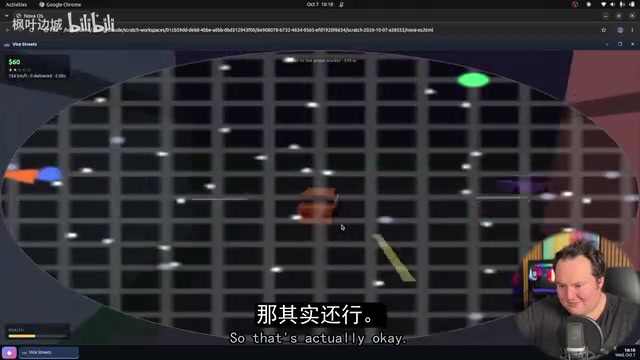
Browser OS (Nova): This task hit the output limit after 43 minutes and had to be rerun at the high setting. The result had some "small model energy," but was reasonably complete — featuring a working clock with date, click ripple effects, a functional email app and file app, a scalable drawing program, and even a mood engine dynamic wallpaper that generates "energy values" based on keyboard typing frequency and mouse movement speed. Of the two built-in mini-games, the GTA clone had decent vehicle handling and pedestrian collision, though map rendering had issues.
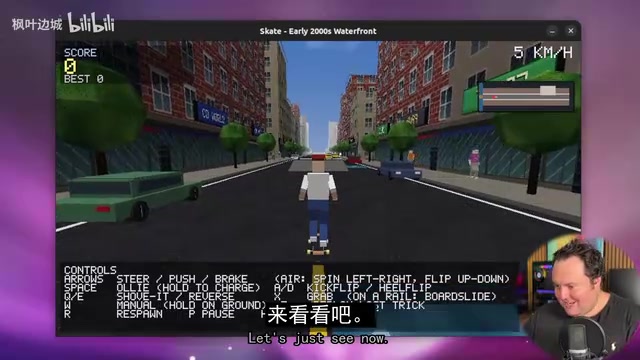
C++ Skateboarding Game: This was one of the blogger's most impressive results. In pure C++ with no dependencies, the model produced a skateboarding game with a cinematic replay feature (press Z to view trick replays with trajectory trails) in about 38 minutes. He stated plainly that "this is noticeably better than what GPT-6 Luna produced."
He then fed the model a reference image of Sonnet 5.5's version, asking it to improve visual fidelity and make the skateboard move independently from the character model during tricks. The redo 23 minutes later clearly drew inspiration from the reference — pedestrian animations were more natural, a beachside boardwalk was added, along with a skybox and water with collision detection that produces a "splash" effect. Minor flaws like reversed store signage text remained, but for a Haiku-tier model, the blogger called this "close to state-of-the-art from six months ago."
Backyard Pool Party Game: This task, built with Blender and Godot, was the highlight of the entire video. The model modeled all assets in Blender itself, then assembled them into a game in Godot. The final product featured a Wii Sports-style UI, character selection, a scene with string lights, and details including a dog jumping into the pool and solid water surface effects. Gameplay involves pressing spacebar at the right moment for a "perfect launch," with mid-air movement — the blogger called it "a pretty capable result."
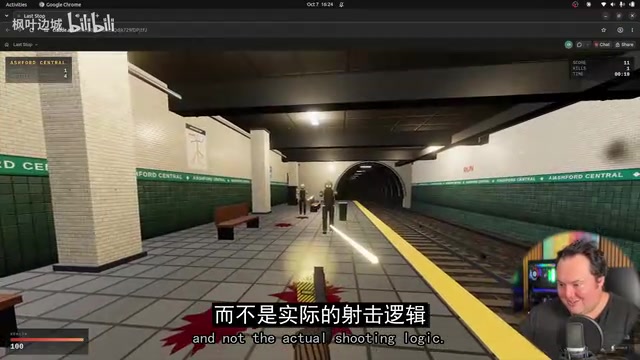
Subway FPS: After clearing a wave of enemies, players board a train that heads to the next station with a different art style. The initial version had bugs — weapons didn't move with the camera, and the game froze when the train arrived. After several rounds of feedback (including pasting console error messages directly), the model eventually fixed the freeze and implemented details like being unable to shoot on the train, unique visuals for each station, and in-car screens displaying the next stop.
On "agentic coding tasks": This refers to a mode where the model autonomously plans, executes step-by-step, and can call tools (such as code executors, file systems, and browsers) to accomplish complex goals — distinct from single Q&A exchanges or simple code completion. In these tasks, the model must independently break down a high-level goal (like "make a skateboarding game") into sub-steps, write and run code, interpret errors, revise its approach, and iterate until completion. This mode demands strong planning, error recovery, and long-context comprehension, making it one of the frontier scenarios for evaluating model capabilities. The "high," "max," and "X-high" settings mentioned refer to the model's extended thinking intensity levels — the higher the intensity, the more tokens the model invests in internal reasoning before generating a final answer, generally improving output quality at the cost of increased token consumption and latency.
From Watches to Demolition Derbies: Probing the Capability Ceiling
The blogger also ran several tasks to test visual and physics capabilities.
The watch website task asked the model to draw design inspiration from a given photograph and implement an exploded view. The result was "pretty solid overall" — it extracted strap details from the image — but had issues including an overly narrow strap, a slightly blurry disassembly view, and no manual drag-and-click interaction. It took about 22 minutes at max.

The demolition derby task was based on a reference image generated by Gemini, requiring soft-body physics, multi-angle cameras, detachable parts, and a suspension system. The result was completed in under 30 minutes, replicating the collision smoke particles from the reference image, with suspension effects and bumpers that bend on reverse impact (a rough implementation of soft-body physics), plus a dusty ground surface and cloud-filled sky.
By contrast, the RuneScape 2007 Grand Exchange PvP recreation exposed the model's limits — it was the only model to start players with completely newbie stats (level 3, 10 HP) rather than maxed-out characters, and the overall result was fairly rudimentary.
On Blender and Godot: Blender is a full-featured open-source 3D modeling and rendering application; Godot is a cross-platform open-source game engine with Python-like syntax. Having the model coordinate both tools — modeling in Blender, exporting assets, then handling game logic and scene assembly in Godot — requires cross-toolchain coordination and fluency with two distinct DSLs (domain-specific languages). Tasks like this are far more complex than generating a webpage or script, making them useful as ceiling tests for model capability. "Soft-body physics" refers to a physics engine feature that simulates deformable objects (like rubber or sheet metal bending on impact), which is computationally far more intensive than rigid-body collision and typically requires manual parameter configuration — an additional challenge for the model's understanding of underlying physics systems.
Conclusion: Cost Redefines What "Good Enough" Means
Across all tests, the blogger's verdict was clear: Haiku 5.5's absolute output quality doesn't match flagships like Sonnet, Opus, or GPT-6 Astra. But it was never trying to compete with them on quality. Its significance lies in delivering capability close to "the frontier from six months ago" at one-quarter the price of those flagships.
The real takeaway remains that 1% figure — all the testing in the entire video consumed just 1% of the weekly quota. For high-throughput, cost-sensitive production scenarios, this price-to-performance ratio redefines what "good enough" actually means. The concern about lower token efficiency at high reasoning intensity is a calculation users will need to work out for themselves when weighing Haiku against GPT-6 Luna.
With only one model left unreleased in the 5.5 family, Haiku's upgrade has already proven that Anthropic has no intention of abandoning its most affordable product line.
Related articles

Microsoft Fabric Database Agent in Action: From Reactive Firefighting to Intelligent Detective
A deep dive into the Microsoft Fabric Database Agent: how to enable it, supported monitoring scenarios, a blocking-issue demo, and the roadmap from reactive to autonomous operations.

Zendesk Uses ChatGPT Enterprise to Build a Sales Agent with 1,000 Daily Active Users
Zendesk opened ChatGPT Enterprise to all employees, who built about 600 apps themselves, including a sales expansion agent with about 1,000 daily active users. This article analyzes how it turns internal data into sales opportunities and its "don't wait" implementation strategy.

Google Releases Gemini 4 Carbon: Its Strongest Model Yet, Debuting with a Cybersecurity Focus
Google releases Gemini 4 Carbon, calling it its strongest model, with a cybersecurity focus. It tops the third-party composite ranking at 59 points but leads by only one or two. This article analyzes its security test results, staged rollout, token pricing, and the divergence between self-reported and third-party tests on hallucinations.