Claude Opus 5.5 Accused of Rewriting Math History? Reddit Buzzes

A Reddit post quotes Claude Opus 5.5 claiming that if the results hold, it would be the most important day in math history—but verifiable details are lacking.
A Reddit post quotes Claude Opus 5.5's output claiming that if the related results hold up, it would be the most important single day in the history of mathematics and theoretical computer science. The post itself provides no theorems, proofs, or paper links, making it an assertion rather than a verifiable academic result. The article's analysis suggests that the Claude Opus series represents Anthropic's strongest reasoning model line, and if it truly made verifiable progress on a long-standing open problem, it could indeed constitute a historic moment—but the premise "if it holds up" is precisely the most fragile link. Community reactions are polarized: one side sees it as a milestone signal for AI-assisted mathematics, while the other emphasizes that without specific propositions and formal verification, it cannot be evaluated. The article notes that the focus of discussion has shifted from "whether AI can do mathematics" to "how to verify the mathematics AI produces," and warns against three misreadings: treating model self-assessment as fact, ignoring the breadth of theoretical computer science, and skipping formal verification. At this stage, signal value exceeds conclusion value; we must wait for reproducible proofs and peer review.
A Mathematical Declaration from Reddit
A short yet striking post recently appeared on Reddit: a user quoted Claude Opus 5.5's output, claiming that "if these results hold up, this would be the most important single day in the history of mathematics and theoretical computer science." The post itself offers no details, but that sentence alone is enough to make both AI researchers and math enthusiasts sit up and take notice.
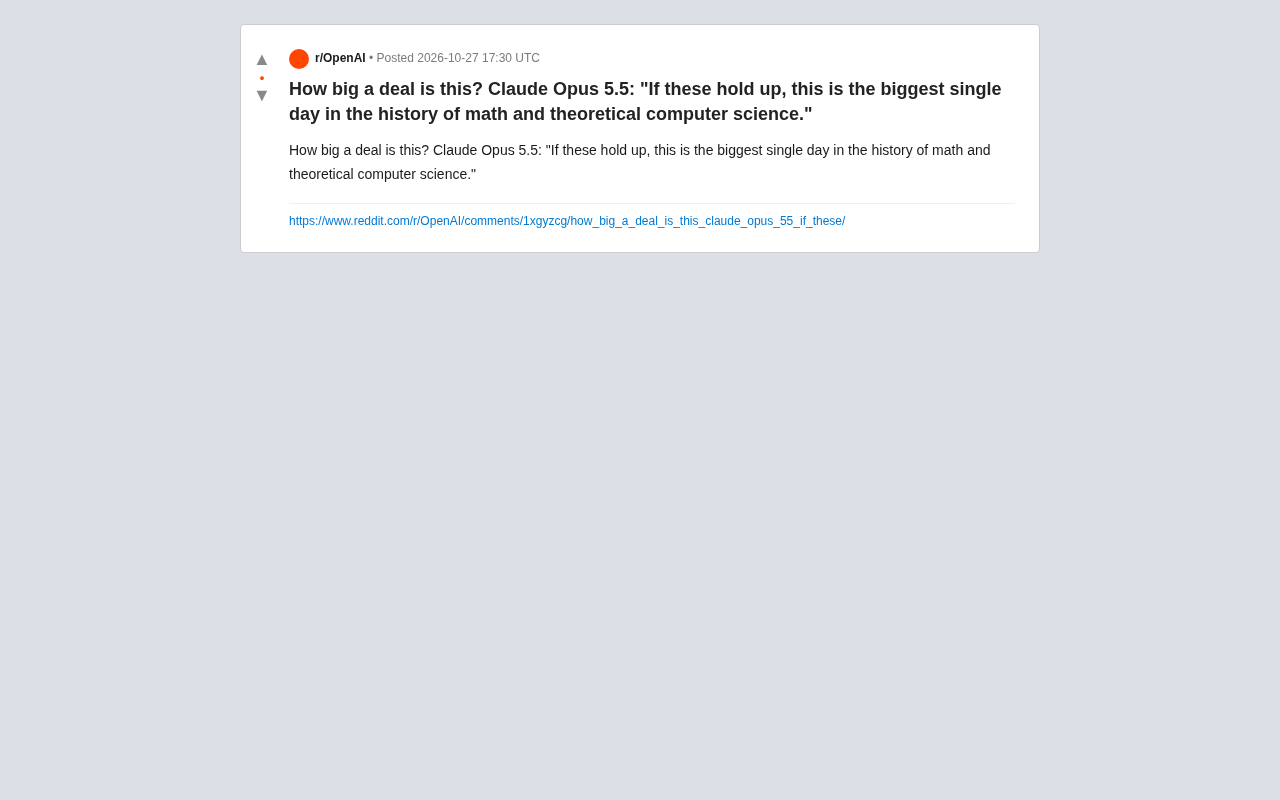
The key question is: what exactly did Claude Opus 5.5 produce that could elevate a single remark to the level of "the most important day in history"? The original post provides no proof or paper link, which means we're dealing with an assertion, not a verifiable academic result.
Why This Statement Deserves Serious Attention
The Claude Opus line has consistently been Anthropic's most capable reasoning model series, and the version number Opus 5.5 itself hints at iterative capability gains. In mathematics and theoretical computer science, AI progress has already moved from "solving competition problems correctly" toward "can it propose new conjectures, fill in proof steps, or even find counterexamples."
If the model truly made verifiable progress on some long-standing open problem, that could indeed constitute a historic moment. But the conditional "if these results hold up" is precisely the most fragile and critical link in the whole affair—it acknowledges that the results have not yet been peer-verified.
Theoretical Computer Science (TCS) is the branch of computer science that studies the nature of computation using mathematical methods. Unlike software and systems work, which leans toward engineering implementation, TCS asks: "What can computation do, what can't it do, and at what cost?" Its core areas include: computational complexity theory (e.g., the P vs NP problem, characterizing the inherent difficulty hierarchy of problems), algorithm design and analysis (studying the asymptotic efficiency and optimality of problem-solving), cryptography (constructing secure protocols based on computational hardness assumptions), computability theory, and formal languages. TCS is deeply intertwined with mathematics (especially combinatorics, mathematical logic, and probability theory), and many major breakthroughs often belong to both fields simultaneously. This also explains why the phrase "the most important single day in the history of mathematics and theoretical computer science" pairs the two—genuine breakthroughs are often cross-disciplinary, such as a complexity lower-bound result that is both a mathematical theorem and a fundamental conclusion in computer science.
Polarized Community Reactions
The Reddit discussion reveals a classic polarization. One side sees this as a milestone signal for AI-assisted mathematics and believes it deserves serious attention; the other points out that without specific propositions, proof drafts, and formal verification, any claim of "the most important day in history" cannot be evaluated.
This divide is itself informative: it shows that the community is no longer simply doubting "whether AI can do mathematics" but has shifted to asking "how do we verify the mathematics AI produces." This shift in evaluation criteria reflects the field's maturity more than any single leak does.
Three Misreadings to Watch Out For
The first misreading is treating the model's self-assessment as fact. Language models can generate highly persuasive evaluative statements, but that does not constitute proof of the results themselves. The second misreading is ignoring the breadth of "theoretical computer science"—this field spans complexity theory, algorithms, cryptography, and more, and a vague "most important day" cannot pinpoint a specific contribution. The third misreading is skipping the formal verification step and going straight to dissemination.
Formal Verification refers to writing propositions and proofs in strict mathematical logic into a machine-checkable form, then having a proof assistant (such as Lean, Coq, or Isabelle) verify them line by line. Compared with traditional "peer reading review," it transfers the question of "whether it holds" from human judgment to a deterministic checking program, theoretically eliminating hidden errors and gaps. In recent years, important practices have emerged in the mathematics community: Lean's mathlib library continues to accumulate formalized theorems, and results such as the Four Color Theorem and the Kepler conjecture have been partially or fully formalized. For AI-generated mathematical results, formal verification is especially critical—language models may produce proofs that appear coherent but contain subtle logical breaks, and machine checking can pinpoint exactly where the break occurs. Thus, the repeated mention of formal verification in community discussions is essentially a demand for "machine-reproducible credibility," rather than drawing conclusions based solely on textual fluency.
A Rational View: Signal Value Exceeds Conclusion Value
Without specific details of the results, this post is better treated as a signal: AI's involvement in the formal sciences is rising to the point of triggering "historic" discussions. As for whether it has truly rewritten mathematical history, we need to wait for reproducible proofs, formal verification, and peer review.
For those tracking the boundaries of AI capabilities, what's worth following is not this evaluative statement itself, but whether specific theorems, proofs, or counterexamples emerge afterward. That is the only basis for judging whether it "holds up."
One-line Summary
A Reddit post quotes Claude Opus 5.5 claiming that if the results hold, it would be the most important day in math history—but verifiable details are lacking.
Paragraph Summary
A Reddit post quotes Claude Opus 5.5's output claiming that if the related results hold up, it would be the most important single day in the history of mathematics and theoretical computer science. The post itself provides no theorems, proofs, or paper links, making it an assertion rather than a verifiable academic result. The article's analysis suggests that the Claude Opus series represents Anthropic's strongest reasoning model line, and if it truly made verifiable progress on a long-standing open problem, it could indeed constitute a historic moment—but the premise "if it holds up" is precisely the most fragile link. Community reactions are polarized: one side sees it as a milestone signal for AI-assisted mathematics, while the other emphasizes that without specific propositions and formal verification, it cannot be evaluated. The article notes that the focus of discussion has shifted from "whether AI can do mathematics" to "how to verify the mathematics AI produces," and warns against three misreadings: treating model self-assessment as fact, ignoring the breadth of theoretical computer science, and skipping formal verification. At this stage, signal value exceeds conclusion value; we must wait for reproducible proofs and peer review.
Related articles

Last Week Tonight Exposé: The Dangerous Ties Between Politicians and White Supremacy
Last Week Tonight investigates Georgia Senate candidate Mike Collins and Florida candidate Marshall Rawson, exposing their multiple ties to white supremacists and the Republican Party's silent response.
AI Buzz Weekly: GPT-6.5 Leak, New Claude Model, and MiniMax's Cost-Effectiveness
This week's AI buzz roundup: suspected GPT-6.5 leak, Microsoft configs showing GPT-6.1 Tera, Anthropic's new model that can identify entire classes of bugs, disappointing early Gemini 4 Carbon results, and MiniMax M3.1 Flash beating Claude Opus 5 and GPT-5.6 Sol in benchmarks at extremely low cost.

AI Briefing: Gemini 4 Carbon Released, Ant Open-Sources Ling-3.1
AI Briefing: Google releases Gemini 4 Carbon qubit model, claiming to surpass Opus 5.5 with half-price tokens; Ant open-sources Ling-3.1-1019 for real-task Personal Agents; domestic AI drug discovery succeeds in 18 of 19 projects, hitting all 6 GPCR targets; zero-revenue company valued at $20B raises another $1B; Sichuan convenience store robot sales fail.