Claude Opus 5.5 Takes On 3D Animation: Generating the "Dodaios" Short From Scratch, With Stunning Results

A user drove Claude Opus 5.5 with a strictly constrained prompt to generate a one-minute 3D animated short from scratch, sparking debate on AI 3D creation.
The article covers a Reddit community share: a user gave Claude Opus 5.5 strict instructions to research a fictional IP "Dodaios," rebuild its mascot, and produce a one-minute text-free 3D animation—banning pre-built skills, templates, animation frameworks, and code-synthesized audio. The author calls it a "real video" rather than motion graphics, and the community responded positively to its staging and detail. The article sees it as end-to-end compression of the 3D pipeline and creative-brief-style prompt engineering, while noting it remains a single-source share whose general capabilities need third-party verification.
Claude Opus 5.5 Takes On 3D Animation: Generating the "Dodaios" Short From Scratch, With Stunning Results
A 3D animated short generated entirely by AI is sparking discussion on Reddit. A user gave Claude Opus 5.5 what looked like an almost impossibly strict instruction: research the backstory of a fictional IP called "Dodaios," rebuild its mascot using images, and bring it to life—all without using any pre-built skills, templates, or code-generated audio. The result is a one-minute piece with no text that tells its story purely through animation—making many people realize for the first time that the boundaries of generative AI in 3D creation have been pushed yet another step further.
A Creative Task That Leaves "No Room to Cut Corners"
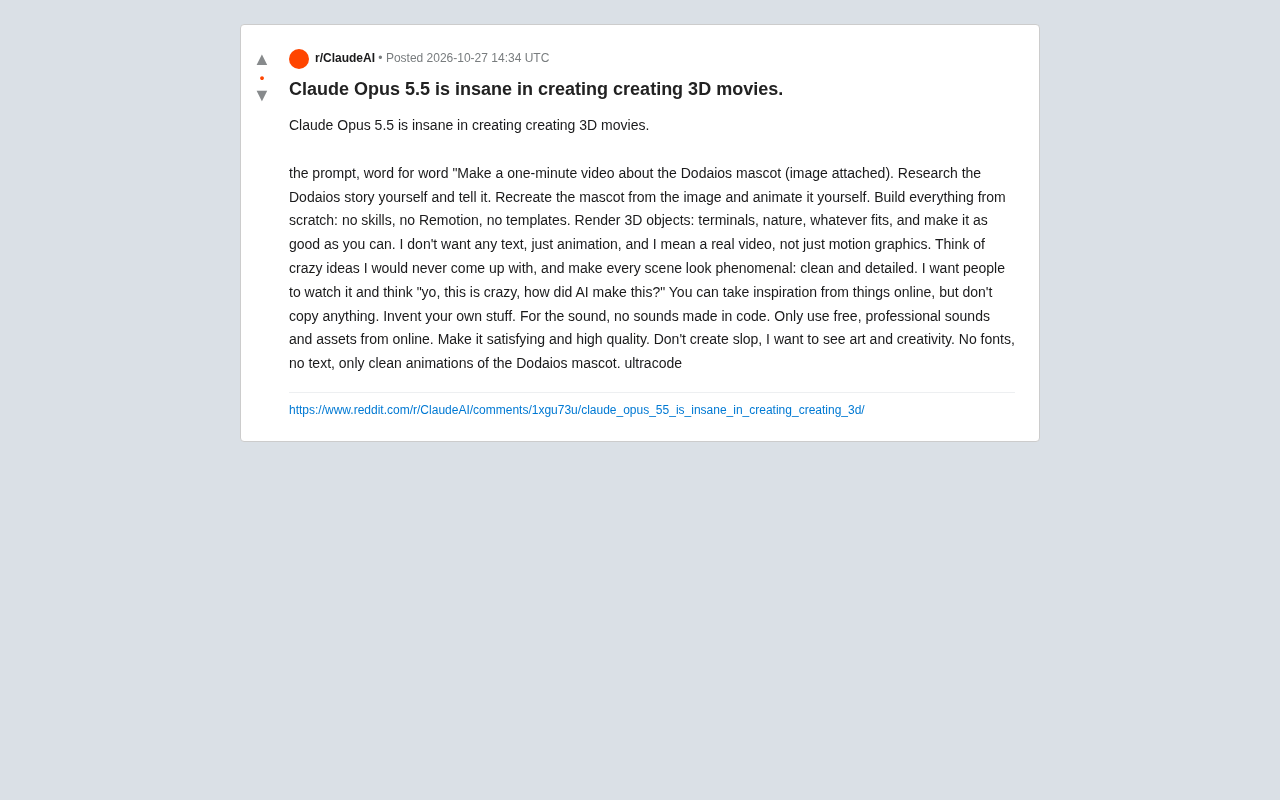
In the original post, the author pasted their prompt word for word. The core constraints centered on several points: no pre-built skills, no animation frameworks like Remotion, no templates; every 3D object (terminals, natural scenery, and other narrative-appropriate elements) had to be built from scratch; sound could not be code-synthesized—only free, professional sound effects and assets available online could be used. In addition, the prompt explicitly required "no text, no fonts," keeping only pure animation; it demanded creativity that breaks out of convention, with every frame clean and rich in detail, aiming to make viewers exclaim, "This was made by AI?"
These constraints are themselves a kind of stress test. They eliminate most shortcuts like "call an API + plug in a template," forcing the model to organize the entire pipeline—modeling, animation, camera work, and sound—on its own at the script level.
The Finished Product: From "Motion Graphics" to "Real Video"
The author emphasized that what they wanted was a "real video," not simple motion graphics. Judging from community feedback, the finished piece exceeded many people's expectations in scene staging and pacing—the mascot's movement through 3D space, the layering of environmental elements, and the overall completeness of visual detail all come closer to a handcrafted animated short than the AI-collage feel common in the past.
Interestingly, the prompt specifically mentioned "no slop" and encouraged the model to "invent its own thing." This is essentially guiding the model to abandon simple imitation of ready-made styles in its training data and instead engage in combinatorial creation. Whether the finished piece fully meets the standard of "art and creativity" remains subjective, but it at least proves that, under sufficiently specific constraints, current models are capable of independently completing a structurally coherent 3D narrative short.
"Motion graphics" refers to graphical animation presented in 2D or pseudo-3D, commonly seen in title sequences, infographics, and UI motion design. Its defining trait is that camera movement and element transformations follow graphic design logic rather than true 3D space. By contrast, "real video" implies a complete virtual camera, depth of field, perspective, lighting, and spatial occlusion between objects, with character movement obeying gravity and inertia. The production pipelines differ enormously: the former relies on layers and keyframes, while the latter requires 3D scenes, materials, and rendering. The author deliberately distinguishes the two to show that the finished piece is not flat assets being jittered or displaced, but a work with 3D spatial staging—a key dividing line for judging whether a generative model has truly completed modeling and animation.
Why This Matters
Compression of the 3D Content Production Chain
Traditional 3D animated short production involves modeling, rigging, animation, lighting, rendering, sound design, and more—typically requiring team collaboration over days or even weeks. This experiment demonstrates a possibility: using a natural language description to compress the entire chain into a single generation process. Although the work is only one minute long, this "end-to-end" creative approach is clearly attractive to independent creators and small studios.
The core stages of a traditional 3D animation pipeline each have their own division of labor: modeling creates geometry, rigging builds skeletons and controllers for characters, animation drives the skeleton through keyframes or motion capture, and lighting & rendering determine the final pixels' light, shadow, and material appearance. These stages are typically completed by different software and different roles in sequence, with intermediate assets repeatedly imported and exported. "End-to-end" generation means the model directly completes all steps from scene construction to image output in one pass based on a natural language description, skipping intermediate asset files. This does not mean the model actually models step by step like a human; rather, it implicitly encodes the decisions of each stage into the generation process, so interpretability and editability are weaker than in a traditional pipeline.
A New Level of Prompt Engineering
In this case, the prompt is no longer a simple instruction like "write a piece of copy," but more like a complete creative brief: defining quality standards, ruling out shortcuts, specifying asset sources, and even setting an emotional goal ("satisfying and high quality"). This kind of structured constraint design is becoming a key means of unlocking model capabilities. The more specific the constraints, the more controllable the output—counterintuitive, yet repeatedly verified in practice.
A creative brief is a standard document in advertising and design, typically containing target audience, core message, style and tone, delivery specifications, and prohibited items. Migrating it into a prompt essentially narrows the model's open generation space into a controllable design problem. Structured constraints work because large models, when lacking constraints, tend to regress to the most common "average style" in their training data—that is, slop; explicit exclusions and quality standards force the model to avoid these high-probability but low-quality paths during decoding. This also explains a counterintuitive phenomenon: the more constraints, the more stable and distinctive the output. The key to writing such prompts is not piling up adjectives, but writing clearly—like acceptance criteria—what counts as acceptable and what is absolutely not allowed.
A Response to "Can AI Make Art?"
The original poster's attitude was clear: no industrial assembly-line output—they wanted to see art and creativity. What the model needed to do was decide its own visual language without any template to follow. Judging from community reactions, this attempt at least changed some people's stereotype that AI-generated content is "all the same."
A Sober Perspective: Between a Single Case and General Capability
To be clear, this is still a single-source community share. The quality of the finished piece depends on the specific prompt, model version, and execution environment, and cannot yet be equated with a stable, reproducible general capability. Whether the model is equally reliable in longer durations, multi-shot transitions, and physical consistency still requires more independent testing. In addition, the actual degree of "building from scratch" lacks third-party verification.
But even with reservations, the value of this case lies in providing a concrete reference point: when constraints are clear enough and goals specific enough, what can generative models achieve in 3D content creation? For creators, a more pragmatic approach might not be arguing about "whether AI can replace animators," but studying how to write a creative brief that leaves the model no room to cut corners.
Conclusion
What Claude Opus 5.5 demonstrated in this experiment is not just the ability to generate a video, but the potential to collapse a complex creative workflow into a single instruction interaction. As prompts evolve from "describing requirements" to "setting creative discipline," AI's role in 3D content is moving from assistive tool toward executing agent. What's worth watching next: whether this capability can be reliably reproduced across different subjects and durations, and how creators will embed it into real production workflows.
One-line Summary
A user drove Claude Opus 5.5 with a strictly constrained prompt to generate a one-minute 3D animated short from scratch, sparking discussion about the boundaries of AI 3D creation.
Paragraph Summary
The article covers a community share on Reddit: a user gave Claude Opus 5.5 strict instructions to research the backstory of a fictional IP "Dodaios," rebuild its mascot, and produce a one-minute text-free 3D animation—prohibiting pre-built skills, templates, animation frameworks, and code-synthesized audio throughout. The author calls the result a "real video" rather than motion graphics, and the community responded positively to its scene staging and detail completeness. The article argues that this case reflects end-to-end compression of the 3D production chain, the value of creative-brief-style prompt engineering, and a response to biases about "whether AI can make art"; at the same time, it cautions that this is still a single-source share, and general capabilities such as longer durations, multi-shot transitions, and physical consistency await third-party verification.
Related articles

LangChain Retry Middleware Configuration: Practices and Selection Guide
Based on Reddit community discussion, this article analyzes LangChain ModelRetryMiddleware retry parameter configuration practices, covering the selection logic and alternatives for key options like max_retries, backoff_factor, and jitter.

Texas Senate Race in Trouble: Why Are Republicans Nervous?
Texas Senate race stirs Republican anxiety. Based on street interviews, this article analyzes the Democratic offensive in funding, organization, and running everywhere, and how Republicans are defending "Texas, Texas" amid the political pendulum effect.

Gemini Chat Now Generates and Edits Google Docs Directly, a New Breakthrough in Office Productivity
Google Gemini's chat interface now generates and edits PDF, Google Docs, Sheets, Slides, Markdown, TXT, and code files. Available to all users; web supports all formats, mobile only PDF for now.