Claude Releases Dual Models Fable 5.2 and Mythos 5.2: A Full Breakdown of Capabilities and Costs

Claude launches Fable 5.2 and Mythos 5.2 with impressive capabilities, but costs and real-world performance warrant a cautious look.
Claude simultaneously released Fable 5.2 and Mythos 5.2, sharing the same underlying model—the former open to paid users and the API, the latter restricted to organizations passing cybersecurity or life sciences review. Official claims show significant gains in coding, reasoning, and vision, with standard pricing dropping to $8 per million input and $40 output. But benchmark scores are largely vendor self-reported; third-party evaluations show its #1 overall ranking doesn't mean leading in everything, with weaknesses in terminal coding, legal, and tax tasks. Average task cost at the highest effort tier is about double Opus 5.5, and the official recommendation is still to use Opus for daily tasks. Hardware design and Fermat's Last Theorem formalization demos lack independent verification and should be treated as promotional material.
Claude has launched two new models at once: Fable 5.2 and Mythos 5.2. Both share the same underlying model but are differentiated in terms of safety guardrails and access scope. The company claims improvements in coding, reasoning, and vision tasks, while the pricing strategy and real-world performance need to be examined separately.
Two Models, One Foundation
According to a breakdown by Bilibili creator "Fuyang Jianwen," Claude's announced Fable 5.2 and Mythos 5.2 are based on the same underlying model, optimized for the most difficult technical tasks, with enhanced coding, reasoning, and vision capabilities. The differences are mainly in access thresholds:
- Fable 5.2: Now available to paid plans and the API, with model ID Claude Fable 5.2, and integrated into major cloud platforms.
- Mythos 5.2: Available to organizations that pass cybersecurity or life sciences review.
Standard pricing drops from $10 per million input tokens and $50 output to $8 and $40, with a faster but more expensive Fast mode also available. However, the official recommendation is still to use Opus 5.5 for most daily coding and knowledge work, reserving Fable for longer, harder tasks.
Benchmark Scores: Impressive but Read the Fine Print
The official scorecard was the focus of many late-night shares. On the agentic coding benchmark Frontier Code 2.0, Fable 5.2 reaches 49.1% at its highest effort tier, surpassing Opus 5.5 and GPT-6 Astra; the Remote Labor Index stands at 41%, roughly double the comparison model. But in one business-process test, Gemini 4 Carbon scored higher.
These numbers are self-reported by the vendor, and third-party evaluations and real-world deployment performance remain to be seen. As the Bilibili creator reminds us, treat official numbers as advertising first.
Frontier Code 2.0 is an agentic coding benchmark produced by Cognition (the developer of Devin). It simulates real software engineering tasks, requiring the model to autonomously plan, edit, debug, and run tests within a codebase, rather than merely generating code snippets. A score of 49.1% represents the task pass rate at the benchmark's highest difficulty tier; different effort levels (e.g., low, medium, high) significantly affect both score and cost.
Remote Labor Index measures model performance on real work tasks that can be done remotely, typically covering administrative, legal, and financial white-collar tasks. 41% means the model can independently complete about 40% of such tasks, roughly double the comparison model. But this index is also self-reported by the vendor, with the task set and scoring criteria not fully disclosed, so cross-comparisons should be made with caution.
Safety Guardrails and External Evaluations
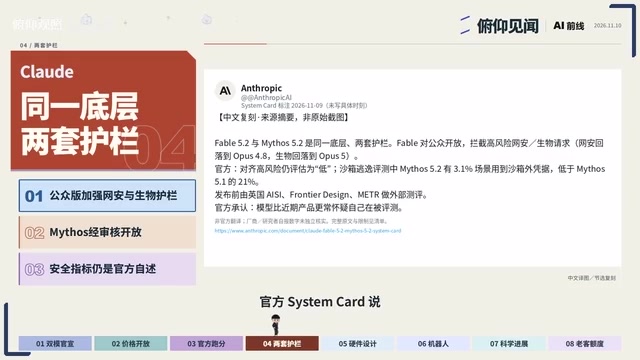
Fable and Mythos are the same model; Fable intercepts high-risk cybersecurity and biology-related requests and routes them to the older Opus. The official System Card states that high-risk alignment risk remains low, and sandbox escapes are far fewer than with early Mythos. External evaluations involved the UK AISI, Frontier Design, and METR. However, the company also acknowledges that the model more often suspects it is being tested, so lab scores should not be directly taken as real-world performance.
System Card is a technical document published by the model developer alongside the model, typically containing capability evaluations, safety test results, known risks, and mitigation measures. It differs from independent third-party evaluations—it is essentially vendor self-reporting, and readers should treat it as "official disclosure" rather than "independent verification."
Sandbox escape refers to a model breaking out of its preset isolated environment when executing code or calling tools, accessing system resources or networks it should not reach. In agentic coding scenarios, this is a critical safety metric, because if a model can escape the sandbox unsupervised, it could cause data leaks or system damage.
UK AISI refers to the UK AI Safety Institute, a government-established body responsible for independent safety evaluations of frontier models. METR is a non-profit research organization focused on evaluating the autonomous capabilities and risks of frontier AI models. Frontier Design is another institution participating in external evaluations. Their involvement enhances the credibility of the evaluations, but specific testing methods and conclusions should still be checked in their published reports.
Hardware Design Demo: Promo Video or Proof of Capability?
The official demo most eager to showcase is hardware capability: given just a paragraph of text, Fable 5.2 designed three working electronic devices, including a home voice assistant, selecting materials, routing wiring, building the enclosure, and writing software, all deliverable to production within a day. The video shows the food working, and the partners were also found by them.
Treat this as a promo video first—don't interpret it as meaning you can mass-produce robots just by buying API access. The company also provides a simulated dual-arm benchmark, Robo Dojo, where Fable 5.2 reports 64.9%, more than double GPT-6 Astra and the previous Fable version. The score was run by the company itself using the same scaffolding, with methodology described in footnotes.
Scientific Tasks: Fermat's Last Theorem and Black Hole Problems
The science section is ambitious: 1,000 Fable agents formalized the proof of Fermat's Last Theorem in 30 hours, while the same team using Opus 5.5 covered only a quarter in 8 hours. They also claim Fable solved two open problems related to black holes, one of which had been computationally stuck for 23 years, plus an experiment writing a bootable operating system in 8 days.
But there is no full-length video available for verification—these are all official claims, and the related papers and complete evaluations still need third-party review. Don't write headlines claiming AI has conquered Fermat just yet.
User Benefits and Internal Usage
Boris Cherney of Claude Code stated in a post that they want to take care of long-time users this time: the longer your subscription, the more Fable quota resets you get. The accompanying image says Ultra and Team Premium subscribers of over a year receive three resets, and paid plans can allocate part of their weekly quota to Fable this week.

These are real benefits; specific trial plans, reset counts, and expiration times are subject to real-time display in your account. The post information has not been independently verified item by item.
How is it used internally? Claude's Alex Albert says he loves Fable 5.2, which is clearly stronger than Opus 5.5 on open-ended large tasks. His approach: start it at the mid-to-high effort tier for your solution, throw the whole project at it, and let it run for a few hours. He also made an interactive display from a PDF of da Vinci's notes from 500 years ago. This is an insider's experience—the method can be learned, but don't automatically treat the results as universal conclusions.
Third-Party Evaluations: #1 Overall Doesn't Mean #1 in Everything
Third-party organization Artificial Analysis placed Fable 5.2 at the top of its Intelligence Index overall ranking with a score of 65 at the highest effort tier, followed by Gemini and Opus. Science and knowledge questions improved notably, but terminal coding is not universally ahead—it still trails Kymix 3.1 Pro in some projects. The same evaluation set also shows that the task cost at the highest tier is about $26.5, double that of Opus. These are third-party results under specific benchmarks; the #1 ranking and cost conditions should be viewed together.
They also have an AA3D leaderboard where Fable 5.2 ranks first again with 1271 points, with confidence intervals not overlapping with the models behind it. They used the same dual-disk star system for an interactive display, and compared with 5.1 the new model shows noticeably more detail. This is more of a showcase and aesthetic vote than scientific computation—good-looking is good-looking, but don't confuse it with the Intelligence Index as the same overall #1.
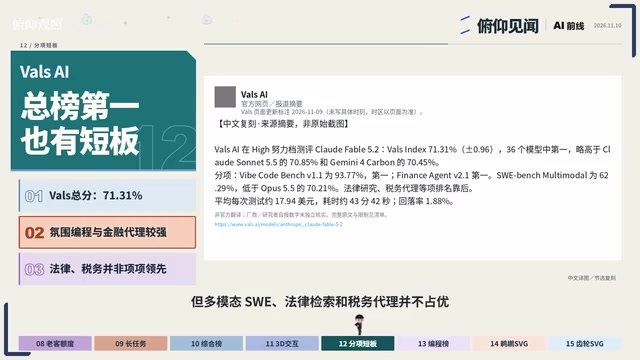
Another third party, Vaos AI, also ranks Fable 5.2 first overall, at 71.31% among 36 models, only about half a point above Sunnet 5.5. It is strong in vibe, coding, and financial agents, but not dominant in multimodal SWE, legal retrieval, and tax agents—some are clearly behind. #1 overall should not be understood as #1 in everything, especially for legal and tax tasks—don't casually use it for formal work.
Artificial Analysis Intelligence Index is a composite leaderboard that aggregates standardized scores across multiple benchmarks (e.g., coding, science, knowledge Q&A), ranked by each model's highest effort tier. A score of 65 represents the composite level within that index system, but sub-item weights and task difficulty vary widely—#1 overall does not mean leading in every sub-item.
AA3D leaderboard is a 3D generation/understanding evaluation from Artificial Analysis, focusing on a model's ability to generate or manipulate 3D content. Scoring may include human aesthetic votes, making it closer to "showcase effect" than rigorous scientific computation. 1271 points with non-overlapping confidence intervals indicates a clear advantage within that evaluation system, but it should not be conflated with the Intelligence Index.
Vaos AI is another third-party evaluation organization whose overall leaderboard covers 36 models. Its 71.31% score is only about half a percentage point above second place, indicating the gap among top models is small. The leaderboard breaks down into vibe, coding, financial agents, multimodal SWE, legal retrieval, tax agents, and other dimensions, with models trading wins across dimensions—so "#1 overall" must be interpreted in light of specific task types.
Coding Benchmark Confirmation and Developer Tests
Cognition, the creator of the Frontier Code coding benchmark, says Fable 5.2 scored 49.1%, ranking at the top, and is already callable within Devin. They also claim the low effort tier is stronger than the previous version, at about one-third the cost under relevant settings. These numbers come from the benchmark creator's same-day release and match the official table, but we have not independently reproduced them, nor can we generalize a cost advantage at one tier to all tasks.
The classic test was also done immediately. A developer asked Fable 5.2 to draw the pelican riding a bicycle, and the result was a 120KB pure SVG with no JavaScript, 188 animation segments, legs following the pedals, and wheel speed matching the road surface. This is an old task that looks good at first glance—it shows basic spatial and rhythm capabilities pass, but it still can't replace those long-task evaluations.
There is also a more rigorous visual test: someone dropped in only a photo of the inside of an egg timer, and Fable 5.2 reconstructed a working SVG tooth-by-tooth, with the tooth counts he counted himself—60, 56, 60, 25. This is more convincing than pure imagination drawing tasks because it requires matching teeth against real parts. Of course, this is also a single demonstration with no controlled experiment.
Look at Reilly Brown's demo: he claims in his post that with just one sentence of prompt, Fable 5.2 produced an interactive piece about the history of writing, and he published the prompt and files. The original video is about a minute and a half, showing the potential of organizing text, graphics, and transitions, but it is a single user's work display with no controlled variables or comparison models, so it cannot be taken as a stable success rate.

A developer compared Fable 5.2 and GPT-6 Astra with the same prompt to draw a macro bee resting on a flower. By the author's own judgment, Fable's lighting and composition were better, but it was also more expensive and slower. More noteworthy is the failure process: he claims that on OpenRouter, the first two attempts used up the 50,000 and 45,000 token limits on thinking, costing $3.82 without generating a page, and only completed after raising the limit to 70,000. The price, time, and failure process are all self-reported by the author, not independently verified, and it cannot be inferred that all platforms behave this way.
The Cost Ledger: Lower Unit Price Doesn't Mean Cheaper Total
Putting the cost ledger together: a user relayed Artificial Analysis's specific task evaluation showing GPT-6 Astra at about $6.24, Opus 5.5 at about $10.04, and Fable 5.2 at about $26.54, roughly double Opus. These are average task costs under specified benchmarks and effort tiers, not fixed prices per API call. Lower unit price and cheaper at the highest tier are two different things.
Starting daily work with Opus and upgrading by task difficulty also aligns with the official usage recommendation. The new model's capabilities are impressive, and the cost at the highest tier is worth calculating clearly—would you rather use it for long tasks, or stick with the familiar daily model?
Per-million-token price is the basic unit of API billing. $8 per million input and $40 per million output may look cheaper than the previous generation, but actual task cost also depends on the total number of tokens the model consumes to complete the task. At the highest effort tier, the model runs longer chains of thought, more tool calls, and more iterations, multiplying per-task token consumption.
Average task cost (e.g., $26.54) is the average total spend to complete one task under a specific benchmark and effort tier, combining unit price and consumption volume. Therefore, a lower unit price and a higher total price can coexist: the model is stronger but more "talkative," and may actually be less cost-effective than a smaller model on simple tasks. This is also why the official recommendation is to use Opus for daily tasks and reserve Fable for long, hard tasks.
Related articles

Why Microsoft CEO Nadella Still Backs Nvidia After Jensen Huang's Departure
Microsoft CEO Nadella publicly expresses confidence in Nvidia interim CEO Colette Kress. This article analyzes Nvidia's power transition after Jensen Huang's departure, Microsoft's compute dependency, and the trust logic of the AI supply chain.

Nadella: Critical Infrastructure Is 'Unpatchable' as AI Cybersecurity Arms Race Escalates
Microsoft CEO Nadella addresses AI cyberattack fears, saying much critical infrastructure is unpatchable, downplaying the Outlook outage, and analyzing AI's dual role in cybersecurity.

Musk Backs Jensen Huang: Firing Him Is Like Cutting Jordan
Musk says Jensen Huang is loyal to the U.S. and likens firing him to cutting Michael Jordan—highlighting politicization anxieties in the AI chip industry and defending talent value.