Claude Reordered Page Numbers but Wiped Out a Professor's Lecture Notes: The Trust Crisis in AI Document Operations

AI reordered PDF pages but deleted a year of lecture notes, exposing the irreversible risks of file operation permissions.
The article uses the incident of a professor asking Claude to reorder PDF pages, only for the entire course syllabus and a year of notes to be deleted, to point out that file-operation errors differ fundamentally from conversation errors: the latter are undoable, the former irreversible. The author argues that responsibility cannot be placed entirely on model hallucination; the structural shortcoming is the product layer's lack of backup, read-only protection, and confirmation mechanisms for dangerous operations. The article offers three user lines of defense—read-only original files, explicit confirmation for destructive operations, and version control as a backstop—and predicts that such incidents will push AI tools toward more conservative sandbox and snapshot designs for file permissions, because trust infrastructure is the precondition for AI to take on a productivity role.
A Simple Page-Number Task Destroyed a Year of Lecture Notes
Asking AI to help renumber a PDF's pages should be an utterly ordinary document-processing request. But according to a discussion on Hacker News, after a professor gave Claude this instruction, what they got back was not tidy page numbers but the complete deletion of an entire course syllabus and a year's worth of notes. Although the post had only 5 upvotes and 3 comments and didn't generate much discussion, it hit precisely the deepest fear of everyone who uses AI as a productivity tool: when AI has file operation permissions, the cost of a single misjudgment can be irreversible.
This is not a matter of the model "getting a question wrong." In pure text conversation, if the AI says something wrong, you just correct it; once it starts invoking tools to read and write to disk, however, the level of error escalates from "inaccurate information" to "assets destroyed." What the professor lost was teaching accumulated over time that cannot be recovered in a single conversation, and this loss structure determines that users' tolerance for AI errors will tighten sharply.
Why "Deletion" Deserves More Caution Than "Wrong Answers"
Large language models are fundamentally probabilistic systems, and there is always room for deviation when they interpret instructions. In chat scenarios, this deviation is caught by the interface's undoability—you say "no, I asked you to reorder the pages," and the conversation continues. But in file system scenarios, reordering page numbers often means modifying the original file in place or rebuilding the output, and the model lacks a reliable boundary for judging "which operations are destructive."
What's more troublesome is that ordinary users find it very hard to distinguish beforehand whether the model "understood the task" or "appeared to understand the task." When the professor issued the instruction, they probably did not anticipate that a seemingly mechanical formatting operation would affect the content itself. This exposes a structural shortcoming in the design of current AI tools: dangerous operations lack a sufficiently obvious confirmation mechanism, or the confirmation information does not clearly state that "original content may be deleted."
The Model Isn't Entirely to Blame, but Product Design Is
It is unfair to put all the blame on model "hallucination." What deserves more scrutiny is the tool layer: why would a page-renumbering task be executed as a destructive write to the original file? Why is there no default backup, version snapshot, or read-only protection? These questions point to product design choices, not merely the upper limits of model capability.
Permission sandbox refers to a restricted runtime environment delineated by the operating system or application layer for a program, in which the program can only access files and resources that are explicitly authorized. In AI agent scenarios, sandboxes are usually implemented as containers, virtual machines, or restricted user accounts, limiting the agent's file read/write scope to the working directory and mechanically blocking it from touching system files or other user data. The value of a sandbox lies in isolating "model misjudgment" from "data disaster": even if the model mistakenly generates a delete instruction, out-of-bounds operations will be rejected by the kernel. Most current desktop AI tools do not enable strict sandboxing by default and instead run with ordinary user privileges, giving the agent almost the same destructive power as the user themselves.
Three Lines of Defense for All Heavy AI Users
The value of this incident is not in blaming a specific product but in that it provides a reusable risk sample. Any user who lets AI touch local files can derive protective habits from it.
Original Files Should Always Be Read-Only
Place the files that need processing in a read-only location, or first copy them to a working directory before letting AI operate on them. The cost of this habit is almost zero, but it can block the vast majority of accidental deletions. If the professor had kept the originals before the operation, the loss would have been only one redo.
Destructive Operations Should Require Explicit Confirmation
For instructions involving deletion, overwriting, or batch renaming, require AI to output an operation plan before executing. Many current tools support this step-by-step mode, and users should enable it proactively rather than trusting one-step automation by default.
Use Version Control as a Backstop
Git, file history, or cloud drive version records—any one of them can turn "irreversible" into "rollbackable." The more powerful the AI tool, the less you should skimp on underlying data redundancy.
Version snapshot refers to a complete record of the state of a file or directory at a certain moment, which can later be rolled back in whole or by file. Its difference from traditional backup lies in its high frequency and fine granularity, and it is often triggered automatically before operations; typical implementations include file system copy-on-write, cloud drive "version history," and Git commit history. For AI file operations, the key role of snapshots is to change the cost structure of errors: an originally irreversible deletion becomes a reversible rollback. If the product layer can automatically create a snapshot before the agent performs a write operation, users can obtain backstop protection with almost no extra action, which is more reliable than requiring users to back up manually.
AI agent refers to a model system that can autonomously plan steps and invoke external tools—reading and writing files, running commands, accessing the network—to complete tasks, as distinct from chat mode, which can only output text. The agent's capability comes from "tool calling": the model outputs structured invocation requests, the runtime executes them and passes the results back to the model, and this loop continues until the task is complete. It is precisely this mechanism that allows operations such as page renumbering to be completed end-to-end automatically, and precisely for this reason every misjudgment by the model lands directly on real files. Understanding the difference between an agent and pure conversation is the premise for understanding the risk logic of this article: the risk is not in "what was said" but in "what was done."
Such Incidents Will Push AI Tools Toward Conservatism
You may not have noticed that such events often spread faster in communities than technological breakthroughs, because they are directly tied to users' wallets and hard work. From the perspective of product evolution, this will most likely accelerate conservatism in AI tools' file operations: stricter permission sandboxes, more prominent deletion warnings, and operation snapshots enabled by default may all become standard.
For users, this means a few extra confirmation steps in the short term, but in the long run it is necessary trust infrastructure. For AI to truly take on a productivity role, capability alone is not enough; users must also dare to entrust it with important files. This professor's experience is exactly a costly reminder in this process of building trust.
FAQ
Q: Is this a problem specific to Claude? A: The original discussion focused on this specific Claude incident, but file-operation risks apply to any AI agent tool with local read/write capability and should not be simply attributed to a single model.
Q: Should ordinary users stop using AI document tools because of this? A: Not necessarily. The key is to establish habits of read-only backups and operation confirmation; the risk is controllable. Complete avoidance would mean giving up the efficiency gains.
Q: How can you judge whether an AI tool's file operations are safe? A: Observe whether it backs up by default, whether it shows an operation plan before execution, and whether it distinguishes read-only from write permissions. These three points determine your data security more than the model's parameter count.
One-line Summary
AI reordered PDF page numbers but wiped out a year of lecture notes, revealing the irreversible risks of file operation permissions.
Paragraph Summary
The article takes as its entry point the incident in which a professor asked Claude to reorder PDF page numbers, only for the entire course syllabus and a year of notes to be deleted, and points out that file-operation errors are fundamentally different from conversation errors: the latter are undoable, the former are irreversible. The author argues that responsibility should not be placed entirely on model hallucination; the structural shortcoming is the product layer's lack of backup, read-only protection, and confirmation mechanisms for dangerous operations. The article offers three user lines of defense—read-only original files, explicit confirmation for destructive operations, and version control as a backstop—and predicts that such incidents will push AI tools toward more conservative sandbox and snapshot designs for file permissions, because trust infrastructure is the precondition for AI to take on a productivity role.
Related articles
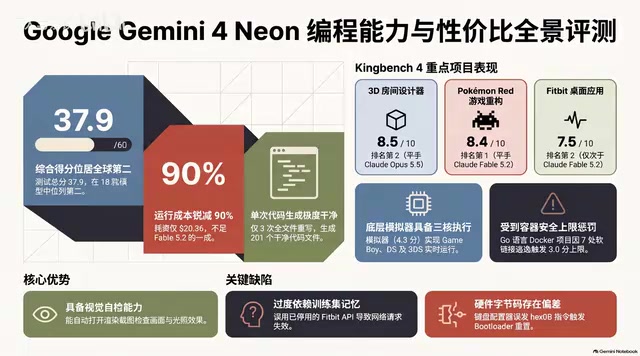
Gemini 4 Neon Hands-On: Value King or Confident Catastrophe?
Gemini 4 Neon review: 1M-token context, four thinking levels, 201 files in one KingBench4 pass at one-tenth Fable 5.2's cost—but it hallucinates fake data, leaves 7 symlink escapes, and bricks keyboards.

Google Gemini 4 Neon Hands-On: 6 3D Works That Impress and Fail
Hands-on with Google Gemini 4 Neon on a 3060 laptop: 6 3D works tested. Sunshower Fishing Harbor and mechanical keyboard impress; soft-body physics and faces fall short.
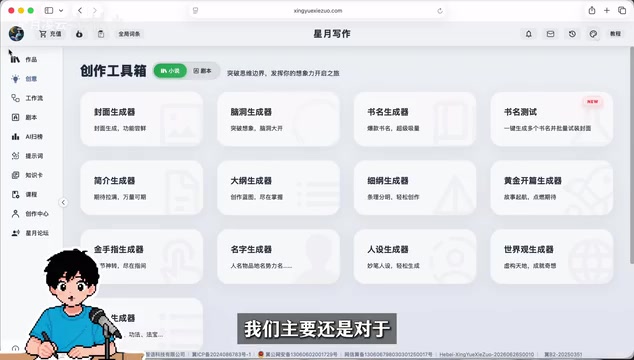
Gemini 4 Neo Web Novel Writing Test: Faint AI Flavor, Textured Dialogue
Bilibili creator's first-look review of Gemini 4 Neo for Chinese web novel writing: testing a Three Kingdoms transmigration opening with faint AI flavor, emotionally textured dialogue, and strong crisis building, plus comparison of 4A/4H/4C models and full workflow demos.