Claude's Safety Guardrails Too Sensitive? User Complaints and Usage Tips
Claude's safety guardrails are overly sensitive and mistakenly block legitimate needs; users need to adjust questioning strategies to cope.
Starting from a Reddit user's complaint, the article explores whether Claude's safety guardrails are too strict. Anthropic prioritizes safety with methods like Constitutional AI, making the model conservative on risky topics and frequently triggering blocks in cybersecurity, healthcare, and legal scenarios. The root cause is difficulty distinguishing malicious intent from legitimate needs, causing over-refusal, lack of explanation, and inefficiency. Users share workarounds like rephrasing, step-by-step questioning, switching models, and applying for permissions. The article sees balancing safety and usability as an industry-wide challenge and advises clarifying context, using system prompts, and checking official docs, noting fundamental fixes still require model optimization.
Introduction: When Safety Guardrails Become a Barrier to Use
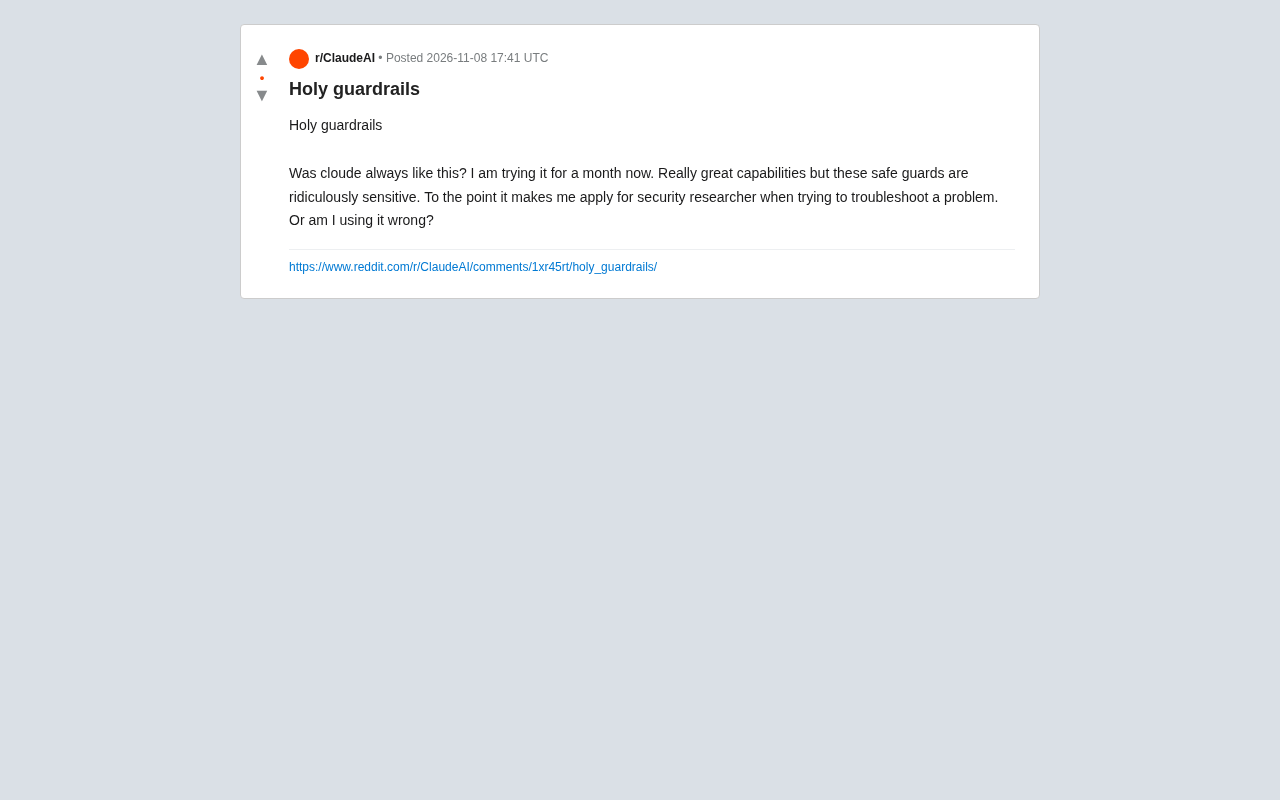
Recently, a Reddit user who had been trying Claude for a month asked: "Is Claude always like this? The capabilities are great, but the safety guardrails are absurdly sensitive." He mentioned that while troubleshooting certain issues, he even felt like he needed to apply as a "security researcher" to continue the conversation. This sparked considerable discussion: Are Claude's safety mechanisms too strict? Is it user error, or is it the product's design?
From community feedback, this is not an isolated case. Many users have encountered Claude's blocks or refusals when trying to discuss security-related topics, medical, legal, or even code vulnerability troubleshooting. Safety guardrails are meant to prevent abuse, but when they frequently interrupt normal workflows, user frustration naturally arises.
Why Are Claude's Safety Guardrails So Sensitive?
Design Philosophy: Safety Over Usability
Anthropic, the company behind Claude, has always made "safety" a core selling point. Its models are trained using methods like "Constitutional AI," aimed at making AI outputs conform to a set of ethical principles. This design philosophy leads Claude to respond conservatively—or even outright refuse—when facing potentially risky topics. Compared to some competitors, Claude's guardrail threshold may be set lower.
According to community observations, Claude is easily triggered by guardrails in the following scenarios:
- Asking about exploitation methods for cybersecurity vulnerabilities (even for defensive purposes)
- Discussing drug dosages or medical advice
- Specific interpretations of legal clauses
- Generating text that could be used for fraud
Constitutional AI is a training method proposed by Anthropic. Its core is to have the model review and revise its own outputs based on a written "constitution"—a set of principled rules—rather than relying entirely on human-annotated preference data. Specifically, the model first generates an initial answer to a question, then self-critiques and rewrites it according to constitutional clauses, and finally uses reinforcement learning to make the model prefer responses that align with these principles. The advantage of this approach is that the rules are transparent and scalable, covering many edge cases that are difficult to annotate individually; the cost is that when encountering ambiguous or potentially risky topics, the model tends to take a more conservative path, manifesting as a lower guardrail threshold and a higher refusal rate. Understanding this helps explain why Claude is easily triggered even in normal technical discussions.
Misalignment Between User Intent and Model Judgment
The problem is that the model has difficulty accurately distinguishing "malicious intent" from "legitimate need." For example, a developer debugging their own application may need to understand a certain attack vector, but Claude may misinterpret it as a potentially malicious request. This misalignment forces users to repeatedly rephrase their questions, and some even feel "censored."
Over-refusal is a specific term in the AI safety field, referring to a model mistakenly rejecting benign requests that should normally be answered, treating them as harmful. It usually stems from classifiers or alignment training being overly sensitive to certain keywords or topics, and from the model lacking sufficient contextual reasoning to distinguish "discussing attack principles" from "carrying out attacks." Over-refusal not only harms user experience but also undermines trust in safety mechanisms, as users gradually learn to circumvent rather than comply with the rules. The industry typically weighs guardrail strictness using two metrics: "benign request refusal rate" and "harmful request interception rate." An ideal guardrail should keep the former as low as possible while maintaining a high latter.
User Feedback: Frustration and Coping Strategies
Common Complaints
In the Reddit post, the user mentioned "feeling like I need to apply as a security researcher just to troubleshoot a problem." This reflects several pain points:
- Over-refusal: Even when the question itself is harmless, Claude may refuse to answer due to keywords or context.
- Lack of explanation: Refusals often come with only a generic statement, without specifying which rule was triggered, making it hard for users to adjust.
- Impact on productivity: In development or research scenarios requiring rapid iteration, frequent blocks interrupt the flow of thought.
User Workarounds
Some users shared their coping techniques:
- Rephrasing questions: Avoid sensitive words and describe the problem in more neutral language. For example, change "how to exploit a vulnerability" to "how to fix a similar vulnerability."
- Step-by-step questioning: Break complex questions into multiple simple ones to reduce the sensitivity of each request.
- Switching models: For certain tasks, switch to models with looser guardrails (such as the GPT series or open-source models).
- Applying for permissions: Some enterprise users can request higher usage permissions through the API, but ordinary users find this difficult to obtain.
System prompt is a set of instructions set by the user or developer before the conversation begins, used to define the model's role, tone, and response boundaries, and its priority is usually higher than regular user messages. In models like Claude, proper use of system prompts can significantly reduce misjudgments: for example, explicitly stating "The following discussion is solely for defensive security research; please explain from a protection perspective" acts as a persistently effective contextual anchor for subsequent dialogue, helping the model gain more basis for judging intent. Note that system prompts are not a panacea—they cannot bypass the model's explicitly prohibited core restrictions—but they can reduce over-refusal caused by missing context, making them a practical tool for technical users to improve usability.
The Balance Between Safety and Usability
A Common Industry Challenge
Claude's dilemma is not unique. All large language model providers are seeking a balance between safety and usability. Too lenient leads to abuse risks; too strict harms user experience. Anthropic's choice clearly leans toward safety, consistent with its brand positioning, but it may also limit its application in certain professional fields.
Advice for Developers
If you frequently use Claude for technical work, try the following to reduce friction:
- Clarify context: State your identity and purpose when asking questions, e.g., "I am a software engineer fixing a security vulnerability in my own project; please explain how this attack works so I can defend against it."
- Use system prompts: Set a role via system prompts to guide Claude toward more professional responses.
- Check official documentation: Understand Claude's usage policies and limitations to avoid clearly prohibited areas.
Conclusion: Understand the Guardrails, Use the Tool Wisely
Claude's safety guardrails are part of its design philosophy. Although they sometimes seem sensitive, users can improve their experience by adjusting questioning strategies. Meanwhile, community feedback is also pushing model providers to optimize the precision of guardrails. For ordinary users, understanding these limitations and adapting flexibly is the key to better leveraging Claude's powerful capabilities.
If you've had similar experiences, feel free to share your coping tips in the community. After all, tools are fixed; people are flexible.
One-line Summary
Claude's safety guardrails are overly sensitive and mistakenly block legitimate needs; users need to adjust questioning strategies to cope.
Paragraph Summary
Starting from a Reddit user's complaint, the article explores whether Claude's safety guardrails are too strict. The author points out that Anthropic makes safety a core selling point and uses methods like Constitutional AI, which makes the model tend toward conservatism on potentially risky topics, leading to frequent blocks in scenarios involving cybersecurity, healthcare, legal matters, etc. The root cause is that the model struggles to distinguish malicious intent from legitimate needs, causing pain points such as over-refusal, lack of explanation, and reduced efficiency. Users share workarounds such as rephrasing questions, step-by-step questioning, switching models, and applying for permissions. The article argues that balancing safety and usability is a common industry challenge and advises developers to clarify context, use system prompts, and check official documentation, while noting that fundamental solutions still require model optimization.
Related articles

Seven Years of Evolution: How Far Has the Foldable Come From the First Generation?
From the first foldable to today's latest models, what has seven years changed? Shallower creases, higher brightness, thinner bodies, and smoother software migration—has the foldable crossed the chasm from enthusiasts to ordinary users? This article discusses the question based on a video comparison.

When Did Humans Start Eating Salt? A 10,000-Year History of Salt
When did humans start eating salt? From salt use at the dawn of agriculture 11,000 years ago to ancient seawater evaporation and rock salt mining, and on to the salt trade, salt taxes, and Gandhi's Salt March, this article traces salt's key role in human civilization.
Microsoft Paza Research: How African Language Speech Recognition Breaks Through Architecture and Data Bottlenecks
Microsoft's Paza research evaluates 53 speech models across 39 African languages, revealing architecture choice matters more than pre-training coverage, 200-300 hours is the practical data threshold, and language typology deeply influences recognition performance.