Climate Tech Meets Robotics: Beyond Solar Inspections, What Other Opportunities Exist?

Climate scenarios suit robots—but climate alone isn't a moat; use cases come first.
Starting from a climate tech investor's Reddit question, the article explores the "robotics × climate" investment logic. Climate tech's core problem is often economics, and scenarios with large spaces, harsh conditions, high repetitiveness, and high labor costs suit robots best. It outlines four directions: renewable O&M (shortest commercialization path), agriculture and soil carbon (needs low-cost sensing but fragmented payment), waste sorting (commercial but price-sensitive), and methane monitoring (regulation-driven). Climate attributes aren't a moat—robotics firms must still compete on cost.
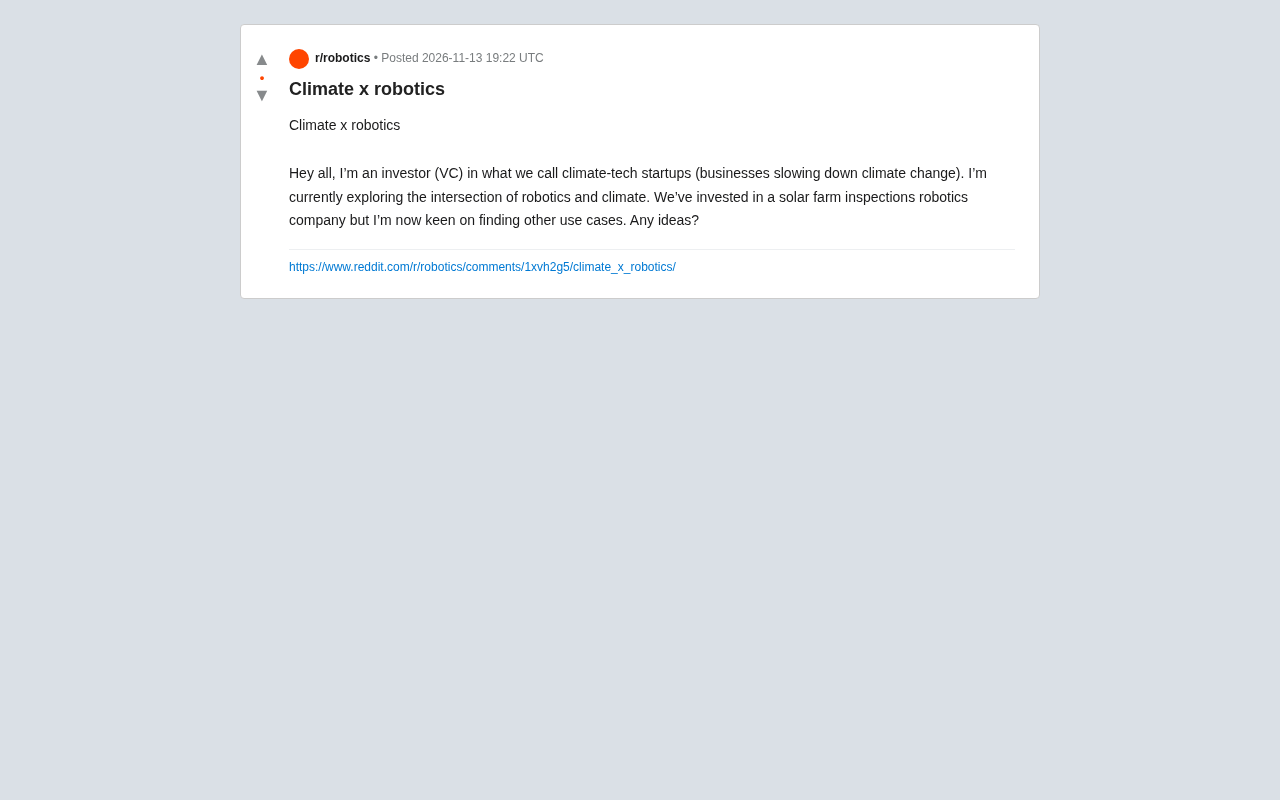
A venture capitalist focused on climate tech posted on Reddit saying they had already invested in a company building inspection robots for solar farms, and now wanted to explore other "robotics × climate" use cases. The question seems simple, but it actually points to a rapidly forming sector: when climate goals shift from policy slogans to quantifiable engineering problems, robots happen to be the player that can turn "green" into "cost-effective."
Why Climate Scenarios Are Naturally Suited to Robotics
The core contradiction in climate tech is often not that the technology can't do it, but that the economics don't add up. Emission reduction, monitoring, and recycling share common traits: large spaces, harsh environments, high repetitiveness, and high labor cost ratios. These are exactly the four things robots do best.
Take renewable energy as an example. Solar farms and wind farms are typically built in remote or harsh environments, where manual inspections are both slow and dangerous. Inspection frequency directly determines whether power generation losses can be discovered in time. The solar inspection robot that investor has already bet on is essentially using automation to simultaneously lower two cost items: "downtime losses" and "labor safety." Similar logic can be replicated to wind turbine blade inspection, transmission line patrols, biodiversity monitoring, and other scenarios.
Another characteristic of climate problems is that they are data-intensive but data is hard to collect. Forests' carbon sinks, soil health, and marine ecosystems have long lacked high-frequency, low-cost observation methods—and this is precisely where robots (especially low-cost drones and ground platforms) can create incremental value.
Several Directions Worth Watching
The Depth of Renewable Energy O&M
Solar inspection is just the entry point. Internal crack detection of wind turbine blades, corrosion monitoring of offshore wind foundations, and thermal runaway early warning for energy storage stations all have room for robots to replace manual work. In these scenarios, the payers are clear (plant operators), ROI is easy to quantify, and they represent the shortest commercialization path among climate robotics.
Thermal Runaway Early Warning for Energy Storage Stations: Lithium-ion battery energy storage systems may experience thermal runaway when overcharged, overheated, or internally short-circuited, releasing flammable gases and triggering fires. Energy storage stations are large in scale with numerous batteries, making it difficult for manual inspections to detect early anomalies in real time. Robots can be equipped with thermal imaging, gas sensors, and acoustic detection modules to autonomously patrol within the station, identifying abnormal temperature rises or electrolyte leakage signs in battery clusters, thereby providing early warning before thermal runaway occurs. The payers in this scenario (station operators and insurance companies) are clear, and it is directly tied to safety compliance, giving it strong commercial drivers.
Agriculture and Soil Carbon
Regenerative agriculture and soil carbon sinks are becoming hotspots in climate investment, but for carbon credits to be credible, the prerequisite is accurate measurement. Ground robots combined with soil sampling, precision fertilization, and weeding can both reduce fertilizer-related emissions and provide data for carbon accounting. The difficulty in this direction is that farmers' willingness to pay is fragmented, and monetization may need to rely on carbon credits or agricultural input services.
Soil Carbon Sinks and Carbon Credits: Soil is the largest carbon pool in terrestrial ecosystems. Through regenerative agriculture (such as no-till, cover crops, and crop rotation), soil organic carbon stocks can be increased, thereby generating tradeable carbon credits. However, soil carbon changes slowly and is highly spatially heterogeneous. Traditional sampling methods are costly and have limited representativeness. Robots can carry near-ground sensors to perform high-density, high-frequency soil spectral measurements and sampling, combined with models to estimate carbon stock changes. Credible carbon credits require rigorous monitoring, reporting, and verification (MRV) systems—and this is precisely where the incremental value of low-cost robotic platforms lies.
Recycling and Waste Sorting
Waste sorting is a classic deployment scenario for robotic vision and grasping technology, and it directly corresponds to the circular economy and reducing landfill emissions. Compared with the climate attribute, this category has stronger commercial attributes, with recycled material price fluctuations being the main risk.
Circular Economy and Landfill Emissions: Waste landfill disposal produces greenhouse gases such as methane, while recycling can significantly reduce carbon emissions across the full lifecycle. Advances in robotic visual recognition and flexible grasping technology have made automated sorting of mixed waste possible, improving the sorting purity and recovery rate of recyclables. However, the economics of this sector are highly dependent on recycled material market prices. When virgin material prices are low, demand for recycled materials declines, and the cost advantage of robotic sorting is weakened. Therefore, attention should be paid to the impact of recycled material price fluctuations on operators' willingness to invest.
Methane and Industrial Emissions Monitoring
Methane leakage has a much stronger short-term greenhouse effect than carbon dioxide, and leak points are often dispersed and hidden. Ground robots or drones equipped with sensors conducting routine inspections can help scenarios such as oil and gas operations and landfills quickly locate emission sources. Tightening regulations will push this demand from "voluntary" to "mandatory."
The Short-Term Greenhouse Effect of Methane: Methane is a short-lived but extremely potent greenhouse gas. According to the IPCC Fifth Assessment Report, its global warming potential over a 100-year scale is about 28 times that of carbon dioxide, and over a 20-year scale it can be as high as 84 times. This means that controlling methane emissions in the short term has a leverage effect on slowing the pace of near-term warming. Oil and gas production, landfills, coal mining, and agriculture are the main anthropogenic emission sources. Leak points are dispersed and hidden, and routine robotic inspections can significantly improve the efficiency of discovering emission sources, meeting increasingly stringent regulatory requirements.
What to Watch Out for When Betting on Climate Robotics
The climate attribute itself does not constitute a moat. Robotics companies ultimately have to compete on cost with manual labor and other automation solutions. Subsidies or carbon prices brought by climate policy are only accelerators, not the foundation of the business model. The investor's question implies a correct judgment: first find specific use cases, then talk about the climate narrative.
In addition, data in climate scenarios often involves land, emissions, and compliance, and the compliance costs of collection and use cannot be ignored. When scaling up, hardware companies will also face the heavy-asset problem of deployment and operations, and these are dimensions that need to be examined closely when evaluating targets.
Judging from the orientation of community discussions, the combination of climate and robotics is still in the use-case exploration stage. The consensus is that the direction holds, but which specific segment will first achieve scale remains undetermined. For early-stage investors, this is both a risk and a window of opportunity.
One-line Summary
Climate scenarios feature large spaces, harsh environments, and high repetitiveness, making them naturally suited to robots replacing manual labor—but the climate attribute itself does not constitute a moat.
Paragraph Summary
Starting from a climate tech investor's question, the article explores the investment logic of the "robotics × climate" sector. The author argues that the core contradiction in climate tech is often that the economics don't add up, and scenarios with large spaces, harsh environments, high repetitiveness, and high labor cost ratios are exactly where robots excel. The article outlines four directions worth watching: renewable energy O&M (solar inspection, wind detection, energy storage early warning) has the shortest commercialization path; agriculture and soil carbon require low-cost, high-frequency observation but willingness to pay is fragmented; waste sorting has strong commercial attributes but is affected by recycled material price fluctuations; methane and industrial emissions monitoring is driven by tightening regulation. Finally, it emphasizes that the climate attribute is not a moat—robotics companies still need to compete on cost with manual labor and other automation solutions—and the community consensus is that the direction holds, but which segment will first scale remains undetermined.
Related articles

Why Microsoft CEO Nadella Still Backs Nvidia After Jensen Huang's Departure
Microsoft CEO Nadella publicly expresses confidence in Nvidia interim CEO Colette Kress. This article analyzes Nvidia's power transition after Jensen Huang's departure, Microsoft's compute dependency, and the trust logic of the AI supply chain.

Nadella: Critical Infrastructure Is 'Unpatchable' as AI Cybersecurity Arms Race Escalates
Microsoft CEO Nadella addresses AI cyberattack fears, saying much critical infrastructure is unpatchable, downplaying the Outlook outage, and analyzing AI's dual role in cybersecurity.

Musk Backs Jensen Huang: Firing Him Is Like Cutting Jordan
Musk says Jensen Huang is loyal to the U.S. and likens firing him to cutting Michael Jordan—highlighting politicization anxieties in the AI chip industry and defending talent value.