Cline Releases @cline/llms 0.2.0: Parsing the LLM SDK Update

Cline's LLM SDK releases 0.2.0, automated but without a changelog — upgrade with your own diff comparison
@cline/llms upgraded from 0.1.x to 0.2.0, a minor version under semantic versioning that may introduce interface changes. The release was automated via GitHub Actions, the page showed loading errors but content is unaffected, and no changelog or migration guide was provided — developers need to compare commit dab4823 against the previous tag themselves. The package name uses the @cline scope and the plural 'llms', suggesting its positioning as a unified multi-model abstraction layer. The article recommends that teams already using the SDK, developers evaluating LLM invocation layers, and ecosystem observers pay attention to this update, and check the README and examples and test in an isolated environment before upgrading. It also notes the common problem of AI toolchains iterating faster than documentation, and that 0.x minor updates don't guarantee backward compatibility.
A Quiet Version Number, a Notable SDK Iteration
On GitHub, the Cline team tagged its LLM SDK as @cline/llms@0.2.0. No launch event, no lengthy announcement — just a single release record auto-generated by the github-actions bot. For developers who don't track open-source repository activity, this amounts to almost nothing happening at all.
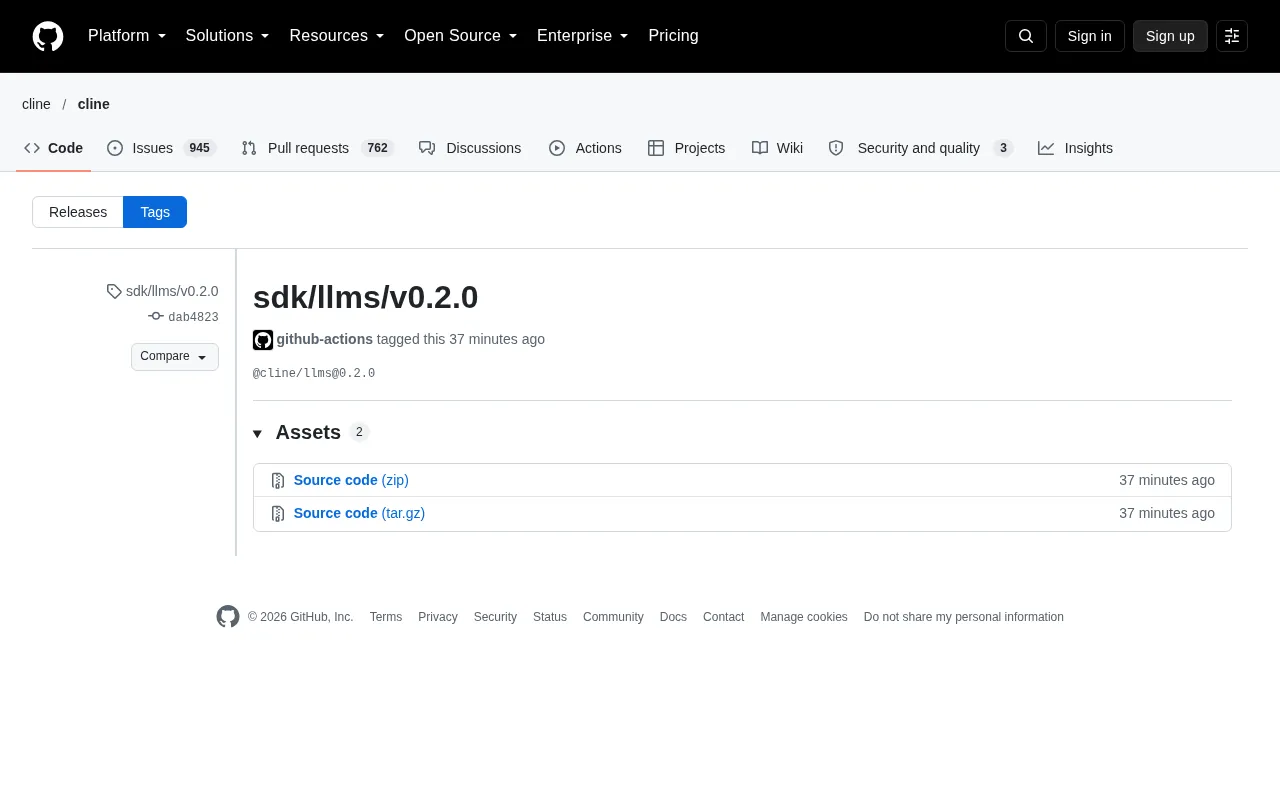
But a version number jumping from 0.1.x to 0.2.0, under semantic versioning conventions, implies substantive changes — possibly new APIs, behavioral adjustments, or upgrades to underlying dependencies. For teams already using the Cline LLM SDK in their projects, this is a signal worth noting; for developers still on the fence, it's also a good time to reassess this toolchain.
What Can Be Read from the Release Information
The Engineering Habits Behind Automated Releases
This tag was applied automatically by GitHub Actions, indicating that the Cline team has already integrated SDK version releases into its CI/CD pipeline. The release page shows several typical loading error messages ("Sorry, something went wrong"), which are common rendering glitches on GitHub Releases pages and unrelated to the release content itself.
The benefit of automated releases is a stable cadence with fewer human errors. The trade-off is that release notes tend to be brief — this one came with no changelog or migration guide. To understand what specifically changed in 0.2.0, the most direct approach is to compare the diff of commit dab4823 against the previous tag.
Semantic Versioning (SemVer) is a versioning convention widely followed in the npm ecosystem, with the format MAJOR.MINOR.PATCH. A major version change indicates incompatible API modifications, a minor version indicates backward-compatible feature additions, and a patch version indicates backward-compatible bug fixes. However, SemVer has special rules for the 0.x stage: public APIs during initial development (major version 0) are considered unstable, and minor versions can contain breaking changes. This is why the article emphasizes that minor upgrades like 0.2.0 still warrant caution — they don't automatically guarantee backward compatibility.
What the Namespace Reveals About Positioning
The package name @cline/llms uses a scoped namespace, a common practice in the npm ecosystem for teams maintaining multi-package projects. The plural naming of llms suggests it may not be a wrapper for a single model, but rather a unified abstraction layer for multiple LLM providers. This aligns with Cline's product positioning as an AI coding assistant: it needs to switch between different models, and the SDK likely handles this adaptation layer.
Scoped namespaces (like @cline/llms) are npm's package organization mechanism, allowing teams to manage multiple related packages under a unified prefix and avoid name collisions with packages in the public registry. Publishing packages through a scope requires organization or user account permissions, which also indirectly confirms that this SDK is officially maintained by the Cline team. For users, scoped packages more clearly indicate origin and ownership.
A unified LLM abstraction layer refers to building a common interface on top of the APIs of different large language model providers (such as OpenAI, Anthropic, local models, etc.), so that upper-layer applications need not be tied to a specific vendor. Such abstractions typically need to handle differences in message formats, streaming responses, tool calling (function calling), token counting, and more across providers. The plural naming of llms suggests the Cline SDK may indeed be fulfilling this adaptation role, allowing the Cline product to flexibly switch between models.
What Version 0.2.0 Actually Means for Developers
Who Should Pay Attention to This Update
Three groups are worth noting: first, teams that have already built automation workflows or internal tools on top of the Cline LLM SDK — minor version upgrades may introduce interface changes that require adaptation; second, developers currently evaluating LLM invocation layers — 0.2.0 means this SDK has moved past its initial experimental stage and is entering stable iteration; third, researchers studying the AI coding tool ecosystem — Cline's SDK design approach is itself a useful sample to observe.
What to Do Before Upgrading
Without a changelog, upgrading can't be based on guesswork. It's recommended to first check the README and example code under the llms directory in the repository to confirm whether API signatures have changed; then run your existing tests in an isolated environment; finally, merge to the main branch. Semantic versioning is a convention, not a guarantee — especially for packages in the 0.x stage, where breaking changes in minor versions are not uncommon.
The Version Cadence Problem in Open-Source AI Toolchains
This Cline release reflects a broader phenomenon: the iteration speed of AI toolchains far outpaces documentation efforts. Model providers frequently update their APIs, downstream SDKs must keep up, but release notes are often omitted. For users, this means higher maintenance costs — you have to read the diff yourself and write your own migration notes.
This isn't a problem unique to Cline. The entire open-source AI ecosystem faces the same tension: rapid iteration attracts attention, but stability and predictability are the foundation for long-term developer retention. Version milestones like 0.2.0 are exactly the window through which to observe whether a project is beginning to value this balance.
Summary
@cline/llms@0.2.0 is a quiet release with limited information but a clear signal: Cline's LLM SDK is continuously evolving, and the automated release pipeline is already in place. For users, it's advisable to base upgrade assessments on the diff; for observers, it's worth continuing to track whether this package subsequently adds a changelog and more complete documentation.
Related articles

Last Week Tonight Exposé: The Dangerous Ties Between Politicians and White Supremacy
Last Week Tonight investigates Georgia Senate candidate Mike Collins and Florida candidate Marshall Rawson, exposing their multiple ties to white supremacists and the Republican Party's silent response.
AI Buzz Weekly: GPT-6.5 Leak, New Claude Model, and MiniMax's Cost-Effectiveness
This week's AI buzz roundup: suspected GPT-6.5 leak, Microsoft configs showing GPT-6.1 Tera, Anthropic's new model that can identify entire classes of bugs, disappointing early Gemini 4 Carbon results, and MiniMax M3.1 Flash beating Claude Opus 5 and GPT-5.6 Sol in benchmarks at extremely low cost.

AI Briefing: Gemini 4 Carbon Released, Ant Open-Sources Ling-3.1
AI Briefing: Google releases Gemini 4 Carbon qubit model, claiming to surpass Opus 5.5 with half-price tokens; Ant open-sources Ling-3.1-1019 for real-task Personal Agents; domestic AI drug discovery succeeds in 18 of 19 projects, hitting all 6 GPCR targets; zero-revenue company valued at $20B raises another $1B; Sichuan convenience store robot sales fail.