Commonsense AI Can't Grasp: Living There or Just Staying? Multimodal Models Fail at Duration Reasoning

Research builds a human-LLM co-annotated tweet corpus, revealing systematic shortcomings of vision-language models in duration commonsense reasoning.
This paper focuses on the capability deficiency of multimodal AI in "duration commonsense reasoning"—inferring from textual, visual, and contextual cues in social media tweets whether the poster is briefly staying or living long-term. The researchers constructed a geotagged tweet corpus co-annotated by humans and LLMs as a test platform to systematically evaluate state-of-the-art vision-language models. Results show that even with multi-turn chain-of-thought prompting, models still struggle. Error analysis identifies two major failure modes: inability to integrate multi-source contextual information (e.g., geolocation, hashtags), and over-reliance on salient visual elements while ignoring subtle semantic cues. The research highlights that such reasoning requires models to truly understand human behavioral logic, not just recognize elements, underscoring significant challenges in context-aware multimodal understanding.
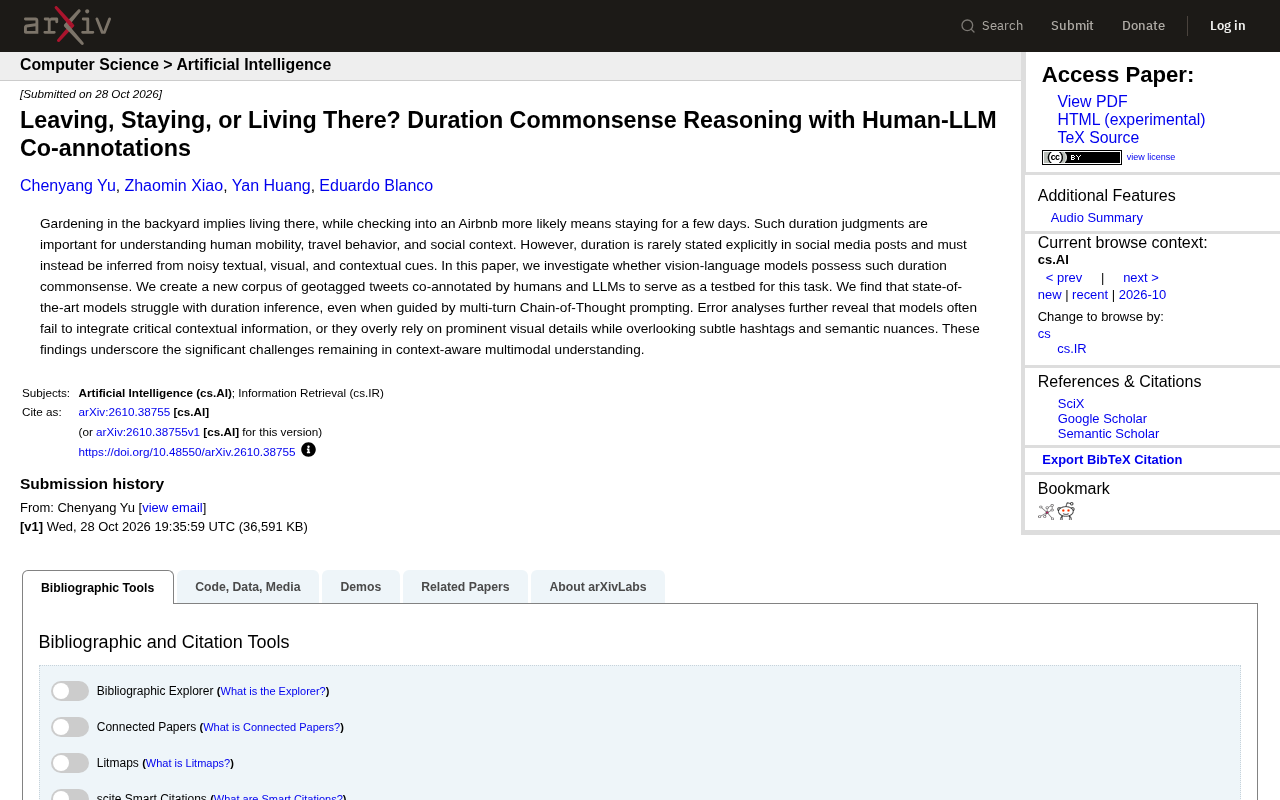
Imagine two social media posts: one is a photo of a backyard garden captioned "weekend labor"; the other is a check-in photo of an Airbnb room captioned "vacation begins." Humans can tell almost instantly: the former suggests long-term residence, while the latter is just a brief stay. But recent research shows that current state-of-the-art vision-language models are almost "blind" in this regard.
The paper titled Leaving, Staying, or Living There? Duration Commonsense Reasoning with Human-LLM Co-annotations directly targets the systematic shortcomings of multimodal AI in duration commonsense reasoning. The researchers built a geotagged tweet corpus co-annotated by humans and large models, specifically testing whether models can infer the implicit information of "duration of stay" from noisy textual, visual, and contextual cues.
Duration Reasoning: A Neglected Multimodal Challenge
Duration judgment sounds simple, but it actually involves complex cross-modal reasoning. Tweets rarely explicitly state "I stayed for three days" or "I live here permanently." Models must piece together the answer from subtle clues: garden tools suggest long-term maintenance, a hotel key card photo points to a brief stay, and certain hashtags hint at local identity.
The paper points out that this type of reasoning is crucial for human mobility analysis, travel behavior research, and social context understanding. The question is: can existing vision-language models handle it? The research team built a dedicated test platform—a geotagged tweet corpus co-annotated by humans and LLMs—to systematically evaluate the models' duration commonsense.
The "human-LLM co-annotation" design itself is noteworthy: it leverages the scalability of LLMs while ensuring quality through human annotation, providing a relatively reliable benchmark for subsequent evaluation.
Even State-of-the-Art Models Fail; Chain-of-Thought Prompting Doesn't Help
The experimental results are not optimistic. The paper explicitly states that even current state-of-the-art models struggle with duration inference, even when researchers used multi-turn Chain-of-Thought (CoT) prompting to guide the models through step-by-step reasoning.
Chain-of-Thought prompting usually improves model performance on complex reasoning tasks, but here it seems to have limited effect. This suggests that the difficulty of duration reasoning lies not in "whether there are enough reasoning steps," but in whether the model truly understands the implicit cues in the context. For a tweet with a garden photo, the model may recognize the visual object "garden" but fail to associate it with the social commonsense of "long-term residence."
Chain-of-Thought (CoT) prompting is a technique that guides large models to output intermediate reasoning steps before giving an answer, initially proven to significantly improve accuracy in math word problems and multi-hop question answering. Its core assumption is that decomposing complex problems into manageable sub-steps can reduce the error rate of single-step reasoning. However, the effectiveness of CoT is highly dependent on whether the model possesses the underlying knowledge required to complete the task—if the model does not understand social commonsense such as "garden tools imply long-term maintenance," more reasoning steps are just spinning on false premises. The findings of this paper echo this limitation: multi-turn CoT failed to improve duration inference, indicating that the bottleneck is not the organization of the reasoning chain, but the model's lack of implicit knowledge reserves to connect visual cues with social behavior patterns.
Error Analysis: Where Exactly Do Models Go Wrong?
The paper's error analysis reveals two typical failure modes.
First, context integration failure. Models often fail to piece together key contextual information. For example, a tweet's geographic location, posting history, hashtags, and other cues are interrelated and jointly point to a duration judgment, but the model may grab only one or two signals and hastily conclude.
Second, over-reliance on visual details. Models are easily drawn to salient visual elements while ignoring more subtle semantic cues. A tweet's hashtag may be more informative than the photo itself—for instance, posts with local community tags likely come from long-term residents—but models often miss the forest for the trees, focusing on prominent objects in the image while ignoring tags and semantic details.
These two error patterns point to the same core dilemma: models lack a true understanding of "context." They can recognize elements but struggle to weave them into a meaningful social scenario.
Context integration is a key capability in multimodal reasoning, referring to the model's ability to synthesize discrete information from different modalities and sources—such as hashtags in text, scene elements in images, and geolocation metadata of tweets—into a coherent semantic judgment. In human cognition, this integration is almost automatic: seeing a "#locallife" tag plus a backyard vegetable garden photo immediately brings to mind long-term residence. But for current models, information from different modalities is often processed independently in separate encoding spaces, and the fusion layer struggles to capture cross-modal implicit associations. Previous research has shown that multimodal models are generally weaker than unimodal human baselines on tasks requiring "connecting scattered clues," and the duration reasoning task in this paper is a concentrated manifestation of this deficiency.
Implications for Multimodal AI Development
The significance of this research goes beyond a benchmark test. It reminds us that the "commonsense" problem in multimodal understanding is far more thorny than imagined. When humans judge "living there or just staying," they invoke a whole set of implicit knowledge about social behavior, spatial usage, and lifestyle—knowledge that is difficult to acquire through simple data scaling.
The paper's conclusion also explicitly states: these findings highlight the significant challenges still facing context-aware multimodal understanding. For researchers committed to building AI systems that better understand the human world, duration reasoning may be a direction worth exploring—it requires models to not only "see" images and text but also "understand" the human behavioral logic behind them.
From an application perspective, improving this capability has direct value for travel recommendations, urban computing, social event analysis, and other scenarios. But before that, how to teach models to read different life stories from gardens and Airbnb check-in photos like humans do remains an open question.
Background Supplement
Vision-Language Models (VLMs) are a class of multimodal neural networks that process both image and text inputs, typically represented by GPT-4V, LLaVA, Flamingo, etc. Their basic architecture usually involves a visual encoder (e.g., ViT) mapping images to feature vectors, then aligning them with the language model's word embedding space through a projection layer or cross-attention mechanism, and finally a large language model performing joint cross-modal reasoning and generation. These models excel in tasks such as image captioning and visual question answering, but their "understanding" often remains at the level of object recognition and surface semantic matching, and they are still weak in reasoning that requires social commonsense, spatial usage habits, and other implicit knowledge. The "duration of stay" inference tested in this paper is a typical example of such deep commonsense reasoning, making vision-language models an ideal subject for testing multimodal commonsense capabilities.
One-line Summary
Research builds a human-LLM co-annotated tweet corpus, revealing systematic shortcomings of vision-language models in duration commonsense reasoning.
Paragraph Summary
This paper focuses on the capability deficiency of multimodal AI in "duration commonsense reasoning," i.e., inferring from textual, visual, and contextual cues in social media tweets whether the poster is briefly staying or living long-term. The researchers constructed a geotagged tweet corpus co-annotated by humans and large language models as a test platform to systematically evaluate the performance of current state-of-the-art vision-language models. The results show that even with multi-turn Chain-of-Thought prompting, models still struggle with duration inference. Error analysis identifies two major failure modes: first, inability to effectively integrate multi-source contextual information such as geographic location and hashtags; second, over-reliance on salient visual elements while ignoring more subtle semantic cues. The research points out that such reasoning requires models to truly understand human behavioral logic, not just recognize image and text elements, highlighting the significant challenges facing context-aware multimodal understanding.
Related articles
Google's Satellite AI Server Reaches Orbit: Gemma Model Generates First Reply in Space
Google's TPU-equipped satellite powers up in orbit, with the onboard Gemma 4 model generating the first reply from space. This article analyzes the technical path, real-world constraints, and implications for edge computing and satellite remote sensing.

AI Agents for Flight Booking Customer Support: Real Needs and Implementation Challenges
Starting from a real Reddit question, this article breaks down four needs for introducing AI Agents into flight booking call centers: basic Q&A, agent assist, call summarization, and quality inspection, and analyzes accuracy concerns and handoff boundary design.

Vercel Unifies Runtime Cache: Data Cache Merges into Runtime Cache
Vercel merges Data Cache into Runtime Cache, unifying storage quotas and billing for Next.js fetch cache, unstable_cache, getCache, and use cache: remote. Pro and Enterprise projects get more storage, and cache reads/writes are now billed at Runtime Cache pricing.