Conditional Entropy-Enhanced EDL: A New Breakthrough in Uncertainty Quantification for Glaucoma Detection

Conditional entropy-regularized evidential deep learning significantly improves uncertainty calibration and attention consistency in glaucoma screening models.
The article presents a study on uncertainty quantification for glaucoma fundus image screening. Traditional deep learning classifiers often cannot reliably express confidence, and high-confidence wrong predictions are especially harmful in clinical settings. The study proposes a conditional entropy-regularized Evidential Deep Learning (EDL) framework; on the EyePACS-AIROGS-light-V2 and RIM-ONE-DL datasets, its calibration error is significantly lower than Deep Ensembles, MC Dropout, post-hoc calibration, and traditional EDL based on Dempster uncertainty. The authors also introduce a Grad-CAM focus index, finding that the EDL model shows greater separation in attention distribution between correct and incorrect samples, with false-negative samples' activations often deviating from the optic disc. The article also notes that the work is limited to two public datasets and lacks multicenter and reader-study validation, and discusses its single-forward-pass inference efficiency advantage and potential for transfer to other medical imaging tasks.
Why Glaucoma Screening Needs Better Uncertainty Quantification
Glaucoma is one of the leading causes of irreversible blindness, and retinal fundus images are a key tool for screening it. However, when classifying these images, deep learning models often cannot reliably express "how certain they are." A high-confidence wrong prediction in a clinical setting can lead to missed or incorrect diagnoses.
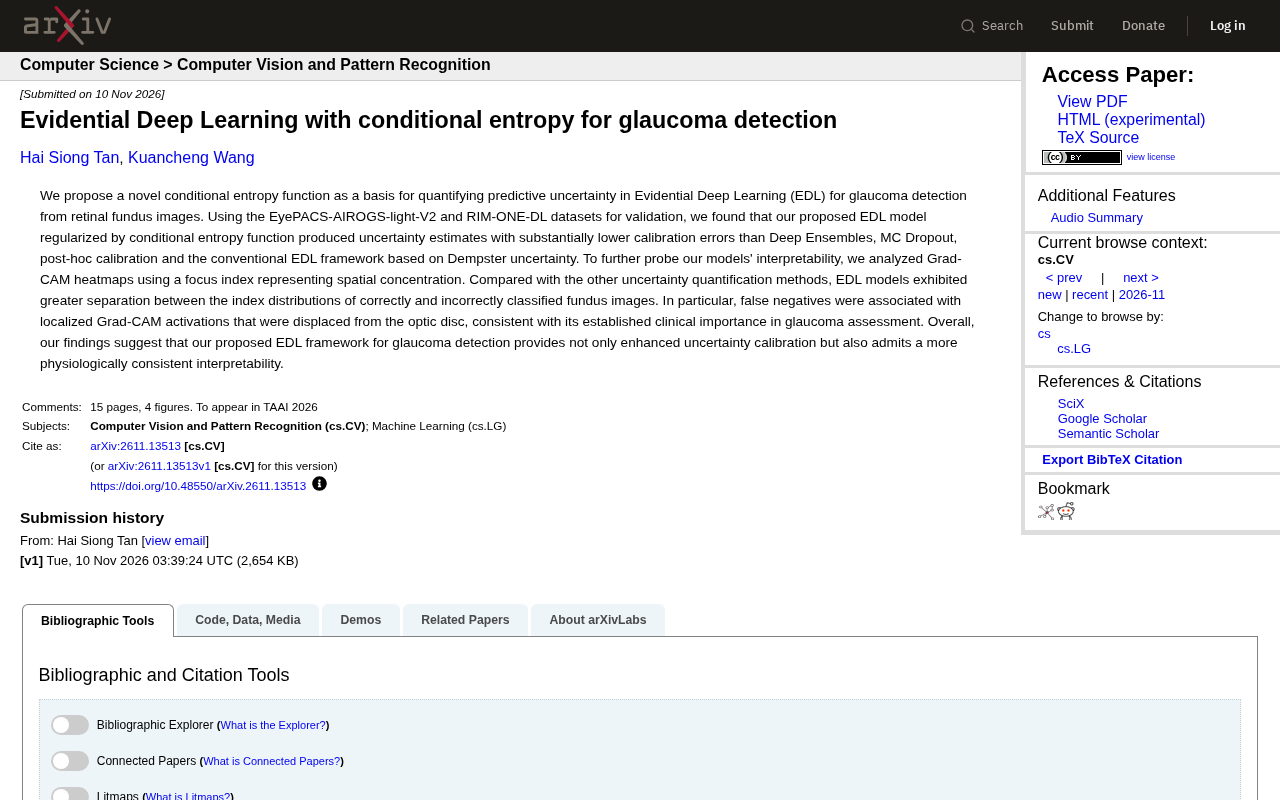
According to a recently published study, an Evidential Deep Learning (EDL) framework based on conditional entropy regularization significantly improves the calibration quality of predictive uncertainty in glaucoma detection tasks. The study validated the approach on two datasets, EyePACS-AIROGS-light-V2 and RIM-ONE-DL, and found that the proposed EDL model achieved substantially lower calibration error than Deep Ensembles, MC Dropout, post-hoc calibration, and the traditional EDL framework based on Dempster uncertainty.
The significance of this result is that uncertainty quantification is no longer merely an "add-on feature" but may become a core component of safe deployment for medical imaging models.
Calibration is a core concept in uncertainty quantification, referring to whether a model's output confidence matches its actual accuracy rate. A well-calibrated model that claims "90% confidence" should indeed be correct in roughly 90% of a large number of similar predictions. The commonly used metric is Expected Calibration Error (ECE), which bins predictions by confidence and computes the weighted sum of the differences between average confidence and average accuracy within each bin. Poorly calibrated models systematically overestimate themselves (overconfidence), which is especially dangerous in clinical screening because a confidently wrong judgment is hard for downstream processes to intercept.
Deep Ensembles estimate uncertainty by training multiple independently initialized models and averaging their outputs. They typically achieve excellent calibration but have training and inference costs that grow linearly with the number of models. MC Dropout keeps Dropout enabled during inference and performs multiple forward passes to sample a predictive distribution. It is simple to implement but involves a trade-off between the number of samples and estimation quality. Both methods belong to "sampling-based" uncertainty estimation and are the main comparison baselines for single-forward-pass methods such as EDL.
How Conditional Entropy Improves EDL's Uncertainty Estimation
Traditional EDL frameworks typically rely on the uncertainty measure from Dempster-Shafer evidence theory, converting the model's output evidence mass into a confidence distribution over predictions. However, the study points out that this measure cannot fully reflect calibration quality in certain cases.
The authors propose a new conditional entropy function as a regularization term that directly constrains the behavior of the evidence distribution. The role of conditional entropy here is to measure the concentration of remaining uncertainty given the predicted class, thereby guiding the model to produce sharper evidence distributions when it classifies correctly and to retain sufficient ambiguity when uncertain.
Experimental results show that this regularization leads to lower calibration error. Compared with sampling-based methods such as Deep Ensembles and MC Dropout, the EDL model has a clear advantage in the reliability of uncertainty estimation—the latter typically require multiple forward passes and incur higher computational cost, whereas EDL can output uncertainty with a single forward pass.
Dempster-Shafer evidence theory describes belief using "evidence" rather than probability: the model outputs a non-negative evidence mass for each class, and more evidence means higher credibility for that class. After converting evidence into a Dirichlet distribution, the total parameter count (i.e., total evidence plus the number of classes) reflects the amount of information the model possesses; less total evidence means greater uncertainty. The traditional EDL uncertainty measure often takes the form of a ratio to the number of classes, i.e., the proportion of "unassigned evidence" in the total belief mass.
The limitation of this measure is that it is an aggregate scalar reflecting only the amount of total evidence, unable to characterize the distributional shape of evidence across classes—yet calibration quality depends precisely on whether this distribution aligns with the true accuracy rate. Conditional entropy takes a different approach: it measures the entropy of the remaining classes conditional on the predicted class, and can sense whether evidence is concentrated in one class or spread uniformly, thus serving as a regularization term that directly shapes the evidence distribution.
Interpretability Analysis: Grad-CAM Focus Index Reveals Model Behavior
In addition to calibration metrics, the research team introduced a metric called the "focus index" to analyze the spatial concentration of Grad-CAM heatmaps. This index quantifies whether the model's attention region is dispersed or concentrated locally.
The analysis found that compared with other uncertainty quantification methods, the EDL model shows greater separation in the distribution of focus index between correctly and incorrectly classified fundus images. This means that the EDL model exhibits clearer differences in spatial attention patterns when it "gets it right" versus "gets it wrong."
Of particular interest are false-negative samples. In these missed glaucoma images, the Grad-CAM activation regions often deviate from the optic disc, showing a localized but mispositioned pattern. The optic disc is a structure with clear clinical importance in glaucoma assessment, and this finding indicates that the model's errors are not random but related to a lack of attention to anatomically critical regions.
Grad-CAM (Gradient-weighted Class Activation Mapping) computes the gradient of the target class score with respect to the final convolutional layer's feature maps, uses the gradients as weights to perform a weighted sum of the feature maps, and applies ReLU to obtain a heatmap of the same size as the input that indicates the spatial regions the model relies on most for its decision. It requires no modification to the network architecture and is applicable to any CNN architecture, but its resolution is coarse, and the heatmap reflects "correlation" rather than strict causal contribution.
The focus index is a derived metric constructed on top of Grad-CAM heatmaps to quantify the vague description of "whether attention is concentrated" into a statistically comparable number. A typical approach is to normalize the heatmap and compute the spatial concentration of activation (e.g., the proportion of the peak region, entropy, or distance from the centroid); higher values indicate more concentrated attention. Because it is a scalar per image, researchers can compare distributional differences of this metric across models and between correct and incorrect samples, elevating interpretability from case-level visualization to quantitative analysis at the group level.
Potential Clinical Value and Limitations
From a clinical perspective, the value of this work lies in its dual improvement: better-calibrated uncertainty enables the model to "know what it doesn't know," while more consistent interpretability patterns provide doctors with clues to scrutinize model decisions. When the model gives a low-uncertainty but incorrect prediction for a fundus image, the focus index can indicate whether attention has deviated from the optic disc region.
It should be noted that the study's validation is limited to two public datasets and has not yet involved multicenter prospective clinical data. The generalization ability of the conditional entropy function across different ethnicities and different camera devices still needs further testing. In addition, as an interpretability measure, the focus index's consistency with clinicians' judgments has not yet been verified in reader studies.
The optic disc is the manifestation of the optic nerve head in fundus images, the region where retinal ganglion cell axons converge and exit the eye, and where the central retinal vessels enter and leave. The core pathology of glaucoma is optic nerve damage, and clinically the key criteria are morphological changes such as an increased cup-to-disc ratio and narrowing of the neuroretinal rim. Therefore, the optic disc and its surrounding area are the anatomical structures with the most concentrated information in glaucoma interpretation.
The deviation of Grad-CAM activation from the optic disc in false-negative samples means the model may rely on cues unrelated to diagnosis, such as peripheral vascular morphology, image brightness, or capture artifacts. This kind of "shortcut learning" may perform well within a dataset but fail across devices and populations, which also explains why the authors emphasize the need for cross-center validation.
Implications for Medical Imaging AI
This study sends a signal: the design of uncertainty quantification should not be divorced from the structural knowledge of the specific task. The introduction of conditional entropy is effective partly because it aligns with the intuition in classification tasks that "correct predictions should be accompanied by concentrated evidence." Similar ideas may be transferable to other medical imaging classification problems, especially screening scenarios where the cost of false negatives is high.
At the same time, combining uncertainty calibration with interpretability analysis provides richer dimensions for model evaluation. A single metric (such as AUC) cannot reveal the model's behavior patterns on erroneous samples, whereas joint analysis of calibration error and focus index can more comprehensively characterize the model's reliability boundaries.
For researchers focused on the safe deployment of AI, the appeal of the EDL approach lies in its inference efficiency—uncertainty estimates can be obtained without multiple sampling passes. If conditional entropy regularization can be more widely validated, it may become a practical option for uncertainty modeling in medical imaging models.
One-line Summary
Conditional entropy-regularized evidential deep learning significantly improves uncertainty calibration and attention consistency in glaucoma screening models.
Paragraph Summary
This article introduces a study on uncertainty quantification for glaucoma fundus image screening. Traditional deep learning classifiers often cannot reliably express confidence, and high-confidence wrong predictions are especially harmful in clinical settings. The study proposes an Evidential Deep Learning (EDL) framework based on conditional entropy regularization; on the EyePACS-AIROGS-light-V2 and RIM-ONE-DL datasets, its calibration error is significantly lower than Deep Ensembles, MC Dropout, post-hoc calibration, and traditional EDL based on Dempster uncertainty. The authors also introduce a Grad-CAM focus index and find that the EDL model shows greater separation in attention distribution between correct and incorrect samples, with false-negative samples' activations often deviating from the optic disc. The article also notes that the work is limited to two public datasets and lacks multicenter and reader-study validation, and discusses its efficiency advantage of single-forward-pass inference and its potential for transfer to other medical imaging tasks.
Related articles

Don't Let Permission Pop-ups Scare Users Away: On-Demand Requests Are the Right Approach for AI Plugins
AI plugins that show a permission wall at install time can scare users away. Based on a technical sharing video, this article analyzes the friction caused by requesting all permissions upfront and introduces on-demand permission requests that ask only when needed, improving the user experience and trust of AI tools.

Perplexity Decider Free for a Week, Plus Compute Grants and Credit Matching
Perplexity Decider V1.3 and Flash V1.3 are free on OpenRouter for a week, plus Infirst.net offers up to $10K compute grants for open-source AI projects and Cognition provides $15K Devin credits with 1:1 matching for startups.

Motorcycle Infiltration: Russia's Drone War of Attrition in Ukraine
An analysis of Russia's motorcycle infiltration tactics in Ukraine: using speed to cross drone kill zones, accepting high casualties to find gaps in Ukrainian defenses, and exploring drone suppression and two Ukrainian response paths.