Confetti: Building Hardware Gadgets Effortlessly with Natural Language

Confetti designs hardware through natural language conversation and integrates component sourcing with part printing orders.
Confetti is a hardware design tool that debuted on Product Hunt, focused on completing hardware project design, editing, and part ordering through natural language conversation. Users don't need CAD modeling skills—they simply describe the device they want, and the system helps generate or modify the design, supporting both creation from scratch and remixing community projects. The platform also integrates component search and part printing orders to form an end-to-end service loop, targeting makers with hardware ideas but without an engineering background. The tool received 83 upvotes and 10 comments, ranking 10th for the day, and is in an early stage. The article notes that whether natural language can cover engineering details such as EMC, power supply, and structural strength remains to be verified, and community project quality and compatibility are potential risks.
Title
Confetti: Building Hardware Gadgets Effortlessly with Natural Language
Meta Description
Confetti is a tool for designing hardware through natural language conversation, supporting creation from scratch or remixing community projects, and integrating component search with part printing and ordering services, aiming to lower the barrier to hardware development.
Article Content
Hardware development has always had a high barrier to entry—learning CAD, finding compatible components, and writing firmware often takes weeks. Now, a tool called Confetti hopes to change that by allowing users to design and edit hardware projects through natural language conversation, and even order 3D-printed parts directly. On Product Hunt, Confetti debuted under the tagline "Build hardware with plain words," earning 83 upvotes and 10 comments, ranking 10th for the day.
Hardware Design That Starts with a Conversation
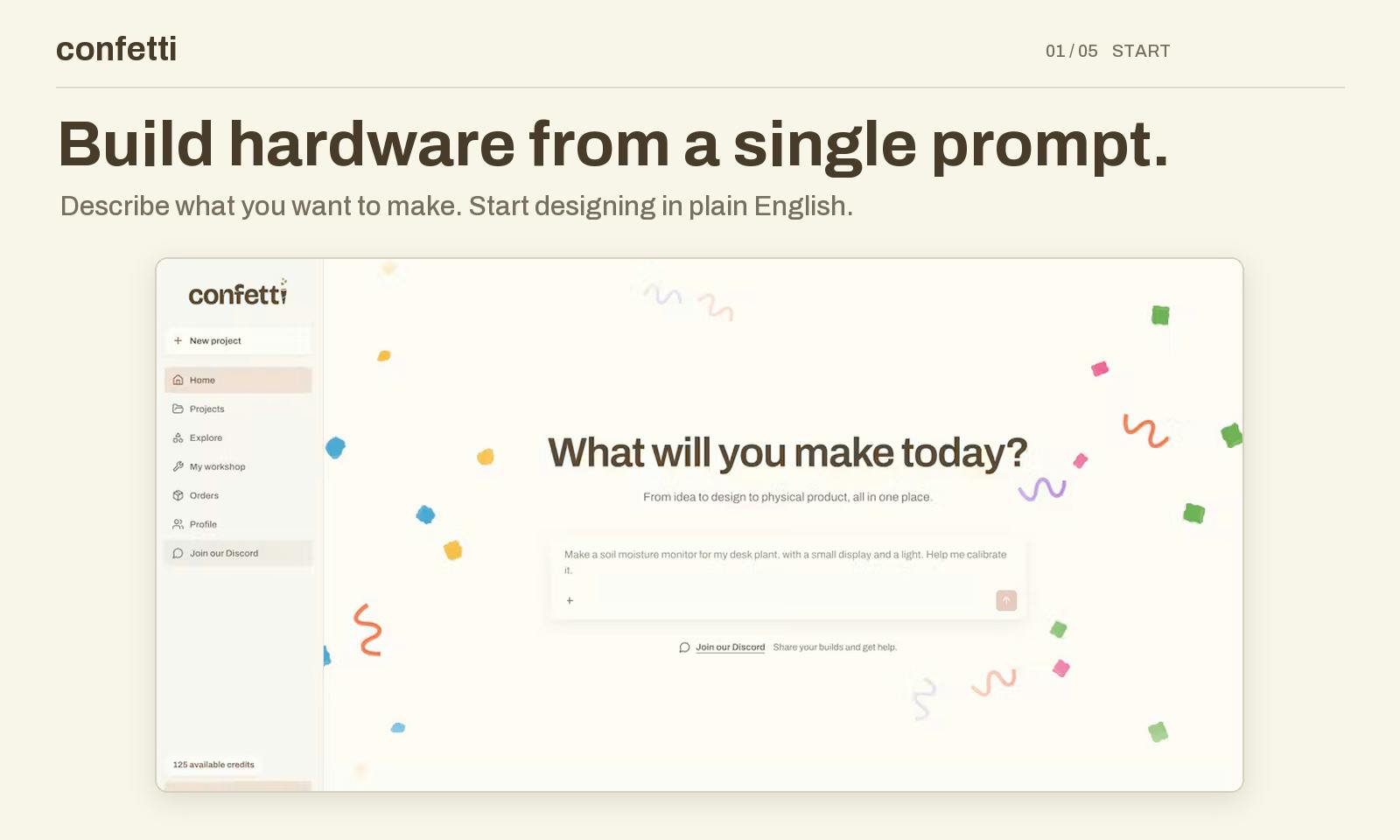
Confetti's core idea is to compress the hardware prototyping workflow into a conversation. Users simply describe the device they want to build in everyday language, and the system helps generate or modify the design. This eliminates the need for CAD modeling skills required in the traditional process and lowers the barrier to finding suitable components.
According to its Product Hunt page, Confetti supports creation from scratch and also allows users to "remix" community projects, modifying designs built by others. This community-driven model helps accelerate idea iteration and lets beginners get started quickly.
CAD (computer-aided design) is a foundational part of hardware development—engineers use it to build 3D models, generate engineering drawings, and verify structural assembly. In the traditional workflow, learning a mainstream CAD program typically takes weeks or even months, and the modeling process relies heavily on understanding dimensions, tolerances, and material properties. Confetti attempts to replace this manual modeling step with natural language, relying on large language models' ability to parse design intent and generate parametric output—users describe functional requirements, and the system translates them into editable geometric models or circuit configurations. This lowers the entry barrier, but it also means design precision depends heavily on how well the model understands engineering constraints.
One-Stop Component Search and Part Ordering
Beyond design, Confetti also integrates component lookup and part printing/ordering. After completing a design, users can place an order directly through the platform and have printed parts delivered to their door. This end-to-end service reduces the hassle of comparing prices and coordinating across multiple suppliers—an appealing proposition for makers focused on efficiency.
Confetti is currently categorized as a design tool, prototyping tool, and maker tool, and its target users are clearly people with hardware ideas but without a professional engineering background.
Component compatibility is one of the most error-prone aspects of hardware prototyping. Chips, connectors, and power modules in different packages differ in pin definitions, voltage levels, and communication protocols—choosing the wrong component can prevent an entire board from working. The traditional approach is to consult datasheets, compare parameters, and cross-verify across multiple supplier platforms. Confetti integrates component search and ordering into the design workflow, which in theory can automatically match available components as users describe their needs. But this also requires the platform to maintain an accurate, continuously updated component library and to perform real-time validation of electrical parameter conflicts—otherwise the end-to-end service could end up amplifying errors.
Market Positioning and Potential Challenges
Judging from Product Hunt feedback, Confetti's ease-of-use concept has drawn some attention, but the numbers—10 comments and 83 upvotes—also indicate it is still in an early stage. Hardware development involves complex issues such as electromagnetic compatibility, power supply, and structural strength, and whether natural language conversation alone can cover these engineering details remains to be verified in practice.
In addition, the quality of community projects varies widely, and the remix model may introduce compatibility or safety risks. If Confetti truly wants to become "the easiest way to build hardware," it will need to keep investing in automated design validation and component compatibility checks.
Electromagnetic compatibility (EMC) and power supply design are engineering domains that natural language interaction struggles to cover directly. EMC focuses on ensuring a device neither generates excessive interference nor succumbs to external interference in an electromagnetic environment, involving details such as routing layout, shielding, and filtering. Power supply design requires calculating current margins, voltage drops, and heat dissipation. Judging these issues relies on simulation and physical testing, not merely on functional descriptions. The same applies to structural strength—the material properties, wall thickness, and load direction of printed parts all affect the reliability of the final product. As a result, conversational tools are more likely to be positioned at the proof-of-concept and rapid prototyping stage, while production-grade designs still require professional engineers to step in for validation.
Conclusion
Confetti attempts to lower the barrier to hardware creation through natural language interaction, bundling design, component sourcing, and manufacturing into a single platform. For makers and hardware enthusiasts, it is a new option worth watching. But whether its actual capabilities can match the promise of "easiest" still needs to be tested by more users in practice.
One-line Summary
Confetti designs hardware through natural language conversation and integrates component sourcing with part printing orders.
Paragraph Summary
Confetti is a hardware design tool that debuted on Product Hunt, focused on completing hardware project design, editing, and part ordering through natural language conversation. Users don't need CAD modeling skills—they simply describe the device they want, and the system helps generate or modify the design, supporting both creation from scratch and remixing community projects. The platform also integrates component search and part printing orders to form an end-to-end service loop, targeting makers with hardware ideas but without an engineering background. The tool received 83 upvotes and 10 comments, ranking 10th for the day, and is in an early stage. The article notes that whether natural language can cover engineering details such as EMC, power supply, and structural strength remains to be verified, and community project quality and compatibility are potential risks.
Related articles

AI Comic Drama with WorkBuddy from Scratch: A Step-by-Step Skill Pack Installation Guide
Learn how to create AI comic dramas with WorkBuddy from scratch. This guide covers installation, Skill pack import and invocation, plus a script generation demo with manual revision tips to get you through the first step from script to storyboard.

WorkBuddy Agent Runs the Entire GEO Database Mining Pipeline with a Single Prompt
WorkBuddy agent automates GEO database mining: from data search and curation to batch correction, differential analysis, co-expression networks, feature gene screening, and immune infiltration—a single prompt generates a complete bioinformatics report, greatly lowering the barrier to bioinformatics analysis.

PC Memory Wasted? Hacker News Debates Centralized Data Centers
Hacker News users argue that personal computer memory is wasted and should be centralized in data centers, sparking debate on centralized vs. distributed computing resource allocation. This article analyzes the logic behind the claim, the costs of centralization, and new tensions in memory resource allocation in the AI era.