Coze Agent Development Complete Guide: Auto-Build + Workflow Hands-On
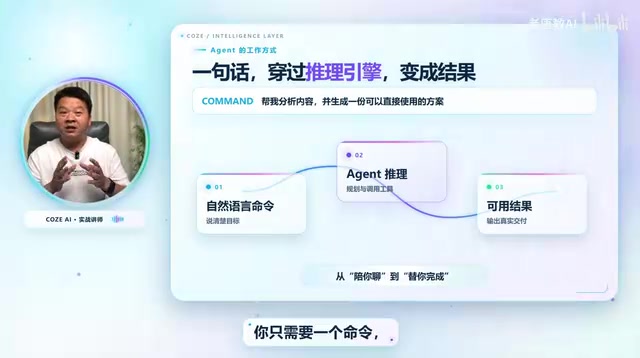
Deconstructing Bilibili's Coze 3.0 zero-prerequisite hands-on course, evaluating its value and target audience.
The article reviews the content framework of a Coze agent development course on Bilibili and evaluates whether it's worth following given Coze 3.0's capabilities. Auto-build generates agents, workflows, or skills from one sentence, lowering the entry barrier, but complex tasks still need manual workflow building, plugin calls, and knowledge base tuning. The course covers digital humans, comic drama, e-commerce, self-media, education, finance, and law, plus local/cloud deployment. It suits those with clear business scenarios willing to practice hands-on, with core value in AI product thinking and structured methodology—while keeping a calm view of "one-click complex tasks."
The pace of AI tool iteration is anxiety-inducing, and not knowing where to start learning is probably the real state of many professionals today. There's a Coze agent development course on Bilibili that emphasizes zero prerequisites and full hands-on practice, attempting to solve this problem. I've thoroughly reviewed its content framework and, combined with Coze 3.0's actual capabilities, will discuss whether this tutorial is worth following.
What Changes Coze 3.0 Brings
The most noteworthy aspect of Coze 3.0 is its auto-build capability. In the past, creating an agent required manually configuring workflows, debugging plugins, and repeated testing—the barrier was not low. Now you can generate an agent, workflow, or skill with a single sentence.
According to the course demonstration, entering "help me build an agent that automatically generates promotional images when I upload product photos" will cause the system to start building automatically. After construction is complete, upload a product image and the result is output directly. Similarly, generating study cards from poetry titles, or generating Xiaohongshu copy and covers from a topic, can all be done with one sentence.

This auto-build solves simple needs. The course also acknowledges that one-sentence generated results may not be precise enough initially and require subsequent tuning. But as an entry method, it significantly lowers the barrier to entry.
An agent is a software entity that can perceive its environment, make autonomous decisions, and execute actions to accomplish specific goals. In platforms like Coze, agents are typically driven by large language models and can call plugins, workflows, and knowledge bases to extend their capability boundaries. Unlike traditional chatbots, agents emphasize task orientation and tool use: the user provides a goal, and it plans steps and calls appropriate resources on its own. Understanding this concept helps distinguish between simple agents generated by "auto-build" and complex agents built manually—the former focuses on rapid validation of needs, while the latter achieves multi-step, multi-condition business logic through finely orchestrated workflows and plugins.
Manual Building: The Core Path for Complex Scenarios
Although auto-build is convenient, complex tasks and enterprise-level agents still rely on manual building. Workflow construction, plugin invocation, and knowledge base tuning—these are the highlights of the course.
The course covers a wide range of scenarios: in the digital human field, input a script to generate a talking-head short video; in the comic drama industry, provide a description to generate storyboards; in e-commerce, upload clothing images to generate product images and sales videos; in self-media, deconstruct the logic of viral short videos; in education, create essay grading assistants and idiom learning cards. There are also corresponding workflow cases for finance, accounting, law, and other industries.
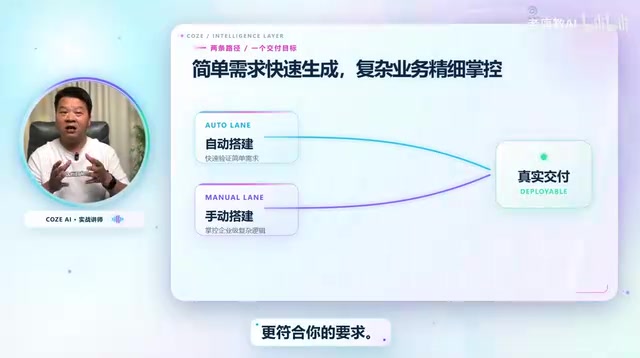
The value of these cases is not in copying them directly, but in demonstrating a structured building approach. Each industry has different needs, but the methodology of task decomposition, workflow design, and knowledge base tuning is universal.
A workflow is the core mechanism in Coze for implementing complex tasks. It orchestrates multiple nodes (such as large model calls, plugin execution, condition judgments, loops, and code blocks) in logical order into reusable automated processes. Unlike single conversational calls, workflows support branching, parallelism, and exception handling, making them suitable for business scenarios that require multi-step collaboration—for example, first identifying a product in an image, then generating copy, and finally synthesizing a promotional image. Plugins are interfaces for calling external services within workflows, and knowledge bases provide domain-specific retrieval-augmented information for models. Only when the three work together can an agent output stably in vertical scenarios.
Local Devices and Cloud Devices: Full-Scenario Office
The course also covers Coze 3.0's local devices and cloud devices. This point is easily overlooked, but it determines which scenarios the agent can be used in. Cloud devices are suitable for lightweight tasks and team collaboration, while local devices can handle scenarios with data privacy or response speed requirements. Only by combining both can Coze become a full-scenario AI office assistant.
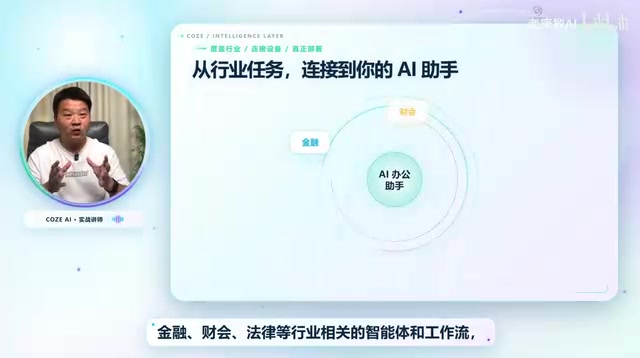
Judging from the course description, localized deployment is the concluding part of the entire tutorial. This means students must not only know how to build agents but also how to deploy them into actual work environments.
The difference between local devices and cloud devices is mainly reflected in deployment location and resource scheduling. Cloud devices are hosted by the platform, elastically scalable, and convenient for team sharing and remote access, suitable for lightweight tasks and collaboration scenarios; local devices run on users' own hardware or private environments, keeping data within the intranet with lower response latency, suitable for privacy-sensitive or real-time processing scenarios. In Coze 3.0, the two can be used in a hybrid manner: place processing involving sensitive data locally, and delegate tasks requiring elastic computing power to the cloud, thereby balancing security and efficiency.
Who This Course Is For
The course repeatedly emphasizes "no programming knowledge required, no need to be a business expert." From the content design, the auto-build section is indeed friendly to beginners, and one-sentence generation lowers the psychological barrier. However, the manual building and workflow tuning sections still require some logical decomposition ability.
A more pragmatic positioning is: suitable for people with clear business scenarios who are willing to spend time following the cases hands-on. If you just want to take a casual look, the auto-build section can give you some surprises; but if you want to truly implement it, the manual building chapters are the key.
Another selling point of the course is AI product thinking and structured methodology. This claim is not exaggerated—Coze's auto-build lowers the technical barrier, but what really determines whether an agent is useful is how you define problems, decompose processes, and design knowledge base structures. These abilities are equally applicable on other platforms.
A Few Calm Judgments
The course's coverage is indeed broad—from auto-build to manual workflows, from digital humans to e-commerce to education and finance—with high case density. But broad coverage also means depth in each industry may be limited. If you have very vertical needs, the course can give you a framework, but you'll have to fill in the details yourself.
Additionally, the course emphasizes "one-click completion of complex tasks" and "one command directly gives results." This holds true in demonstration scenarios, but actual implementation still requires repeated debugging. The initial quality of auto-built agents and workflows varies, and the course also mentions teaching everyone to "make it more precise." If you learn with the expectation that "it will work once built," you may be disappointed; if you learn with the expectation of "learning the method and tuning it yourself," your gains will be greater.
The value of platforms like Coze lies in bringing the barrier to agent development down to a level that ordinary people can reach. This course is essentially teaching you how to use this lever. Tools will change, platforms will iterate, but the thinking of decomposing needs, designing processes, and tuning results can be retained.
One-line Summary
Deconstructing Bilibili's Coze 3.0 zero-prerequisite hands-on course, evaluating its value and target audience.
Paragraph Summary
The article reviews the content framework of a Coze agent development course on Bilibili and, combined with Coze 3.0's actual capabilities, evaluates whether it's worth following. Coze 3.0's auto-build feature can generate agents, workflows, or skills with a single sentence, greatly lowering the entry barrier, but complex tasks and enterprise-level applications still require manual workflow building, plugin invocation, and knowledge base tuning. The course covers multi-industry cases including digital humans, comic drama, e-commerce, self-media, education, finance, accounting, and law, and also involves full-scenario office deployment with local and cloud devices. The author believes the course is suitable for people with clear business scenarios who are willing to practice hands-on, and its core value lies in cultivating AI product thinking and structured methodology rather than mere tool operation, while maintaining a calm judgment about the "one-click completion of complex tasks" promotion.
Related articles

DeepSeek Harness: A Beginner's Installation and Testing Guide
A DeepSeek Harness tutorial for test engineers: set up Node.js, launch with one NPX command, configure official and third-party models, and explore web search, file I/O, and trace-view agent observability.
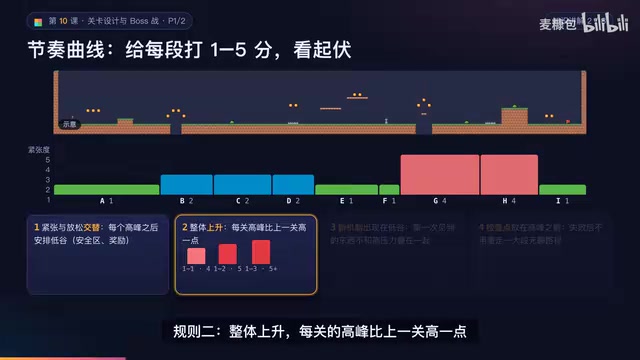
AI Game Development in Practice: Designing Levels with the Four-Step Method and Pacing Curves
AI game development lesson 10: design levels with the four-step method (teach, practice, combine, test) and a 1-5 pacing curve, plus sightline guidance and safety zones—implement Animatable Body 2D moving platforms and generate ASCII sketches for 1-2 Underground Cavern and 1-3 Guard Hall.

AI Game Development in Practice: Two-Phase Boss State Machines and Death Heatmap Tuning
AI game development lesson 10: implement a two-phase Boss with a state machine, guarantee fairness with color signals and a 0.4-second warning floor, locate difficulty cliffs with a death heatmap, and apply lightest-to-heaviest fixes one at a time, with an acceptance checklist and common pitfalls.