Coze AI Agent in Practice: One-Sentence Building and Industry Cases
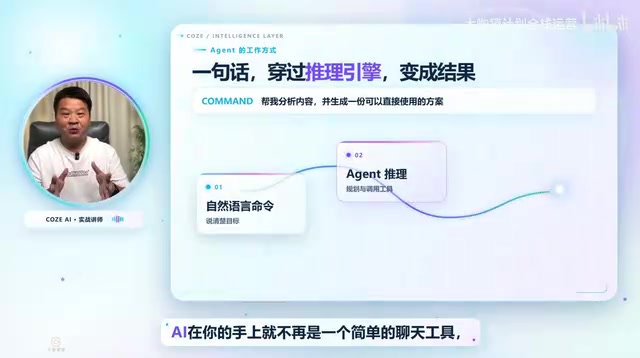
Bilibili's Coze course teaches you to create practical AI agents from scratch using automatic and manual building methods.
Based on Bilibili's "COZE Full Teaching Series," this article sorts out Coze 3.0's core capabilities and learning path. The course advocates that AI should transform from a chat tool into a task executor, delivering actual results through agents. Coze 3.0 supports automatic building (one-sentence generation of agents, workflows, or skills) and manual building (for complex tasks and enterprise-level applications), covering digital humans, comic dramas, e-commerce, education, finance, and other industries. The article emphasizes that automatic building is suitable for quickly validating simple needs, while manual building is the watershed for complex business, and the core value of the course lies in cultivating AI product thinking and structured methodology. It concludes with rational learning advice: first run through the cases, then modify them, and ultimately move beyond them.
From Chat Tool to Task Executor
AI tools are iterating faster and faster, with new terms flying around everywhere, leaving many people both anxious and unsure where to start. The course "COZE Full Teaching Series" launched on Bilibili attempts to solve this pain point: no programming background required, no need to be a business expert either—through a large number of real cases, it teaches you step by step how to build AI agents you can use directly. This article is based on the course content, sorting out Coze 3.0's core capabilities, the differences between automatic and manual building paths, and how several typical industries implement it, plus some judgment on learning paths.
From Chat Tool to Task Executor
The course opens by pointing out a cognitive shift: after learning, AI in your hands is no longer a simple chat tool, but an advanced assistant that can complete complex tasks with one click. You only need one command, and it gives you the result directly.
Behind this positioning is the essential difference between agents and traditional conversational AI. The output of a chat tool is text, while the output of an agent is a deliverable result—a promotional image, a talking-head video, a study card. The scenarios covered by the course include video editing, AI comic dramas, e-commerce detail page production, and fields such as finance, education, and more.
The course repeatedly emphasizes that the real value is not just teaching you how to use Coze well, but helping you build AI product thinking and a methodology for structured applications. This statement deserves serious attention: tools will become outdated, but the ability to break down business needs into an "input—processing—output" process has a lower migration cost.
Agent is a core concept in the current AI field, referring to an AI system that can perceive the environment, make autonomous decisions, and execute actions to achieve goals. Compared with traditional conversational AI (such as ChatGPT), an agent not only generates text but can also call tools, access external data, execute multi-step tasks, and ultimately deliver usable results. Its typical architecture includes a planning module (decomposing tasks), a memory module (storing context), and a tool-use module (calling APIs or functions). On platforms such as Coze, agents can be built in a low-code way, allowing users to combine large models, plugins, and workflows without programming to achieve automated task processing. The key to understanding agents is to distinguish their output from that of chatbots: the former outputs "results," while the latter outputs "replies."
Automatic Building: Generate Agents, Workflows, and Skills in One Sentence
A major feature of Coze 3.0 is support for both automatic and manual building methods. The logic of automatic building is straightforward: describe the requirement in natural language, and the platform automatically generates the corresponding agent, workflow, or skill.

The course gives three demonstrations. The first is an agent: enter "help me build an agent that can automatically generate promotional images after uploading a product image," and after running, the platform begins building automatically; once completed, upload a product image, wait a moment, and the effect appears directly. The second is a workflow: enter "help me build a workflow that automatically generates poetry study cards after inputting the name of a poem, with images that match the mood on the card and beautiful poetry layout," and after it is made, drop in a keyword, and a beautiful study card is generated. The third is a skill: enter "help me create a skill that automatically generates viral Xiaohongshu copy and covers after inputting a topic," and after creation, enter a parent-child education topic, and the graphic content and cover are all done.
What needs to be viewed objectively is that the course itself admits that what is generated in one sentence may not be perfect at first, and subsequent courses will teach how to make it more precise and better meet requirements. Automatic building is suitable for solving simple needs—this is its reasonable positioning.
Workflow in AI agent building refers to breaking down a complex task into multiple ordered steps and defining the input, processing logic, and output of each step, so that the agent can automatically execute according to an established process. For example, a workflow for generating poetry study cards may include: receiving the poem name → calling a large model to generate analysis and image description → calling an image generation model → layout and composite the card. The core value of workflows lies in transforming uncertain natural language requirements into repeatable, debuggable deterministic processes, especially suitable for tasks requiring multi-step collaboration. Platforms such as Coze provide visual workflow editors, where users can build by dragging nodes and configuring parameters without writing code. The relationship between workflows and agents is: an agent can call a workflow as one of its skills, and a workflow itself can also run independently.
Skill in the Coze platform specifically refers to a concrete capability module that an agent can call, usually encapsulating specific functions such as generating Xiaohongshu copy, making cover images, checking the weather, and so on. Skills can be built-in plugins of the platform or custom workflows or API wrappers created by users. Agents expand their capability boundaries by calling skills to complete more complex tasks. For example, an e-commerce agent may integrate multiple skills such as "generate product descriptions," "create promotional posters," and "analyze competitor data." Skill design emphasizes reusability and composability; users can encapsulate commonly used functions as skills and share them across different agents. Understanding the concept of skills helps grasp the modular construction approach of agents: the agent is the brain, and skills are the hands and feet.
Manual Building: The Necessary Path for Complex Tasks and Enterprise-Level Agents
If the goal is complex tasks or enterprise-level agents, automatic building is not enough—manual building is required. This part of the course provides in-depth hands-on practice around real implementation scenarios in various industries.
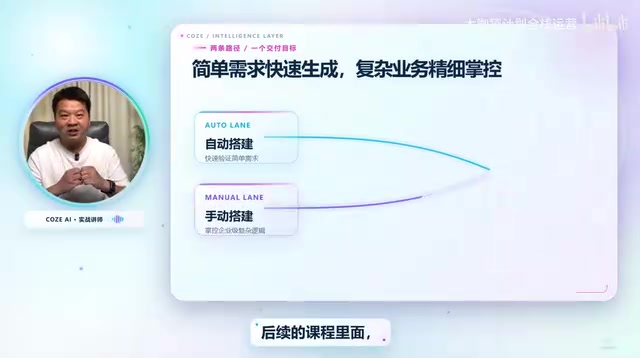
Several directions are worth noting. In the digital human field: input a piece of copy, and automatically generate a digital human talking-head short video. In the comic drama industry: give a simple description and generate a comic drama video. In the e-commerce industry: upload an image of clothing and immediately generate a high-quality sales image; upload an image, and a sales video can also be automatically generated. In the self-media industry: break down the underlying logic of viral short videos. In the education industry: essay correction assistants, idiom study cards, teaching aid tools. The course also includes corresponding methods for agents and workflows related to finance, accounting, law, and other industries.

The learning curve of this path is clearly steeper, but it corresponds to tasks in real business that have blurred boundaries and require multi-step judgment. What automatic building can cover is often templated single-point needs; only manual building can handle scenarios that require connecting multiple links and embedding business rules.
3.0's Local and Cloud Devices: The Puzzle Piece for All-Scenario Office Work
The course also mentions Coze 3.0's local devices and cloud devices, with the goal of making Coze a full-scenario AI office assistant. Subsequent courses mainly revolve around Coze's latest 3.0 and manual workflow building, connecting the entire process of AI from 0 to 1.
From design thinking and building techniques to specific practice methods and then to localized deployment, the course claims to teach not only technology but also industry thinking and methods. Whether this framework holds depends on whether learners can truly transfer the cases to their own industries—the course provides samples, and the purpose is to draw inferences from one instance.
The distinction between local devices and cloud devices involves two modes of AI deployment. Cloud devices mean the agent runs on cloud servers, and users call it through web pages or APIs. The advantage is elastic computing power and no need for local hardware, but it depends on the network and data must be uploaded. Local devices mean the agent is deployed on the user's local machine or edge device. The advantage is better data privacy and lower response latency, but it is limited by local computing power. Coze 3.0 supports both, aiming to cover scenarios from lightweight personal use to enterprise-sensitive data processing. This hybrid architecture is the current development trend of AI office assistants, allowing users to flexibly choose according to task sensitivity and resource conditions. The course's mention of "all-scenario office work" precisely emphasizes that agents can cross device boundaries and collaborate seamlessly on phones, computers, and the cloud.
Learning Advice and Rational Judgment
This course has a substantial amount of information, claiming 150 lessons, with supporting knowledge base documents shared for free. For zero-background users, its value lies in lowering the startup threshold with real cases rather than piling up concepts.
A few judgments for reference. First, automatic building is suitable for quickly validating ideas, but do not expect that one-sentence generation can be directly launched—subsequent tuning is normal. Second, manual building and workflow orchestration are the real watershed; only those willing to invest time can build tools that fit their own industry needs. Third, the "AI product thinking" emphasized by the course is more worth noting than specific operations; operations will change with version updates, but the ability to decompose requirements and design processes will not.
The course concludes by saying that starting from the Coze platform, you can draw inferences and build AI tools that fully fit your own industry needs, creating a high-quality AI team of your own. This goal is not small, but the path is at least clear: first run through the cases, then modify the cases, and finally move beyond the cases.
One-line Summary
Bilibili's Coze course teaches you to create practical AI agents from scratch using automatic and manual building methods.
Paragraph Summary
The article is based on Bilibili's "COZE Full Teaching Series" course and sorts out Coze 3.0's core capabilities and learning path. The course advocates that AI should transform from a chat tool into a task executor, delivering actual results through agents. Coze 3.0 supports automatic building (one-sentence generation of agents, workflows, or skills) and manual building (for complex tasks and enterprise-level applications), covering multiple industry scenarios such as digital humans, comic dramas, e-commerce, education, and finance. The article emphasizes that automatic building is suitable for quickly validating simple needs, while manual building is the watershed for handling complex business, and the core value of the course lies in cultivating AI product thinking and structured methodology. Finally, it gives rational learning advice: first run through the cases, then modify the cases, and ultimately move beyond the cases to achieve drawing inferences from one instance.
Related articles
 Tech Frontiers
Edge AI on Microcontrollers: When Is It Actually Worth Deploying?
Drawing on Reddit discussions and Arm case studies, this article analyzes the real-world use cases for edge AI on microcontrollers: when each device needs independent inference, when a gateway or cloud is more reasonable, and the costs and boundaries of specialized hardware.
 Tech Frontiers
Pushing the Limits of Extreme Sudoku on a 16GB GPU: Insights from Depth and Flow Matching
A researcher trained a 16.54M-parameter model on a 16GB GPU to solve extreme Sudoku, finding effective depth breaks the 60% plateau and flow matching with improved sampling pushes accuracy past 99% with ~50× lower layer-evaluation budget.
 Tech Frontiers
AI Agent Approval Workflows: Why Human Confirmations Always Get Mindlessly Clicked
Why do AI agent approval workflows always get mindlessly clicked? A Reddit discussion shows that separating rules from keys, low-frequency high-risk approvals, and GitHub Environments-style gates are the keys to effective approvals.