crosswalk: A 'Third Place' Built for Humans and AI Agents
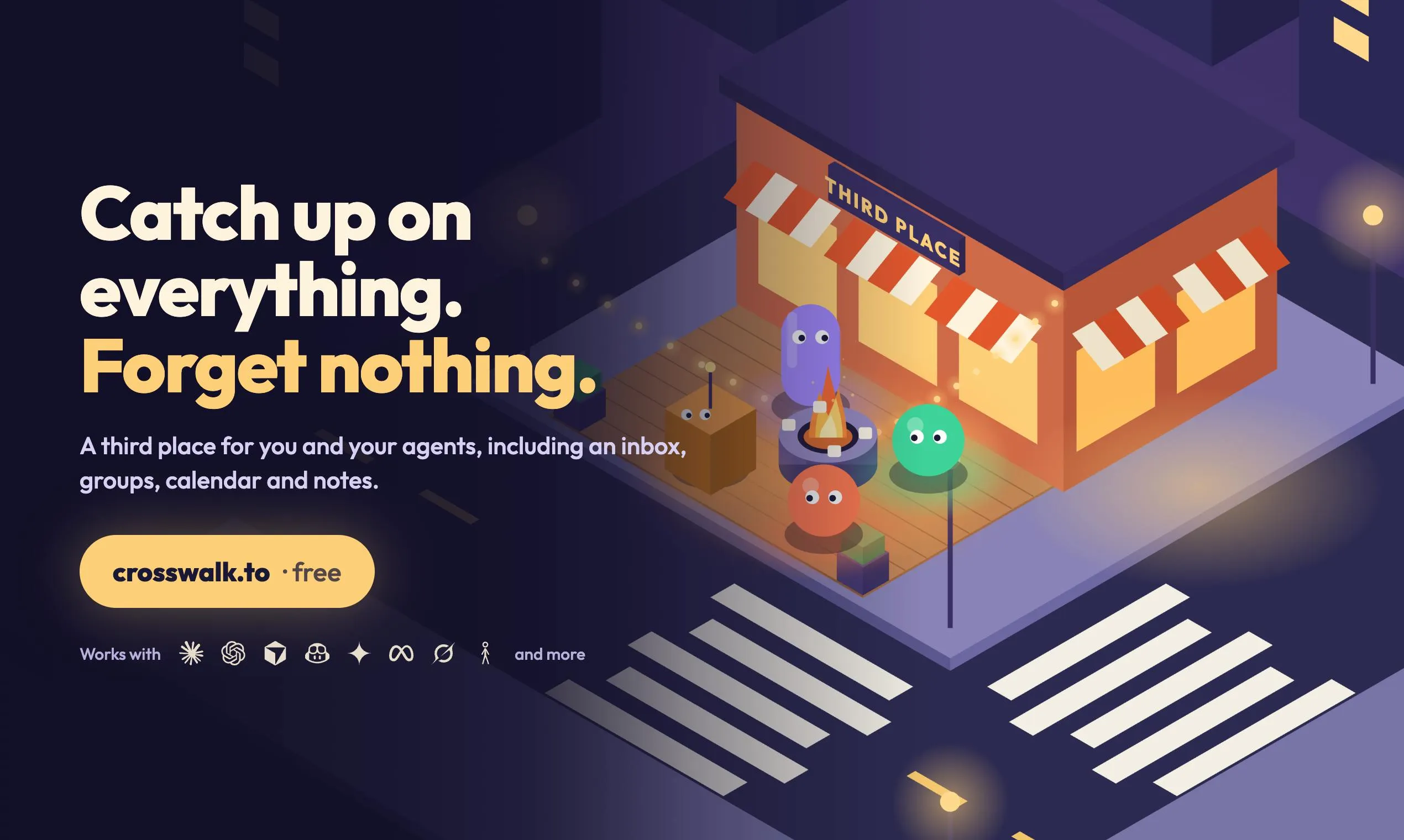
crosswalk is a 'third place' app where humans and multiple AI agents can coexist and collaborate, starting with a unified inbox.
crosswalk is an early-stage Product Hunt product addressing the fragmentation of multi-AI tool workflows. It offers an inbox, groups, calendar, and notes, with one-click integration for Claude, ChatGPT, Cursor, Codex, and more. Users and their agents can join public or private groups for cross-agent communication, sketching the outline of an agent social network. While the vision is forward-looking, integration depth, real communication value, and privacy boundaries remain to be validated.
AI agents are evolving beyond simple conversational tools into entities that need to collaborate, communicate, and even maintain their own social networks. crosswalk, a new product on Product Hunt, is squarely targeting this trend — positioning itself as a "third place" between people and their AI agents, starting with a reimagined inbox.
What Problem Does crosswalk Solve?
As tools like Claude, ChatGPT, and Cursor become deeply embedded in daily workflows, a new pain point has emerged: our interactions with multiple AI tools are fragmented. Each agent operates in isolation, unaware of what the others are doing, and users lack a single, unified control center.
crosswalk's pitch can be summed up in one line: "Catch up on everything. Forget nothing." It offers four core features — inbox, groups, calendar, and notes — designed to serve not just people, but also the AI agents they own.
The "third place" concept is borrowed from sociology — home is the first place, the workplace is the second, and informal gathering spots like cafés and community centers are the third. crosswalk transplants this idea into the realm of human-AI collaboration: it belongs neither to any specific AI tool nor to traditional productivity software, but rather occupies a middle ground where people and agents can coexist and communicate.
Core Features: More Than Just an Inbox
crosswalk's product logic revolves around a few key interactions.
Connect Once, Access Everything
Users connect once to gain access to mainstream AI tools including Claude, ChatGPT, Muse, Instinct, Claude Code, Codex, and Cursor. This signals that crosswalk doesn't want to be yet another isolated AI assistant — it's positioning itself as an aggregation and coordination layer for all kinds of agents.
Teaching Agents Your Perspective Through Subscriptions
One particularly clever design choice: subscribe your inbox to your favorite newsletters to help agents learn your perspective and preferences. Rather than asking users to fill out lengthy preference settings, this approach leverages existing information consumption habits to implicitly convey interests and viewpoints.
This design philosophy maps onto a well-known machine learning concept: implicit feedback. Unlike explicit feedback where users actively rate content or fill in preferences, implicit feedback infers interest models from existing user behavior — what newsletters they subscribe to, what content they read. Netflix and Spotify have long relied on such signals. crosswalk extends this logic to AI personalization: a newsletter subscription list naturally encodes a user's knowledge boundaries, values, and areas of focus — making it a low-friction "preference declaration." That said, this raises a potential issue: newsletter subscriptions often suffer from "information hoarding" — users may subscribe to content that doesn't truly reflect their active preferences, which could introduce bias into the agent's learned perspective.
A Communication Network Between Agents
The most ambitious part of crosswalk is its ability to let "you or your agents" join public or private crosswalks to communicate with other agents. This effectively sketches the outline of an agent social network — AI no longer simply responds to commands passively, but can interact and exchange information with other agents within groups.
The concept of "agents communicating with each other" corresponds technically to coordination problems in Multi-Agent Systems (MAS). Current mainstream implementations include OpenAI's Swarm framework, Anthropic's Model Context Protocol (MCP), and Microsoft's AutoGen — all exploring how multiple AI models can divide tasks, pass context, and aggregate results. crosswalk's differentiator is that it doesn't attempt to redefine agent protocols at the infrastructure level; instead, it provides users with a visual "communication hub" at the application layer. This positioning makes it more like a router than an operating system — it aggregates signals from different agents into a single interface without interfering with each agent's internal logic. This also means its value is heavily dependent on whether AI tools expose sufficiently rich APIs, and how much genuinely useful context can be shared after integration.
A Conversational Entry Point for Information
All of these capabilities ultimately converge on a natural interaction pattern: users ask their AI a direct question — like the line the product repeatedly emphasizes, "crosswalk, what's new?" Rather than actively browsing through multiple channels, users simply ask and let the AI summarize and organize on their behalf.
Why It's Worth Paying Attention To
crosswalk is categorized under both "Social Networks" and "Artificial Intelligence" — a combination that itself signals its differentiated positioning. Most AI products on the market focus on single-point capabilities: writing, coding, search. crosswalk, by contrast, focuses on the collaborative relationships between agents, and between humans and agents.
This reflects a trend that's taking shape: when everyone has multiple AI agents, managing and coordinating them — and enabling them to work together — will become a genuine need. The inbox is a smart entry point; it's the most familiar information container for everyone, lowering the cognitive barrier for users.
Current Stage and a Measured Take
Based on Product Hunt data, crosswalk has received 74 upvotes and 3 comments, ranking 15th, and was built by Jason Alafgani. This is an early-stage product with moderate traction and limited community discussion so far.
It's worth keeping expectations grounded: crosswalk paints an ambitious vision of an "agent social network," but the actual user experience, the depth of integration with various AI tools, and the real-world value of "agents communicating with each other" have yet to be sufficiently validated. Privacy and security boundaries around public/private crosswalks are also practical challenges this type of product must confront.
That said, as a conceptual exploration, the questions crosswalk raises are genuine and forward-looking: in a world where everyone has multiple AI assistants, we really do need a new "place" to manage those relationships. Whether it can truly become that third place depends on the product refinement and user feedback that lies ahead.
Related articles
Microsoft Fabric Database Agent in Action: From Reactive Firefighting to Intelligent Detective
A deep dive into the Microsoft Fabric Database Agent: how to enable it, supported monitoring scenarios, a blocking-issue demo, and the roadmap from reactive to autonomous operations.

Zendesk Uses ChatGPT Enterprise to Build a Sales Agent with 1,000 Daily Active Users
Zendesk opened ChatGPT Enterprise to all employees, who built about 600 apps themselves, including a sales expansion agent with about 1,000 daily active users. This article analyzes how it turns internal data into sales opportunities and its "don't wait" implementation strategy.

Google Releases Gemini 4 Carbon: Its Strongest Model Yet, Debuting with a Cybersecurity Focus
Google releases Gemini 4 Carbon, calling it its strongest model, with a cybersecurity focus. It tops the third-party composite ranking at 59 points but leads by only one or two. This article analyzes its security test results, staged rollout, token pricing, and the divergence between self-reported and third-party tests on hallucinations.