Cybertruck's Curtain Call: Musk's Tweet Declares Production Halt, the End of a Product Gamble

Musk's tweet announcing Cybertruck production halt exposes deep problems in Tesla's product strategy.
Musk announced via tweet that Tesla's Cybertruck will be gradually discontinued next year to make way for the Cybercab, a cavalier and ironic way to make the announcement. The article analyzes the root causes of its failure: design obsession led to complex stainless steel manufacturing and high costs, and the product failed to meet pickup buyers' core needs for payload, reliability, and practicality while facing fierce competition. Behind the halt is Tesla's strategic shift toward Robotaxi, but Cybercab commercialization still faces uncertainties regarding technological maturity and regulatory approval. The article notes that this case warns the industry that design gimmicks and founder charisma cannot replace product feasibility, and reminds consumers of the long-term risks of discontinued models in terms of parts supply, software updates, and resale value.
A Death Announced by a Tweet
"I declare the time of death: 1:30 AM on November 6th, cause of death: a tweet." This is how a commentator summed up the fate of Tesla's Cybertruck. Elon Musk announced via tweet on Friday that Tesla will "gradually wind down" Cybertruck production next year to make way for the Cybercab. What makes this news striking is not only that a heavily hyped vehicle was sentenced to death in such a cavalier manner, but also that it exposes deep-seated problems in Tesla's product strategy.
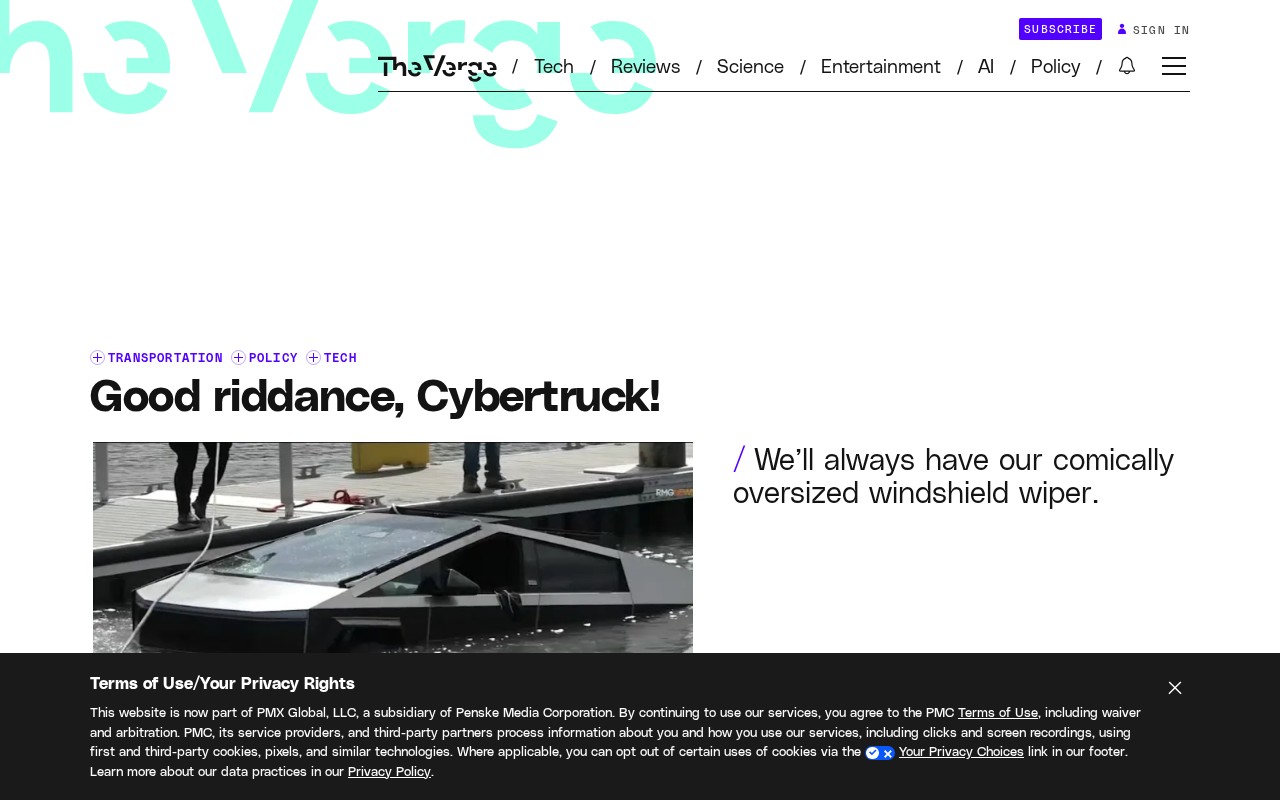
The Cybertruck was once seen as Tesla's weapon to disrupt the pickup truck market, and its cyberpunk-inspired design sparked endless discussion. However, from launch to discontinuation, this vehicle never escaped controversy. Musk ended its lifecycle with a single tweet rather than through a formal statement or earnings call—this "tweet-style death sentence" is itself full of irony, mirroring the absurd narrative that has followed this vehicle all along.
Why It Failed: Design Obsession and Market Misalignment
The Cybertruck's failure was no accident. From the stainless steel body and angular styling at its initial reveal to the manufacturing issues that kept surfacing during production ramp-up, this vehicle felt more like a personal aesthetic experiment than a product thoroughly validated by the market. Pickup truck buyers value payload capacity, reliability, and practicality, and the Cybertruck did not deliver a convincing answer on these core dimensions.
More critically, Tesla encountered significant difficulties in production ramp-up and cost control. The stainless steel exoskeleton's manufacturing process is complex, driving up production costs, while the final pricing struggled to cover those costs. Meanwhile, traditional automakers and emerging brands alike rolled out more competitive electric pickups, continuously squeezing the Cybertruck's market space. Musk attributed the production halt to "making way for the Cybercab," but anyone paying attention knows that weak sales and insufficient product competitiveness are the real reasons.
Stainless Steel Exoskeleton and Production Challenges
The cold-rolled stainless steel exoskeleton used in the Cybertruck is its design signature, but this material choice brought significant manufacturing challenges. Stainless steel is hard and has poor ductility, making it difficult to form with traditional stamping processes. Tesla had to resort to special techniques such as laser cutting and bending, resulting in slow production cycles and low yield rates. Moreover, unlike traditionally painted bodies, the stainless steel body cannot hide flaws through paint, so any surface defect is fully exposed, further driving up quality control costs. This approach of sacrificing manufacturing feasibility for design is a major reason for the Cybertruck's slow production ramp-up and persistently high costs.
Strategic Pivot: Robotaxi Is Musk's Real Bet
Musk made it clear that halting Cybertruck production is to free up resources for Cybercab manufacturing. This statement reveals that Tesla's strategic focus is shifting from a diversified vehicle lineup to autonomous ride-hailing vehicles. The Cybercab is designed as a fully autonomous vehicle without a steering wheel or pedals, carrying Musk's grand vision for a Robotaxi network.
However, this pivot is equally fraught with risk. The commercialization of Robotaxi depends on the maturity of autonomous driving technology and regulatory approval, both of which are full of uncertainty. By betting on the Cybercab, Tesla is narrowing its product line and concentrating resources on a battle it must win. The Cybertruck's exit is essentially a trade-off Tesla made under resource constraints—abandoning a failed project to focus on a product that could define the future.
Cybercab and the Robotaxi Network
The Cybercab is Tesla's dedicated autonomous taxi planned for mass production in 2026, with its core feature being the removal of the steering wheel and pedals, relying entirely on Tesla's FSD (Full Self-Driving) software for L4/L5 autonomous driving. The Robotaxi network refers to Tesla's envisioned business model of providing on-demand mobility services through fleet sharing, similar to Uber but without human drivers. The key bottleneck for this vision is that FSD technology has not yet met regulatory-recognized safety standards for driverless operation, and regulations in various states regarding vehicles without steering wheels remain unclear. Whether Tesla can obtain operating permits in key markets before Cybercab mass production will directly determine the success or failure of this strategy.
Implications for the Industry and Consumers
The Cybertruck's discontinuation provides a cautionary case for the entire electric vehicle industry. It demonstrates that even a company with Tesla's strong brand appeal cannot sustain a product's success through design gimmicks and founder charisma alone. Products must ultimately return to user needs and manufacturing feasibility.
For consumers, Cybertruck owners find themselves in an awkward position. A discontinued model means that subsequent parts supply, software updates, and resale value may all be affected. Although Tesla has stated it will continue to provide service to existing owners, the blow to used-car values from discontinuation is almost inevitable. This also reminds the market that when purchasing niche or experimental models, buyers need to weigh the risks of long-term ownership.
Musk ended the Cybertruck with a single tweet, but behind it lies a profound reflection on Tesla's product strategy. Abandoning unsuccessful attempts is not shameful; what truly deserves attention is whether the Cybercab can become the next success story.
Long-Term Ownership Risks of Discontinued Models
A vehicle being discontinued does not mean service stops immediately, but it will gradually affect owners' long-term experience. Regarding parts supply, automakers typically promise about 10 years of component availability, but parts inventory for niche models is limited, and wait times may lengthen. Regarding software updates, discontinued models may be excluded from new feature rollouts, especially autonomous driving features that depend on hardware iterations. Regarding resale value, discontinuation news often causes used-car prices to drop sharply in the short term, and reduced maintenance convenience further depresses residual values. For Cybertruck owners, these risks were not fully priced in at the time of purchase.
Related articles
 Tech Frontiers
Edge AI on Microcontrollers: When Is It Actually Worth Deploying?
Drawing on Reddit discussions and Arm case studies, this article analyzes the real-world use cases for edge AI on microcontrollers: when each device needs independent inference, when a gateway or cloud is more reasonable, and the costs and boundaries of specialized hardware.
 Tech Frontiers
Pushing the Limits of Extreme Sudoku on a 16GB GPU: Insights from Depth and Flow Matching
A researcher trained a 16.54M-parameter model on a 16GB GPU to solve extreme Sudoku, finding effective depth breaks the 60% plateau and flow matching with improved sampling pushes accuracy past 99% with ~50× lower layer-evaluation budget.
 Tech Frontiers
AI Agent Approval Workflows: Why Human Confirmations Always Get Mindlessly Clicked
Why do AI agent approval workflows always get mindlessly clicked? A Reddit discussion shows that separating rules from keys, low-frequency high-risk approvals, and GitHub Environments-style gates are the keys to effective approvals.