Data Centers Spark Nationwide Backlash: A New Variable in the 2026 Midterms

Localized data center construction costs trigger bipartisan opposition, making 2026 a key US political issue.
In 2026, large-scale data center construction and infrastructure spending in the US have sparked community opposition nationwide, quickly becoming a key issue in many congressional districts. Opposition crosses party lines: conservatives focus on land and energy, progressives on environmental and community burdens, with consensus on the asymmetric structure of local costs and distant benefits. The article notes that rapid construction pace and cost-sharing mechanisms, not technology itself, are the direct triggers. This trend may raise approval cycles, site selection difficulty, and compliance costs, constraining the AI industry's computing expansion and testing companies' ability to obtain social license.
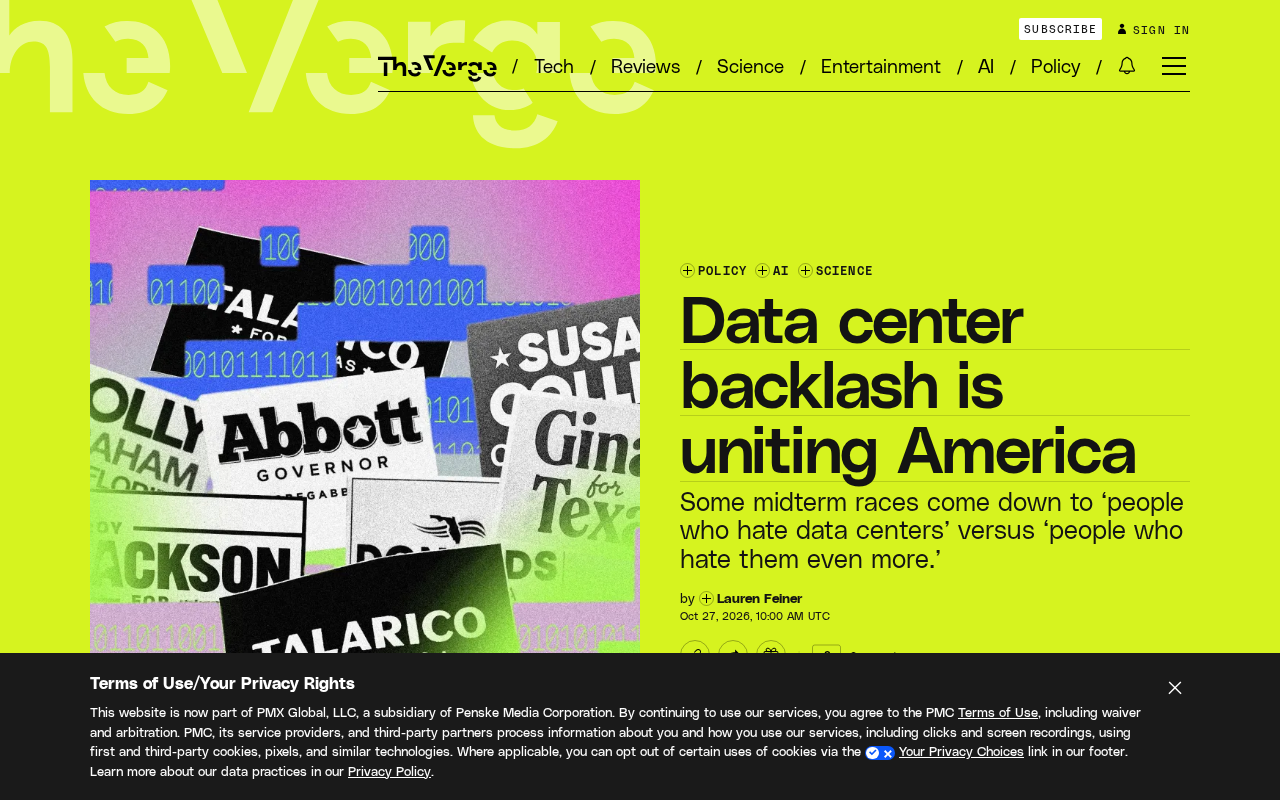
Data centers are becoming a rare bipartisan issue in American politics. According to an RSS source, in 2026, the construction of large-scale server storage facilities and the accompanying infrastructure spending have sparked opposition in communities across the country and become a significant issue in many congressional districts.
From Local Opposition to a National Issue
The data center construction boom brings not only computing power but also land use, electricity consumption, and infrastructure costs. These costs are often borne by local communities, while the benefits flow to distant tech giants. This asymmetry has rapidly pushed opposition across party lines—conservatives focus on land and energy, progressives focus on environmental and community impacts, and the two have found common ground in opposing data centers.
The source notes that this issue "seems to be able to activate all kinds of voters," and its political energy is already sufficient to influence the agenda-setting of congressional districts.
Why Data Centers Became a Political Bullseye
The particularity of data centers lies in the fact that they turn the abstract AI boom into concrete local conflicts. What residents see is construction sites, rising electricity bills, and changed land use—not cloud-based models. This gap between "visible costs" and "invisible benefits" is the core fuel for opposition sentiment.
The report emphasizes that rapid construction and related infrastructure spending are the direct causes of community opposition, indicating that the problem is not the technology itself but the pace of construction and the cost-sharing mechanism.
Data centers are the physical载体 (carriers) supporting AI training and inference, typically characterized by extremely high power density and cooling demands. A large AI data center campus can consume hundreds of megawatts of electricity—equivalent to the power usage of tens of thousands of households—and requires supporting substations, transmission lines, and cooling water systems. These facilities often break ground in concentrated periods within months, while local power grids, roads, and public services are not prepared for them.
In the United States, data centers are typically built after tech companies apply to local governments for tax incentives and land approval, but costs such as grid upgrades and road improvements are often spread among utility ratepayers. This "corporate investment, community pays" structure means that even if projects bring jobs and tax revenue, they are prone to resistance due to short-term construction disturbance, rising electricity prices, and land-use changes. Understanding this cost-sharing mechanism is key to understanding the bipartisan wave of opposition.
Potential Impact on the AI Industry
When local opposition evolves into a national political issue, the approval cycles, site selection difficulty, and compliance costs of data centers may all rise. For AI companies that rely on large-scale computing expansion, this means that expansion speed may be constrained by local politics. The report positions data centers as one of the key political issues of 2026, suggesting that their influence has gone beyond the community level.
"Social license" refers to the degree to which a company or project obtains informal recognition from the community and the public in the location where it operates. Although it is not a legal permit, it directly affects whether a project can proceed smoothly. In the data center sector, social license is changing from a soft factor to a hard constraint: local hearings, zoning plans, and referendums can all delay or even reject projects.
For AI companies, computing expansion depends not only on chip supply and capital expenditure but also on whether they can obtain grid access, water permits, and community support in target areas. When opposition spreads across party lines, companies need to engage in community communication in advance and explore benefit-sharing mechanisms (such as local tax contributions, waste heat utilization, and grid flexibility services); otherwise, longer approval cycles and limited site selection will directly slow down the pace of model training and deployment.
Observations and Judgments
This trend deserves continued attention: whether data centers can transform from "objects of opposition" into "infrastructure that shares benefits with communities" will determine the social license for AI computing expansion. At present, the bipartisan nature of the opposition makes it difficult to resolve with simple policy promises, and builders need to respond more proactively to local concerns.
One-line Summary
Localized data center construction costs trigger bipartisan opposition, making 2026 a key political issue in the United States.
Paragraph Summary
In 2026, large-scale data center construction and accompanying infrastructure spending in the United States have sparked community opposition across the country and rapidly become a key issue in many congressional districts. Opposition crosses party lines: conservatives focus on land use and energy consumption, progressives focus on environmental impact and community burden, and both sides find consensus on the asymmetric structure of "local costs, distant benefits." The article points out that the rapid pace of construction and the cost-sharing mechanism are the direct triggers of opposition sentiment, not the technology itself. This trend may increase data center approval cycles, site selection difficulty, and compliance costs, thereby constraining the AI industry that relies on computing expansion and testing companies' ability to obtain social license.
Related articles

AI Comic Drama with WorkBuddy from Scratch: A Step-by-Step Skill Pack Installation Guide
Learn how to create AI comic dramas with WorkBuddy from scratch. This guide covers installation, Skill pack import and invocation, plus a script generation demo with manual revision tips to get you through the first step from script to storyboard.

WorkBuddy Agent Runs the Entire GEO Database Mining Pipeline with a Single Prompt
WorkBuddy agent automates GEO database mining: from data search and curation to batch correction, differential analysis, co-expression networks, feature gene screening, and immune infiltration—a single prompt generates a complete bioinformatics report, greatly lowering the barrier to bioinformatics analysis.

PC Memory Wasted? Hacker News Debates Centralized Data Centers
Hacker News users argue that personal computer memory is wasted and should be centralized in data centers, sparking debate on centralized vs. distributed computing resource allocation. This article analyzes the logic behind the claim, the costs of centralization, and new tensions in memory resource allocation in the AI era.