De Staat's New Music Video Uses AI-Generated Pelican on a Bicycle, Ushering Music Videos into the Generative Era

The AI pelican-on-a-bicycle shot at 00:44 in a Dutch band's music video marks generative AI's entry into commercial visual storytelling.
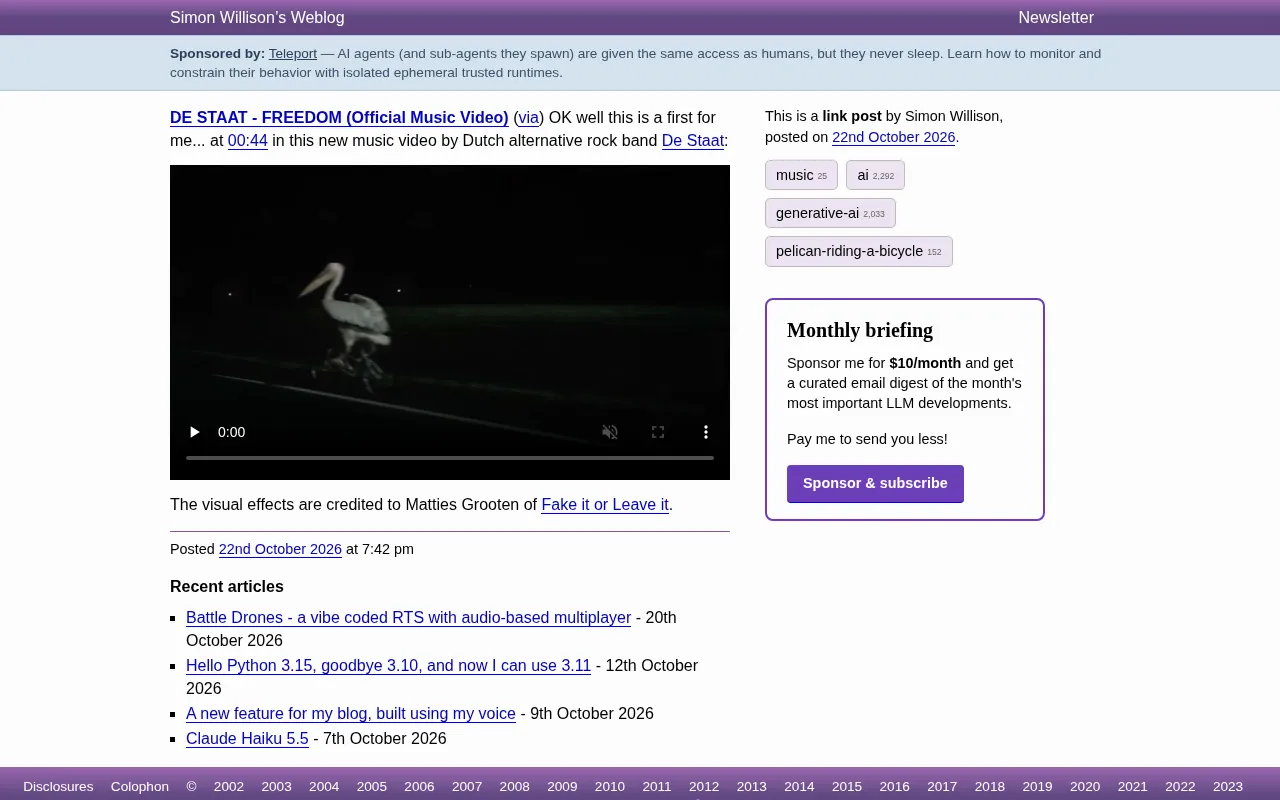
At the 44-second mark of Dutch alternative rock band De Staat's "Freedom" music video, a pelican rides a bicycle—a clip widely believed to be made with generative AI by Matties Grooten of independent studio Fake it or Leave it. Tech blogger Simon Willison documented it, sparking Hacker News debate. "Pelican riding a bicycle" was an informal test meme in the AI video community; its commercial debut shows generated content can now blend into live-action and post-production. Generative AI is entering through low-cost, short-cycle music videos, giving small studios big-label visual density, while creative judgment stays human. The takeaway: use AI clips with restraint as brief, unexpected visual punctuation.
Dutch alternative rock band De Staat's official music video for their new single "Freedom" recently sparked discussion on Hacker News—not because of the music itself, but because of a bizarre frame at the 44-second mark: a pelican riding a bicycle across the screen. The shot was created by visual effects artist Matties Grooten (studio Fake it or Leave it) and is widely believed to be the product of generative AI. Tech blogger Simon Willison documented the moment on his blog, describing his reaction as "this is the first time I've seen this."
Why One Shot Caught the Tech Community's Attention
The image of a pelican riding a bicycle isn't random. In the AI-generated content community, it has become an informal test case—just as programmers use "Hello World" to verify an environment, supporters of generative video models use "pelican riding a bicycle" to test a model's ability to understand absurd combinations. De Staat's music video brought this meme into a formal commercial work, meaning AI-generated clips are beginning to break away from experimental demos and enter visual storytelling aimed at general audiences.
Willison's original post gave the precise timestamp (00:44) and credited the creator—and the very way he documented it proves the point: viewers need to be guided to confirm which segment is AI-generated. In other words, generated content no longer carries an obvious "AI feel"; it blends in among live-action footage and post-production effects without exposing itself.
The reason "pelican riding a bicycle" became a test case is directly tied to the weaknesses of generative video models. Early models excelled at common subjects and conventional motion, but when faced with two semantically unrelated elements (a bird and a bicycle) and an action requiring physical plausibility (riding), they tended to produce anatomical errors, limb interpenetration, and inconsistent motion trajectories. As a result, this prompt can simultaneously test a model's compositional generalization, understanding of object interaction, and temporal consistency, making it a low-cost, high-information stress test. Its popularity in the community is similar to "space opera" or "hand detail" tests in the image generation space—not because pelicans or bicycles matter in themselves, but because they quickly expose the boundaries of a model.
Where Generative AI Actually Fits in Music Videos
Music videos have always been a testing ground for visual effects. From the 1980s reliance on film compositing, to the spread of CGI in the 1990s, to the recent introduction of virtual production and real-time engines, music videos have far lower budgets and shorter cycles than films, making them better suited for rapid experimentation. Generative AI slots right into this gap: for a few seconds of absurd footage that would require modeling, rigging, and rendering with traditional CG, a generative model may need only a prompt plus post-production touch-ups.
The involvement of small studios like Fake it or Leave it is also worth noting. Generative tools lower the barrier to VFX production, giving independent bands access to a visual density that was once affordable only to major labels. This doesn't mean traditional VFX artists have been replaced—Grooten's credit shows that creative judgment and compositing integration are still done by humans.
Virtual production refers to the technique of displaying backgrounds in real time on LED walls on set, combined with camera tracking and game engine rendering; The Mandalorian is its landmark case. Real-time engines (such as Unreal Engine) allow directors to see images close to the final result on set, reducing post-production rework. These technologies still require building sets, assets, and lighting, and have a relatively high cost threshold. What sets generative video models apart is that they skip the modeling and rendering pipeline and generate pixels directly from text or images, making them especially suited to a few seconds of absurd footage for which traditional CG wouldn't be worthwhile. But they are currently difficult to control precisely and usually require multiple generations followed by selection, along with post-production touch-ups such as compositing, color grading, and erasing—which is why the final cut still needs a VFX artist's oversight.
Controversies and Unresolved Questions
In the Hacker News thread, reactions split into two camps. One side saw this as a landmark moment for generative AI entering mainstream visual culture, while the other questioned the copyright ownership of training data and whether such "meme-ified" AI shots are merely a short-term gimmick.
These disagreements remain unresolved. What can be confirmed as fact is this: a Dutch rock band, an independent VFX studio, and a test meme circulating in the tech community converged in a 44-second shot. The path for commercial applications of generative AI may well start with this kind of low-cost, highly shareable scenario—rather than with the big-budget productions that are so often hyped.
The core of the training data copyright dispute is that generative models are typically trained on vast amounts of online video and images, much of which is copyrighted, and model outputs may resemble training material in style or composition. Judicial practice currently varies across countries: U.S. courts focus more on whether the output is "substantially similar" to an original work, while the EU's AI Act requires general-purpose models to disclose summaries of their training data. For commercial music videos, the risk is not only legal but also reputational—if viewers believe a shot "stole" an artist's style, it could trigger a PR backlash. Another unresolved issue is sustainability: once "AI-feel" shots become commonplace, their novelty and shareability will fade, and at that point what determines the quality of a work will still be the creativity itself.
Takeaways for Content Creators
For those making videos or brand content, the value of this case isn't about "whether to use AI" but about how it demonstrates the best way to insert an AI clip: short, unexpected, in contrast with the main content, and backed by a clear human creator credit. Making AI-generated content the star of an entire work risks drawing the audience's attention to the tool; using it as a precise joke or visual punctuation mark is far more likely to be accepted.
De Staat's music video neither hid its use of AI nor hyped it as a selling point. That restraint may be more worth learning from than the technology itself.
One-line Summary
The AI pelican-on-a-bicycle shot at 00:44 in a Dutch band's music video marks generative AI's entry into commercial visual storytelling.
Paragraph Summary
At the 44-second mark of Dutch alternative rock band De Staat's music video for their new single "Freedom," a pelican rides a bicycle—a clip widely believed to be made with generative AI, created by Matties Grooten of independent VFX studio Fake it or Leave it. Tech blogger Simon Willison documented the moment, sparking discussion on Hacker News. "Pelican riding a bicycle" was originally an informal test meme in the AI video community; its first appearance in a commercial music video shows that generated content can now blend into live-action and post-production without revealing itself. The article argues that generative AI is entering through low-cost, short-cycle music videos, giving small studios access to visual density once affordable only to major labels—while creative judgment remains human. The tech community remains divided over training data copyright and the sustainability of the gimmick, and the lesson from this case is that using AI clips with restraint as brief, unexpected visual punctuation—rather than as the star of a work—is more readily accepted by audiences.
Related articles

Microsoft Fabric Database Agent in Action: From Reactive Firefighting to Intelligent Detective
A deep dive into the Microsoft Fabric Database Agent: how to enable it, supported monitoring scenarios, a blocking-issue demo, and the roadmap from reactive to autonomous operations.

Zendesk Uses ChatGPT Enterprise to Build a Sales Agent with 1,000 Daily Active Users
Zendesk opened ChatGPT Enterprise to all employees, who built about 600 apps themselves, including a sales expansion agent with about 1,000 daily active users. This article analyzes how it turns internal data into sales opportunities and its "don't wait" implementation strategy.

Google Releases Gemini 4 Carbon: Its Strongest Model Yet, Debuting with a Cybersecurity Focus
Google releases Gemini 4 Carbon, calling it its strongest model, with a cybersecurity focus. It tops the third-party composite ranking at 59 points but leads by only one or two. This article analyzes its security test results, staged rollout, token pricing, and the divergence between self-reported and third-party tests on hallucinations.